


Page 244 - Textbook of Pathology, 6th Edition
P. 244
228 acute transforming viruses because it does not contain v-onc,
           and from other slow transforming viruses because it does
           not have fixed site of insertion for insertional mutagenesis.
           Probably, the process is multifactorial:
           i) HTLV-I genome has unique region called pX distinct from
           other retroviruses, which encodes for two essential viral
           oncoproteins— TAX and REX. TAX protein up-regulates the

           expression of cellular genes controlling T-cell replication,

           while REX gene product regulates viral protein production
     SECTION I
           by affecting mRNA expression.
           ii) TAX viral protein interacts with transcription factor, NF-
           κB, which stimulates genes for cytokines (interleukins) and
           their receptors in infected T cells which activates proliferation
           of T cells by autocrine pathway.
           iii) The inappropriate gene expression activates pathway of
           the cell proliferation by activation of cyclins and inactivation
           of tumour suppressor genes CDKN2A/p16 and p53,
           stimulating cell cycle.
           iv) Initially, proliferation of infected T cells is polyclonal but
           subsequently several mutations appear due to TAX-based
           genomic changes in the host cell and monoclonal proliferation
           of leukaemia occurs.

           VIRUSES AND HUMAN CANCER: A SUMMARY
           In man, epidemiological as well as circumstantial evidence
           has been accumulating since the discovery of contagious
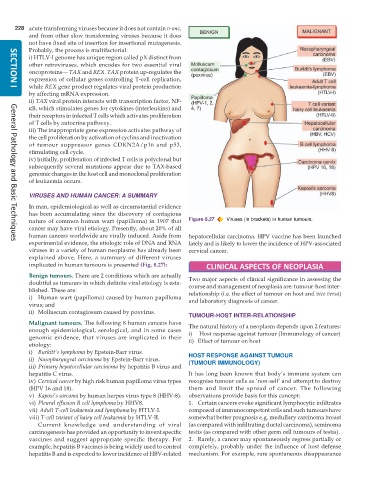
           nature of common human wart (papilloma) in 1907 that  Figure 8.27  Viruses (in brackets) in human tumours.
           cancer may have viral etiology. Presently, about 20% of all
           human cancers worldwide are virally induced. Aside from  hepatocellular carcinoma. HPV vaccine has been launched
           experimental evidence, the etiologic role of DNA and RNA  lately and is likely to lower the incidence of HPV-associated
     General Pathology and Basic Techniques
           viruses in a variety of human neoplasms has already been  cervical cancer.
           explained above. Here, a summary of different viruses
           implicated in human tumours is presented (Fig. 8.27):     CLINICAL ASPECTS OF NEOPLASIA
           Benign tumours. There are 2 conditions which are actually  Two major aspects of clinical significance in assessing the
           doubtful as tumours in which definite viral etiology is esta-  course and management of neoplasia are: tumour-host inter-
           blished. These are:                                 relationship (i.e. the effect of tumour on host and vice versa)
           i) Human wart (papilloma) caused by human papilloma  and laboratory diagnosis of cancer.
           virus; and
           ii) Molluscum contagiosum caused by poxvirus.
                                                               TUMOUR-HOST INTER-RELATIONSHIP
           Malignant tumours. The following 8 human cancers have  The natural history of a neoplasm depends upon 2 features:
           enough epidemiological, serological, and in some cases  i)  Host response against tumour (Immunology of cancer)
           genomic evidence, that viruses are implicated in their  ii) Effect of tumour on host
           etiology:
           i) Burkitt’s lymphoma by Epstein-Barr virus.        HOST RESPONSE AGAINST TUMOUR
           ii) Nasopharyngeal carcinoma by Epstein-Barr virus.  (TUMOUR IMMUNOLOGY)
           iii) Primary hepatocellular carcinoma by hepatitis B virus and
           hepatitis C virus.                                  It has long been known that body’s immune system can
           iv) Cervical cancer by high risk human papilloma virus types  recognise tumour cells as ‘non-self’ and attempt to destroy
           (HPV 16 and 18).                                    them and limit the spread of cancer. The following
           v) Kaposi’s sarcoma by human herpes virus type 8 (HHV-8).  observations provide basis for this concept:
           vi) Pleural effusion B cell lymphoma by HHV8.       1. Certain cancers evoke significant lymphocytic infiltrates
           vii) Adult T-cell leukaemia and lymphoma by HTLV-I.  composed of immunocompetent cells and such tumours have
           viii) T-cell variant of hairy cell leukaemia by HTLV-II.  somewhat better prognosis e.g. medullary carcinoma breast
              Current knowledge and understanding of viral     (as compared with infiltrating ductal carcinoma), seminoma
           carcinogenesis has provided an opportunity to invent specific  testis (as compared with other germ cell tumours of testis).
           vaccines and suggest appropriate specific therapy. For  2. Rarely, a cancer may spontaneously regress partially or
           example, hepatitis B vaccines is being widely used to control  completely, probably under the influence of host defense
           hepatitis B and is expected to lower incidence of HBV-related  mechanism. For example, rare spontaneous disappearance

