


Page 246 - Textbook of Pathology, 6th Edition
P. 246
230 of these two subpopulation of lymphocytes and        ii) Specific stimulation of the immune system was attemp-
           macrophages. Activated macrophages mediate cytotoxicity  ted next by immunising the host with irradiated tumour cells
           by production of oxygen free radicals or by tumour necrosis  but failed to yield desired results because if the patient’s
           factor.                                             tumour within the body failed to stimulate effective
           ii) Humoral mechanism. As such there are no anti-tumour  immunity, the implanted cells of the same tumour are
           humoral antibodies which are effective against cancer cells  unlikely to do so.
           in vivo. However,  in vitro humoral antibodies may kill  iii) Current status of immunotherapy is focussed on
           tumour cells by complement activation or by antibody-  following three main approaches:
           dependent cytotoxicity. Based on this, monoclonal antibody  a) Cellular immunotherapy consists of infusion of tumour-
     SECTION I
           treatment is offered to cases of some non-Hodgkin’s  specific cytotoxic T cells which will increase the population
           lymphoma.                                           of tumour-infiltrating lymphocytes (TIL). The patient’s
           iii) Immune regulatory mechanism. In spite of host immune  peripheral blood lymphocytes are cultured with interleukin-
           responses, most cancers grow relentlessly. This is due to some  2 which generates lymphokine-activated killer cells having
           of the following controlling mechanisms:            potent anti-tumour effect.
           a) During progression of the cancer, immunogenic cells may  b) Cytokine therapy is used to build up specific and non-
           disappear.                                          specific host defenses. These include: interleukin-2,
           b) Cytotoxic T-cells and NK-cells may play a self regulatory  interferon-α and -γ, tumour necrosis factor-α, and
           role.                                               granulocyte-monocyte colony stimulating factor (GM-CSF).
           c) Immunosuppression mediated by various acquired   c) Monoclonal antibody therapy is currently being tried against
           carcinogenic agents (viruses, chemicals, radiation).  CD20 molecule of B cells in certain B cell leukaemias and
           d) Immunosuppressive role of factors secreted by tumour  lymphomas.
           cells e.g. transforming growth factor-β.
              The mechanisms of these immune responses are     EFFECT OF TUMOUR ON HOST
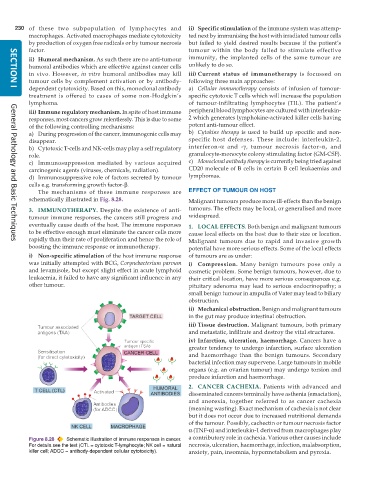
           schematically illustrated in Fig. 8.28.             Malignant tumours produce more ill-effects than the benign

           3. IMMUNOTHERAPY.  Despite the existence of anti-   tumours. The effects may be local, or generalised and more
           tumour immune responses, the cancers still progress and  widespread.
           eventually cause death of the host. The immune responses  1. LOCAL EFFECTS. Both benign and malignant tumours
           to be effective enough must eliminate the cancer cells more  cause local effects on the host due to their size or location.
           rapidly than their rate of proliferation and hence the role of  Malignant tumours due to rapid and invasive growth
     General Pathology and Basic Techniques
           boosting the immune response or immunotherapy.      potential have more serious effects. Some of the local effects
           i) Non-specific stimulation of the host immune response  of tumours are as under:
           was initially attempted with BCG, Corynebacterium parvum  i) Compression. Many benign tumours pose only a
           and levamisole, but except slight effect in acute lymphoid  cosmetic problem. Some benign tumours, however, due to
           leukaemia, it failed to have any significant influence in any  their critical location, have more serious consequences e.g.
           other tumour.                                       pituitary adenoma may lead to serious endocrinopathy; a
                                                               small benign tumour in ampulla of Vater may lead to biliary
                                                               obstruction.
                                                               ii) Mechanical obstruction. Benign and malignant tumours
                                                               in the gut may produce intestinal obstruction.
                                                               iii) Tissue destruction. Malignant tumours, both primary
                                                               and metastatic, infiltrate and destroy the vital structures.
                                                               iv) Infarction, ulceration, haemorrhage. Cancers have a
                                                               greater tendency to undergo infarction, surface ulceration
                                                               and haemorrhage than the benign tumours. Secondary
                                                               bacterial infection may supervene. Large tumours in mobile
                                                               organs (e.g. an ovarian tumour) may undergo torsion and
                                                               produce infarction and haemorrhage.
                                                               2. CANCER CACHEXIA.  Patients with advanced and
                                                               disseminated cancers terminally have asthenia (emaciation),
                                                               and anorexia, together referred to as cancer cachexia
                                                               (meaning wasting). Exact mechanism of cachexia is not clear
                                                               but it does not occur due to increased nutritional demands
                                                               of the tumour. Possibly, cachectin or tumour necrosis factor
                                                               α (TNF-α) and interleukin-1 derived from macrophages play
           Figure 8.28  Schematic illustration of immune responses in cancer.  a contributory role in cachexia. Various other causes include
           For details see the text (CTL = cytotoxic T-lymphocyte; NK cell = natural  necrosis, ulceration, haemorrhage, infection, malabsorption,
           killer cell; ADCC = antibody-dependent cellular cytotoxicity).  anxiety, pain, insomnia, hypermetabolism and pyrexia.

