


Page 353 - Textbook of Pathology, 6th Edition
P. 353
of coagulation such as antithrombin III and protein C and S  At times, it may be difficult to distinguish primary  337
           and plays a role in the clearance of activated factors and  pathologic fibrinolysis from secondary fibrinolysis
           fibrinolytic enzymes. Thus, patients with liver disease may  accompanying DIC.
           develop hypercoagulability and are predisposed to develop
           DIC and systemic fibrinolysis.                      DISSEMINATED INTRAVASCULAR COAGULATION (DIC)
              The major causes of bleeding in liver diseases are as
           under:                                              Disseminated intravascular coagulation (DIC), also termed
                                                               defibrination syndrome or consumption coagulopathy, is a
           A. Morphologic lesions:                             complex thrombo-haemorrhagic disorder (intravascular
           1. Portal hypertension e.g. varices, splenomegaly with  coagulation and haemorrhage) occurring as a secondary
           secondary thrombocytopenia.                         complication in some systemic diseases.
           2. Peptic ulceration.                               ETIOLOGY.  Although there are numerous conditions
           3. Gastritis.                                       associated with DIC, most frequent causes are listed below:
           B. Hepatic dysfunctions:                            1. Massive tissue injury: in obstetrical syndromes (e.g.
           1. Impaired hepatic synthesis of coagulation factors.  abruptio placentae, amniotic fluid embolism, retained dead
                                                               foetus), massive trauma, metastatic malignancies, surgery.
           2. Impaired hepatic synthesis of coagulation inhibitors:                                                   CHAPTER 13
           protein C, protein S and antithrombin III.          2. Infections: especially endotoxaemia, gram-negative and
                                                               meningococcal septicaemia, certain viral infections, malaria,
           3. Impaired absorption and metabolism of vitamin K.  aspergillosis.
           4. Failure to clear activated coagulation factors causing DIC  3. Widespread endothelial damage: in aortic aneurysm,
           and systemic fibrinolysis.
                                                               haemolytic-uraemic syndrome, severe burns, acute
           C.  Complications of therapy:                       glomerulonephritis.
           1. Following massive transfusion leading to dilution of  4. Miscellaneous: snake bite, shock, acute intravascular
           platelets and coagulation factors.                  haemolysis, heat stroke.
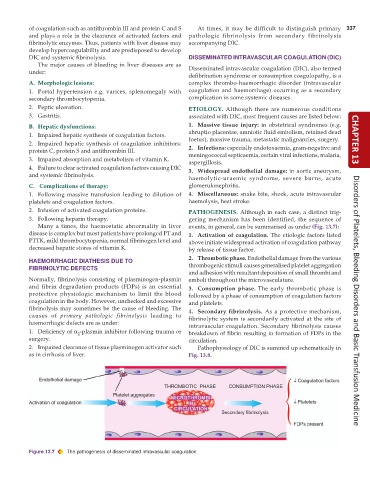
           2. Infusion of activated coagulation proteins.      PATHOGENESIS. Although in each case, a distinct trig-
           3. Following heparin therapy.                       gering mechanism has been identified, the sequence of
              Many a times, the haemostatic abnormality in liver  events, in general, can be summarised as under (Fig. 13.7):
           disease is complex but most patients have prolonged PT and  1. Activation of coagulation. The etiologic factors listed
           PTTK, mild thrombocytopenia, normal fibrinogen level and  above initiate widespread activation of coagulation pathway
           decreased hepatic stores of vitamin K.              by release of tissue factor.
                                                               2. Thrombotic phase. Endothelial damage from the various
           HAEMORRHAGIC DIATHESIS DUE TO
           FIBRINOLYTIC DEFECTS                                thrombogenic stimuli causes generalised platelet aggregation
                                                               and adhesion with resultant deposition of small thrombi and
           Normally, fibrinolysis consisting of plasminogen-plasmin  emboli throughout the microvasculature.
           and fibrin degradation products (FDPs) is an essential  3. Consumption phase. The early thrombotic phase is
           protective physiologic mechanism to limit the blood  followed by a phase of consumption of coagulation factors
           coagulation in the body. However, unchecked and excessive  and platelets.                                  Disorders of Platelets, Bleeding Disorders and Basic Transfusion Medicine
           fibrinolysis may sometimes be the cause of bleeding. The  4. Secondary fibrinolysis. As a protective mechanism,
           causes of  primary pathologic fibrinolysis  leading to  fibrinolytic system is secondarily activated at the site of
           haemorrhagic defects are as under:                  intravascular coagulation. Secondary fibrinolysis causes
           1. Deficiency of α -plasmin inhibitor following trauma or  breakdown of fibrin resulting in formation of FDPs in the
                           2
           surgery.                                            circulation.
           2. Impaired clearance of tissue plasminogen activator such  Pathophysiology of DIC is summed up schematically in
           as in cirrhosis of liver.                           Fig. 13.8.


           Figure 13.7  The pathogenesis of disseminated intravascular coagulation.

