


Page 348 - Textbook of Pathology, 6th Edition
P. 348
332 B. Due to rise in platelet count i.e. thrombocytosis. antimetabolites), certain antibiotics (sulfonamides, PAS,
C. Due to defective platelet functions. rifampicin, penicillins), drugs used in cardiovascular diseases
(digitoxin, thiazide diuretics), diclofenac, acyclovir, heparin
A. THROMBOCYTOPENIAS and excessive consumption of ethanol.
Clinically, the patient presents with acute purpura. The
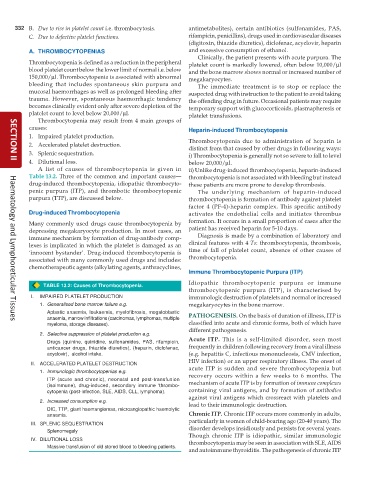
Thrombocytopenia is defined as a reduction in the peripheral platelet count is markedly lowered, often below 10,000/μl
blood platelet count below the lower limit of normal i.e. below and the bone marrow shows normal or increased number of
150,000/μl. Thrombocytopenia is associated with abnormal megakaryocytes.
bleeding that includes spontaneous skin purpura and The immediate treatment is to stop or replace the
mucosal haemorrhages as well as prolonged bleeding after suspected drug with instruction to the patient to avoid taking
trauma. However, spontaneous haemorrhagic tendency the offending drug in future. Occasional patients may require
becomes clinically evident only after severe depletion of the temporary support with glucocorticoids, plasmapheresis or
platelet count to level below 20,000/μl. platelet transfusions.
Thrombocytopenia may result from 4 main groups of
causes: Heparin-induced Thrombocytopenia
1. Impaired platelet production.
2. Accelerated platelet destruction. Thrombocytopenia due to administration of heparin is
distinct from that caused by other drugs in following ways:
3. Splenic sequestration. i) Thrombocytopenia is generally not so severe to fall to level
4. Dilutional loss. below 20,000/μl.
SECTION II
A list of causes of thrombocytopenia is given in ii) Unlike drug-induced thrombocytopenia, heparin-induced
Table 13.2. Three of the common and important causes— thrombocytopenia is not associated with bleeding but instead
drug-induced thrombocytopenia, idiopathic thrombocyto- these patients are more prone to develop thrombosis.
penic purpura (ITP), and thrombotic thrombocytopenic The underlying mechanism of heparin-induced
purpura (TTP), are discussed below. thrombocytopenia is formation of antibody against platelet
factor 4 (PF-4)-heparin complex. This specific antibody
Drug-induced Thrombocytopenia activates the endothelial cells and initiates thrombus
Many commonly used drugs cause thrombocytopenia by formation. It occurs in a small proportion of cases after the
depressing megakaryocyte production. In most cases, an patient has received heparin for 5-10 days.
immune mechanism by formation of drug-antibody comp- Diagnosis is made by a combination of laboratory and
lexes is implicated in which the platelet is damaged as an clinical features with 4 Ts: thrombocytopenia, thrombosis,
‘innocent bystander’. Drug-induced thrombocytopenia is time of fall of platelet count, absence of other causes of
associated with many commonly used drugs and includes: thrombocytopenia.
chemotherapeutic agents (alkylating agents, anthracyclines,
Immune Thrombocytopenic Purpura (ITP)
Idiopathic thrombocytopenic purpura or immune
TABLE 13.2: Causes of Thrombocytopenia.
thrombocytopenic purpura (ITP), is characterised by
I. IMPAIRED PLATELET PRODUCTION immunologic destruction of platelets and normal or increased
1. Generalised bone marrow failure e.g. megakaryocytes in the bone marrow.
Aplastic anaemia, leukaemia, myelofibrosis, megaloblastic PATHOGENESIS. On the basis of duration of illness, ITP is
anaemia, marrow infiltrations (carcinomas, lymphomas, multiple
Haematology and Lymphoreticular Tissues
myeloma, storage diseases). classified into acute and chronic forms, both of which have
different pathogenesis.
2. Selective suppression of platelet production e.g.
Drugs (quinine, quinidine, sulfonamides, PAS, rifampicin, Acute ITP. This is a self-limited disorder, seen most
anticancer drugs, thiazide diuretics), (heparin, diclofenac, frequently in children following recovery from a viral illness
acyclovir), alcohol intake. (e.g. hepatitis C, infectious mononucleosis, CMV infection,
HIV infection) or an upper respiratory illness. The onset of
II. ACCELERATED PLATELET DESTRUCTION
1. Immunologic thrombocytopenias e.g. acute ITP is sudden and severe thrombocytopenia but
recovery occurs within a few weeks to 6 months. The
ITP (acute and chronic), neonatal and post-transfusion
(isoimmune), drug-induced, secondary immune ‘thrombo- mechanism of acute ITP is by formation of immune complexes
cytopenia (post-infection, SLE, AIDS, CLL, lymphoma). containing viral antigens, and by formation of antibodies
against viral antigens which crossreact with platelets and
2. Increased consumption e.g. lead to their immunologic destruction.
DIC, TTP, giant haemangiomas, microangiopathic haemolytic
anaemia. Chronic ITP. Chronic ITP occurs more commonly in adults,
particularly in women of child-bearing age (20-40 years). The
III. SPLENIC SEQUESTRATION
Splenomegaly disorder develops insidiously and persists for several years.
Though chronic ITP is idiopathic, similar immunologic
IV. DILUTIONAL LOSS thrombocytopenia may be seen in association with SLE, AIDS
Massive transfusion of old stored blood to bleeding patients.
and autoimmune thyroiditis. The pathogenesis of chronic ITP

