


Page 355 - Textbook of Pathology, 6th Edition
P. 355
BLOOD GROUPS AND BLOOD TRANSFUSION However, out of all these, D antigen is most strongly 339
immunogenic and, therefore, clinically most important. In
BLOOD GROUP ANTIGENS AND ANTIBODIES practice, Rh grouping is performed with anti-D antiserum.
Individuals who are D-positive are referred to as Rh-positive
Karl Landsteiner described the existence of major human and those who lack D antigen are termed Rh-negative.
blood groups in 1900 and was awarded Nobel Prize in 1930. Practically, there are no naturally-occurring Rh anti-
The term blood group is applied to any well-defined system bodies. All Rh antibodies in Rh-negative individuals are
of red blood cell antigens which are inherited characteristics. acquired from immunisation such as by transfusion and
Over 20 blood group systems having approximately 400 during pregnancy, resulting in fatal haemolytic transfusion
blood group antigens are currently recognised. The ABO and reaction and haemolytic disease of the newborn (described
Rhesus (Rh) blood group systems are of major clinical later).
significance. Other minor and clinically less important blood
group systems are: Lewis system, P system, I system, MNS BLOOD TRANSFUSION
system, Kell and Duffy system, and Luthern system.
Individuals who lack the corresponding antigen and have A pre-transfusion compatibility testing is essential prior to
any blood transfusion. The procedure consists of the
not been previously transfused have naturally-occurring following: CHAPTER 13
antibodies in their serum. The most important are anti-A and
anti-B antibodies, usually of IgM class. Immune antibodies, 1. ABO and Rh(D) grouping of the patient (recipient).
on the other hand, are acquired in response to transfusion 2. Antibody screening of the patient’s serum to detect the
and by transplacental passage during pregnancy. These are presence of clinically significant antibodies.
warm antibodies, usually of IgG class. 3. Selecting the donor blood of the same ABO and Rh group.
ABO SYSTEM. This system consists of 3 major allelic genes: 4. Cross-matching the patient’s serum against donor red cells
A, B and O, located on the long arm of chromosome 9. These to confirm donor-recipient compatibility.
genes control the synthesis of blood group antigens A and The indications for blood transfusion are acute blood loss
B. The serum of an individual contains naturally-occurring and various haematologic disorders considered already. In
antibodies to A and/or B antigen, whichever antigen is addition to the whole blood transfusion, the modern blood-
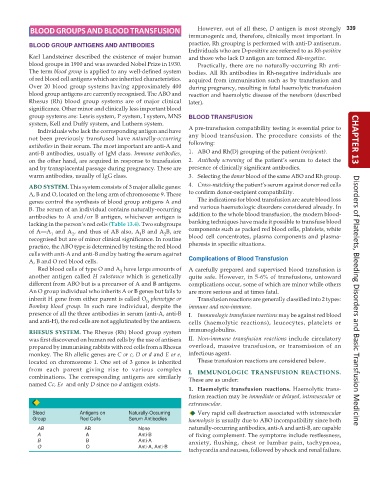
lacking in the person’s red cells (Table 13.4). Two subgroups banking techniques have made it possible to transfuse blood
of A—A and A , and thus of AB also, A B and A B, are components such as packed red blood cells, platelets, white
1
2
1
2
recognised but are of minor clinical significance. In routine blood cell concentrates, plasma components and plasma-
practice, the ABO type is determined by testing the red blood pheresis in specific situations.
cells with anti-A and anti-B and by testing the serum against
A, B and O red blood cells. Complications of Blood Transfusion
Red blood cells of type O and A have large amounts of A carefully prepared and supervised blood transfusion is
2
another antigen called H substance which is genetically quite safe. However, in 5-6% of transfusions, untoward
different from ABO but is a precursor of A and B antigens. complications occur, some of which are minor while others
An O group individual who inherits A or B genes but fails to are more serious and at times fatal.
inherit H gene from either parent is called O phenotype or Transfusion reactions are generally classified into 2 types: Disorders of Platelets, Bleeding Disorders and Basic Transfusion Medicine
h
Bombay blood group. In such rare individual, despite the immune and non-immune.
presence of all the three antibodies in serum (anti-A, anti-B I. Immunologic transfusion reactions may be against red blood
and anti-H), the red cells are not agglutinated by the antisera. cells (haemolytic reactions), leucocytes, platelets or
RHESUS SYSTEM. The Rhesus (Rh) blood group system immunoglobulins.
was first discovered on human red cells by the use of antisera II. Non-immune transfusion reactions include circulatory
prepared by immunising rabbits with red cells from a Rhesus overload, massive transfusion, or transmission of an
monkey. The Rh allelic genes are C or c, D or d and E or e, infectious agent.
located on chromosome 1. One set of 3 genes is inherited These transfusion reactions are considered below.
from each parent giving rise to various complex I. IMMUNOLOGIC TRANSFUSION REACTIONS.
combinations. The corresponding antigens are similarly These are as under:
named Cc, Ee and only D since no d antigen exists.
1. Haemolytic transfusion reactions. Haemolytic trans-
fusion reaction may be immediate or delayed, intravascular or
TABLE 13.4: The ABO Blood Groups. extravascular.
Blood Antigens on Naturally-Occurring Very rapid cell destruction associated with intravascular
Group Red Cells Serum Antibodies haemolysis is usually due to ABO incompatibility since both
AB AB None naturally-occurring antibodies, anti-A and anti-B, are capable
A A Anti-B of fixing complement. The symptoms include restlessness,
B B Anti-A anxiety, flushing, chest or lumbar pain, tachypnoea,
O O Anti-A, Anti-B
tachycardia and nausea, followed by shock and renal failure.

