


Page 369 - Textbook of Pathology, 6th Edition
P. 369
Myeloid Leukaemoid Reaction                           absence of infiltration by immature cells in organs and  353
           CAUSES.  Majority of leukaemoid reactions involve the  tissues.
           granulocyte series. It may occur in association with a wide  Table 14.3 sums up the features to distinguish myeloid
           variety of diseases. These are as under:              leukaemoid reaction from chronic myeloid leukaemia.
           1. Infections e.g. staphylococcal pneumonia, disseminated
           tuberculosis, meningitis, diphtheria, sepsis, endocarditis,  Lymphoid Leukaemoid Reaction
           plague, infected abortions etc.                     CAUSES. Lymphoid leukaemoid reaction may be found in
           2. Intoxication e.g. eclampsia, mercury poisoning, severe  the following conditions:
           burns.                                              1. Infections e.g. infectious mononucleosis, cytomegalovirus
           3. Malignant diseases e.g. multiple myeloma, myelofibrosis,  infection, pertussis (whooping cough), chickenpox, measles,
           Hodgkin’s disease, bone metastases.                 infectious lymphocytosis, tuberculosis.
           4. Severe haemorrhage and severe haemolysis.        2. Malignant diseases may rarely produce lymphoid
                                                               leukaemoid reaction.
            LABORATORY FINDINGS. Myeloid leukaemoid reaction
            is characterised by the following laboratory features:  LABORATORY FINDINGS. The blood picture is         CHAPTER 14
            1. Leucocytosis, usually moderate, not exceeding 100,000/  characterised by the following findings:
            μl.                                                  1. Leucocytosis not exceeding 100,000/μl.
            2. Proportion of  immature cells mild to moderate,   2. The differential white cell count reveals mostly mature
            comprised by metamyelocytes, myelocytes (5-15%), and  lymphocytes simulating the blood picture found in cases
            blasts fewer than 5% i.e. the blood picture simulates  of CLL.
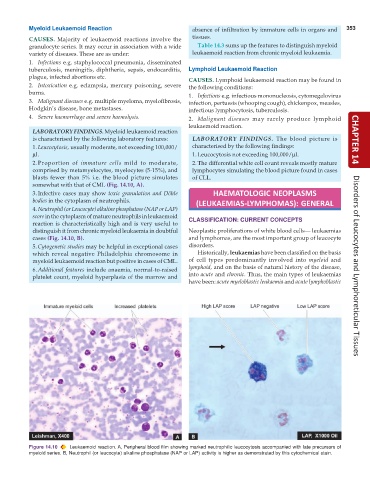
            somewhat with that of CML (Fig. 14.10, A).
            3. Infective cases may show  toxic granulation and Döhle    HAEMATOLOGIC NEOPLASMS
            bodies in the cytoplasm of neutrophils.
                                                                  (LEUKAEMIAS-LYMPHOMAS): GENERAL
            4. Neutrophil (or Leucocyte) alkaline phosphatase (NAP or LAP)
            score in the cytoplasm of mature neutrophils in leukaemoid  CLASSIFICATION: CURRENT CONCEPTS
            reaction is characteristically high and is very useful to
            distinguish it from chronic myeloid leukaemia in doubtful  Neoplastic proliferations of white blood cells— leukaemias
            cases (Fig. 14.10, B).                             and lymphomas, are the most important group of leucocyte
            5. Cytogenetic studies may be helpful in exceptional cases  disorders.
            which reveal negative Philadelphia chromosome in      Historically, leukaemias have been classified on the basis
            myeloid leukaemoid reaction but positive in cases of CML.  of cell types predominantly involved into  myeloid and
            6. Additional features include anaemia, normal-to-raised  lymphoid, and on the basis of natural history of the disease,  Disorders of Leucocytes and Lymphoreticular Tissues
            platelet count, myeloid hyperplasia of the marrow and  into acute and chronic. Thus, the main types of leukaemias
                                                               have been: acute myeloblastic leukaemia and acute lymphoblastic


           Figure 14.10  Leukaemoid reaction. A, Peripheral blood film showing marked neutrophilic leucocytosis accompanied with late precursors of
           myeloid series. B, Neutrophil (or leucocyte) alkaline phosphatase (NAP or LAP) activity is higher as demonstrated by this cytochemical stain.

