


Page 367 - Textbook of Pathology, 6th Edition
P. 367
and appearance in blood of atypical ‘mononucleosis cells’.  4. The proliferation of these cells is responsible for  351
           The pathogenesis of these pathologic features is outlined  generalised lymphadenopathy and hepatosplenomegaly.
           below:                                              5. The sore throat in IM may be caused by either necrosis of
           1. In a susceptible sero-negative host who lacks antibodies,  B cells or due to viral replication within the salivary epithelial
           the virus in the contaminated saliva invades and replicates  cells in early stage.
           within epithelial cells of the salivary gland and then enters B  Besides the involvement of EBV in the pathogenesis of
           cells in the lymphoid tissues which possess receptors for EBV.  IM, its role in neoplastic transformation in nasopharyngeal
           The infection spreads throughout the body via bloodstream  carcinoma and Burkitt’s lymphoma is discussed in
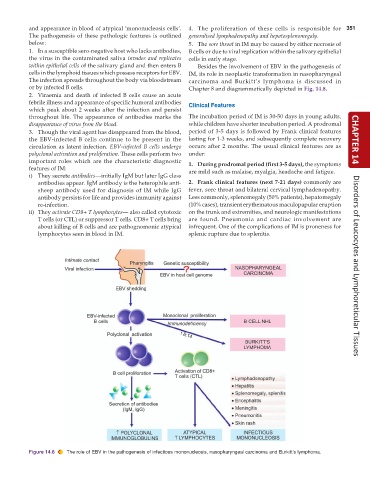
           or by infected B cells.                             Chapter 8 and diagrammatically depicted in Fig. 14.8.
           2. Viraemia and death of infected B cells cause an acute
           febrile illness and appearance of specific humoral antibodies  Clinical Features
           which peak about 2 weeks after the infection and persist
           throughout life. The appearance of antibodies marks the  The incubation period of IM is 30-50 days in young adults,
           disappearance of virus from the blood.              while children have shorter incubation period. A prodromal
           3. Though the viral agent has disappeared from the blood,  period of 3-5 days is followed by Frank clinical features
           the EBV-infected B cells continue to be present in the  lasting for 1-3 weeks, and subsequently complete recovery  CHAPTER 14
           circulation as latent infection.  EBV-infected B cells undergo  occurs after 2 months. The usual clinical features are as
           polyclonal activation and proliferation. These cells perform two  under:
           important roles which are the characteristic diagnostic  1. During prodromal period (first 3-5 days), the symptoms
           features of IM:                                     are mild such as malaise, myalgia, headache and fatigue.
           i) They secrete antibodies—initially IgM but later IgG class
              antibodies appear. IgM antibody is the heterophile anti-  2. Frank clinical features (next 7-21 days) commonly are
              sheep antibody used for diagnosis of IM while IgG  fever, sore throat and bilateral cervical lymphadenopathy.
              antibody persists for life and provides immunity against  Less commonly, splenomegaly (50% patients), hepatomegaly
              re-infection.                                    (10% cases), transient erythematous maculopapular eruption
           ii) They activate CD8+ T lymphocytes— also called cytotoxic  on the trunk and extremities, and neurologic manifestations
              T cells (or CTL) or suppressor T cells. CD8+ T cells bring  are found. Pneumonia and cardiac involvement are
              about killing of B cells and are pathognomonic atypical  infrequent. One of the complications of IM is proneness for
              lymphocytes seen in blood in IM.                 splenic rupture due to splenitis.                      Disorders of Leucocytes and Lymphoreticular Tissues


           Figure 14.8  The role of EBV in the pathogenesis of infectious mononucleosis, nasopharyngeal carcinoma and Burkitt’s lymphoma.

