


Page 37 - Textbook of Pathology, 6th Edition
P. 37
21
                                                         Cell Injury and
            Chapter 3
            Chapter 3
                                                  Cellular Adaptations                                                CHAPTER 3


           Cells are the basic units of tissues, which form organs and  adaptations, which can be best understood in the context of
           systems in the human body. Traditionally, body cells are  basic knowledge of normal structure and functions of cell
           divided in to two main types: epithelial and mesenchymal  outlined below.
           cells. In health, the cells remain in accord with each other. In
           1859, Virchow first published cellular theory of disease,          THE NORMAL CELL
           bringing in the concept that diseases occur due to
           abnormalities at the level of cells. Since then, study of  Different types of cells of the body possess features which
           abnormalities in structure and function of cells in disease has  distinguish one type from another. However, most
           remained the focus of attention in understanding of diseases.  mammalian cells have a basic plan of common structure and
           Thus, most forms of diseases begin with cell injury followed  function, except the red blood cell which is devoid of nucleus
           by consequent loss of cellular function. Cell injury is defined as  and its structure is described separately on page 288.  Cell Injury and Cellular Adaptations
           a variety of stresses a cell encounters as a result of changes in its
           internal and external environment.                  CELL STRUCTURE
              In general, cells of the body have inbuilt mechanism to
           deal with changes in environment to an extent. The cellular  Under normal conditions, cells are dynamic structures
           response to stress may vary and depends upon the following  existing in fluid environment. A cell is enclosed by cell
           variables:                                          membrane that extends internally to enclose nucleus and
           i) The type of cell and tissue involved.            various subcellular organelles suspended in cytosol
           ii) Extent and type of cell injury.                 (Fig. 3.2).
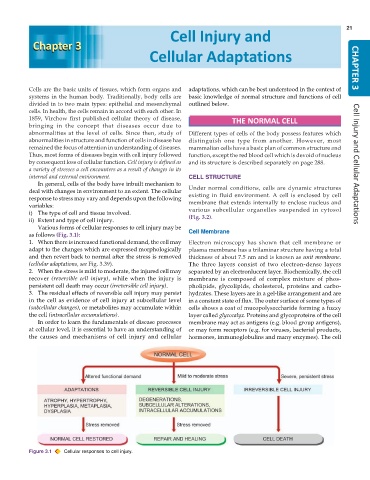
              Various forms of cellular responses to cell injury may be
           as follows (Fig. 3.1):                              Cell Membrane
           1. When there is increased functional demand, the cell may  Electron microscopy has shown that cell membrane or
           adapt to the changes which are expressed morphologically  plasma membrane has a trilaminar structure having a total
           and then revert back to normal after the stress is removed  thickness of about 7.5 nm and is known as unit membrane.
           (cellular adaptations, see Fig. 3.39).              The three layers consist of two electron-dense layers
           2. When the stress is mild to moderate, the injured cell may  separated by an electronlucent layer. Biochemically, the cell
           recover  (reversible cell injury), while when the injury is  membrane is composed of complex mixture of phos-
           persistent cell death may occur (irreversible cell injury).  pholipids, glycolipids, cholesterol, proteins and carbo-
           3. The residual effects of reversible cell injury may persist  hydrates. These layers are in a gel-like arrangement and are
           in the cell as evidence of cell injury at subcellular level  in a constant state of flux. The outer surface of some types of
           (subcellular changes), or metabolites may accumulate within  cells shows a coat of mucopolysaccharide forming a fuzzy
           the cell (intracellular accumulations).             layer called glycocalyx. Proteins and glycoproteins of the cell
              In order to learn the fundamentals of disease processes  membrane may act as antigens (e.g. blood group antigens),
           at cellular level, it is essential to have an understanding of  or may form receptors (e.g. for viruses, bacterial products,
           the causes and mechanisms of cell injury and cellular  hormones, immunoglobulins and many enzymes). The cell


           Figure 3.1  Cellular responses to cell injury.

