


Page 416 - Textbook of Pathology, 6th Edition
P. 416
400                                                      iv) Small intestine—Ischaemic bowel disease, infarction.
                                                               v) Lower extremities—Intermittent claudication, gangrene.

                                                               ARTERITIS

                                                               Arteritis, angiitis and vasculitis are the common terms used
                                                               for inflammatory process in an artery or an arteriole. It may
                                                               occur following invasion of the vessel by infectious agents,
                                                               or may be induced by non-infectious injuries such as
                                                               chemical, mechanical, immunologic and radiation injury. The
                                                               non-infectious group is more important than the infectious
                                                               type. A classification of arteritis based on this is given in
                                                               Table 15.3.

                                                               I.  INFECTIOUS ARTERITIS

                                                               Direct invasion of the artery by infectious agents, especially
                                                               bacteria and fungi, causes infectious arteritis. It may be found
                                                               in the vicinity of an infected focus like in tuberculosis,
                                                               pneumonia, abscesses, etc. or less frequently may arise from
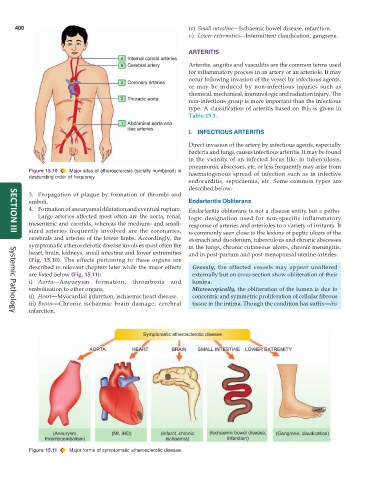
           Figure 15.10  Major sites of atherosclerosis (serially numbered) in  haematogenous spread of infection such as in infective
           descending order of frequency.
                                                               endocarditis, septicaemia, etc. Some common types are
                                                               described below.
           3. Propagation of plaque by formation of thrombi and
           emboli.                                             Endarteritis Obliterans
           4. Formation of aneurysmal dilatation and eventual rupture.  Endarteritis obliterans is not a disease entity but a patho-
              Large arteries affected most often are the aorta, renal,  logic designation used for non-specific inflammatory
           mesenteric and carotids, whereas the medium- and small-  response of arteries and arterioles to a variety of irritants. It
           sized arteries frequently involved are the coronaries,  is commonly seen close to the lesions of peptic ulcers of the
     SECTION III
           cerebrals and arteries of the lower limbs. Accordingly, the  stomach and duodenum, tuberculous and chronic abscesses
           symptomatic atherosclerotic disease involves most often the  in the lungs, chronic cutaneous ulcers, chronic meningitis,
           heart, brain, kidneys, small intestine and lower extremities  and in post-partum and post-menopausal uterine arteries.
           (Fig. 15.10).  The effects pertaining to these organs are
           described in relevant chapters later while the major effects  Grossly, the affected vessels may appear unaltered
           are listed below (Fig. 15.11):                        externally but on cross-section show obliteration of their
           i) Aorta—Aneurysm formation, thrombosis and           lumina.
           embolisation to other organs.                         Microscopically, the obliteration of the lumen is due to
           ii) Heart—Myocardial infarction, ischaemic heart disease.  concentric and symmetric proliferation of cellular fibrous
           iii) Brain—Chronic ischaemic brain damage, cerebral   tissue in the intima. Though the condition has suffix—itis
           infarction.
     Systemic Pathology


           Figure 15.11  Major forms of symptomatic atherosclerotic disease.

