


Page 848 - Textbook of Pathology, 6th Edition
P. 848
832


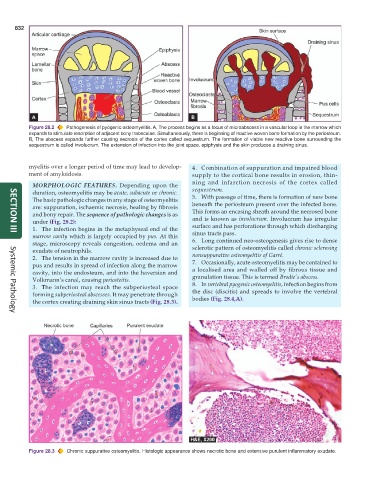
           Figure 28.2  Pathogenesis of pyogenic osteomyelitis. A, The process begins as a focus of microabscess in a vascular loop in the marrow which
           expands to stimulate resorption of adjacent bony trabeculae. Simultaneously, there is beginning of reactive woven bone formation by the periosteum.
           B, The abscess expands further causing necrosis of the cortex called sequestrum. The formation of viable new reactive bone surrounding the
           sequestrum is called involucrum. The extension of infection into the joint space, epiphysis and the skin produces a draining sinus.


           myelitis over a longer period of time may lead to develop-  4. Combination of suppuration and impaired blood
           ment of amyloidosis.                                  supply to the cortical bone results in erosion, thin-
                                                                 ning and infarction necrosis of the cortex called
            MORPHOLOGIC FEATURES. Depending upon the
                                                                 sequestrum.
            duration, osteomyelitis may be acute, subacute or chronic.  5. With passage of time, there is formation of new bone
            The basic pathologic changes in any stage of osteomyelitis
            are: suppuration, ischaemic necrosis, healing by fibrosis  beneath the periosteum present over the infected bone.
            and bony repair. The sequence of pathologic changes is as  This forms an encasing sheath around the necrosed bone
            under (Fig. 28.2):                                   and is known as involucrum. Involucrum has irregular
            1. The infection begins in the metaphyseal end of the  surface and has perforations through which discharging
            marrow cavity which is largely occupied by pus. At this  sinus tracts pass.
     SECTION III
            stage, microscopy reveals congestion, oedema and an  6. Long continued neo-osteogenesis gives rise to dense
            exudate of neutrophils.                              sclerotic pattern of osteomyelitis called chronic sclerosing
            2. The tension in the marrow cavity is increased due to  nonsuppurative osteomyelitis of Garré.
            pus and results in spread of infection along the marrow  7. Occasionally, acute osteomyelitis may be contained to
            cavity, into the endosteum, and into the haversian and  a localised area and walled off by fibrous tissue and
                                                                 granulation tissue. This is termed Brodie’s abscess.
            Volkmann’s canal, causing periosteitis.              8. In vertebral pyogenic osteomyelitis, infection begins from
            3. The infection may reach the subperiosteal space
            forming subperiosteal abscesses. It may penetrate through  the disc (discitis) and spreads to involve the vertebral
            the cortex creating draining skin sinus tracts (Fig. 28.3).  bodies (Fig. 28.4,A).
     Systemic Pathology


           Figure 28.3  Chronic suppurative osteomyelitis. Histologic appearance shows necrotic bone and extensive purulent inflammatory exudate.

