


Page 846 - Textbook of Pathology, 6th Edition
P. 846
830


            Chapter 28                   The Musculoskeletal System
            Chapter 28


                         SKELETAL SYSTEM                       line phosphatase (other being hepatic alkaline phosphatase) is
                                                               a marker for osteoblastic activity. Its levels are raised in
           The skeleton consists of cartilage and bone. Cartilage has a  puberty during period of active bone growth and in
           role in growth and repair of bone, and in the adults forms  pathologic conditions associated with high osteoblastic
           the articular skeleton responsible for movement of joints.  activity such as in fracture repair and Paget’s disease of the
           Bone is a specialised form of connective tissue which  bone.
           performs the function of providing mechanical support and  2. Osteocytes. Osteocytes are those osteoblasts which get
           is also a mineral reservoir for calcium homeostasis. There  incorporated into the bone matrix during its synthesis. Osteo-
           are 206 bones in the human body, and depending upon their  cytes are found within small spaces called lacunae lying in
           size and shape may be long, flat, tubular etc.      the bone matrix. The distribution of the osteocytic lacunae is
                                                               a reliable parameter for distinguishing between woven and
           NORMAL STRUCTURE OF BONE                            lamellar bone.
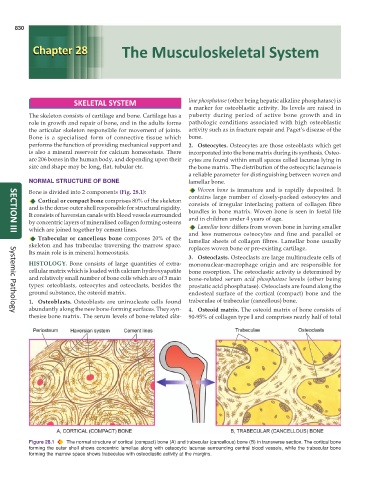
           Bone is divided into 2 components (Fig. 28.1):         Woven bone is immature and is rapidly deposited. It
              Cortical or compact bone comprises 80% of the skeleton  contains large number of closely-packed osteocytes and
           and is the dense outer shell responsible for structural rigidity.  consists of irregular interlacing pattern of collagen fibre
                                                               bundles in bone matrix. Woven bone is seen in foetal life
           It consists of haversian canals with blood vessels surrounded  and in children under 4 years of age.
           by concentric layers of mineralised collagen forming osteons
                                                                  Lamellar bone differs from woven bone in having smaller
           which are joined together by cement lines.          and less numerous osteocytes and fine and parallel or
     SECTION III
              Trabecular or cancellous bone composes 20% of the  lamellar sheets of collagen fibres. Lamellar bone usually
           skeleton and has trabeculae traversing the marrow space.  replaces woven bone or pre-existing cartilage.
           Its main role is in mineral homeostasis.
                                                               3. Osteoclasts. Osteoclasts are large multinucleate cells of
           HISTOLOGY. Bone consists of large quantities of extra-  mononuclear-macrophage origin and are responsible for
           cellular matrix which is loaded with calcium hydroxyapatite  bone resorption. The osteoclastic activity is determined by
           and relatively small number of bone cells which are of 3 main  bone-related serum  acid phosphatase levels (other being
           types: osteoblasts, osteocytes and osteoclasts, besides the  prostatic acid phosphatase). Osteoclasts are found along the
           ground substance, the osteoid matrix.               endosteal surface of the cortical (compact) bone and the
           1. Osteoblasts. Osteoblasts are uninucleate cells found  trabeculae of trabecular (cancellous) bone.
           abundantly along the new bone-forming surfaces. They syn-  4. Osteoid matrix. The osteoid matrix of bone consists of
     Systemic Pathology
           thesise bone matrix. The serum levels of bone-related alka-  90-95% of collagen type I and comprises nearly half of total


           Figure 28.1  The normal structure of cortical (compact) bone (A) and trabecular (cancellous) bone (B) in transverse section. The cortical bone
           forming the outer shell shows concentric lamellae along with osteocytic lacunae surrounding central blood vessels, while the trabecular bone
           forming the marrow space shows trabeculae with osteoclastic activity at the margins.

