


Page 843 - Textbook of Pathology, 6th Edition
P. 843
827


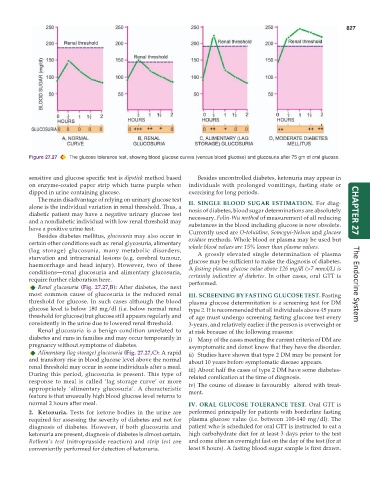
           Figure 27.27  The glucose tolerance test, showing blood glucose curves (venous blood glucose) and glucosuria after 75 gm of oral glucose.


           sensitive and glucose specific test is dipstick method based  Besides uncontrolled diabetes, ketonuria may appear in
           on enzyme-coated paper strip which turns purple when  individuals with prolonged vomitings, fasting state or
           dipped in urine containing glucose.                 exercising for long periods.
              The main disadvantage of relying on urinary glucose test
           alone is the individual variation in renal threshold. Thus, a  II. SINGLE BLOOD SUGAR ESTIMATION.  For diag-
                                                               nosis of diabetes, blood sugar determinations are absolutely
           diabetic patient may have a negative urinary glucose test  necessary. Folin-Wu method of measurement of all reducing  CHAPTER 27
           and a nondiabetic individual with low renal threshold may  substances in the blood including glucose is now obsolete.
           have a positive urine test.
              Besides diabetes mellitus, glucosuria may also occur in  Currently used are O-toluidine, Somogyi-Nelson and glucose
           certain other conditions such as: renal glycosuria, alimentary  oxidase methods. Whole blood or plasma may be used but
           (lag storage) glucosuria, many metabolic disorders,  whole blood values are 15% lower than plasma values.
                                                                  A grossly elevated single determination of plasma
           starvation and intracranial lesions (e.g. cerebral tumour,  glucose may be sufficient to make the diagnosis of diabetes.
           haemorrhage and head injury). However, two of these
           conditions—renal glucosuria and alimentary glucosuria,  A fasting plasma glucose value above 126 mg/dl (>7 mmol/L) is
                                                               certainly indicative of diabetes. In other cases, oral GTT is
           require further elaboration here.                   performed.
              Renal glucosuria  (Fig. 27.27,B): After diabetes, the next                                              The Endocrine System
           most common cause of glucosuria is the reduced renal  III. SCREENING BY FASTING GLUCOSE TEST. Fasting
           threshold for glucose. In such cases although the blood  plasma glucose determnitation is a screening test for DM
           glucose level is below 180 mg/dl (i.e. below normal renal  type 2. It is recommended that all individuals above 45 years
           threshold for glucose) but glucose still appears regularly and  of age must undergo screening fasting glucose test every
           consistently in the urine due to lowered renal threshold.  3-years, and relatively earlier if the person is overweight or
              Renal glucosuria is a benign condition unrelated to  at risk because of the following reasons:
           diabetes and runs in families and may occur temporarily in  i) Many of the cases meeting the current criteria of DM are
           pregnancy without symptoms of diabetes.             asymptomatic and donot know that they have the disorder.
              Alimentary (lag storage) glucosuria (Fig. 27.27,C): A rapid  ii) Studies have shown that type 2 DM may be present for
           and transitory rise in blood glucose level above the normal  about 10 years before symptomatic disease appears.
           renal threshold may occur in some individuals after a meal.  iii) About half the cases of type 2 DM have some diabetes-
           During this period, glucosuria is present. This type of  related comlication at the time of diagnosis.
           response to meal is called ‘lag storage curve’ or more  iv) The course of disease is favourably  altered with treat-
           appropriately ‘alimentary glucosuria’. A characteristic  ment.
           feature is that unusually high blood glucose level returns to
           normal 2 hours after meal.                          IV. ORAL GLUCOSE TOLERANCE TEST.  Oral GTT is
           2. Ketonuria. Tests for ketone bodies in the urine are  performed principally for patients with borderline fasting
           required for assessing the severity of diabetes and not for  plasma glucose value (i.e. between 100-140 mg/dl). The
           diagnosis of diabetes. However, if both glucosuria and  patient who is scheduled for oral GTT is instructed to eat a
           ketonuria are present, diagnosis of diabetes is almost certain.  high carbohydrate diet for at least 3 days prior to the test
           Rothera’s test (nitroprusside reaction) and  strip test are  and come after an overnight fast on the day of the test (for at
           conveniently performed for detection of ketonuria.  least 8 hours). A fasting blood sugar sample is first drawn.

