


Page 913 - Textbook of Pathology, 6th Edition
P. 913
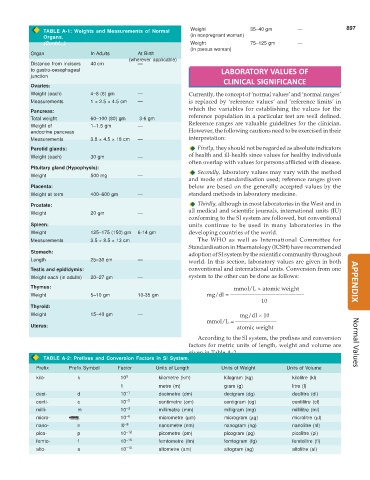
TABLE A-1: Weights and Measurements of Normal Weight 35–40 gm — 897
Organs. (in nonpregnant woman)
(Contd...) Weight 75–125 gm —
(in parous woman)
Organ In Adults At Birth
(wherever applicable)
Distance from incisors 40 cm —
to gastro-oesophageal LABORATORY VALUES OF
junction
CLINICAL SIGNIFICANCE
Ovaries:
Weight (each) 4–8 (6) gm — Currently, the concept of ‘normal values’ and ‘normal ranges’
Measurements 1 × 2.5 × 4.5 cm — is replaced by ‘reference values’ and ‘reference limits’ in
which the variables for establishing the values for the
Pancreas:
Total weight 60–100 (80) gm 3-6 gm reference population in a particular test are well defined.
Weight of 1–1.5 gm — Reference ranges are valuable guidelines for the clinician.
endocrine pancreas However, the following cautions need to be exercised in their
Measurements 3.8 × 4.5 × 18 cm — interpretation:
Parotid glands: Firstly, they should not be regarded as absolute indicators
Weight (each) 30 gm — of health and ill-health since values for healthy individuals
often overlap with values for persons afflicted with disease.
Pituitary gland (Hypophysis):
Secondly, laboratory values may vary with the method
Weight 500 mg —
and mode of standardisation used; reference ranges given
Placenta: below are based on the generally accepted values by the
Weight at term 400–600 gm — standard methods in laboratory medicine.
Prostate: Thirdly, although in most laboratories in the West and in
all medical and scientific journals, international units (IU)
Weight 20 gm —
conforming to the SI system are followed, but conventional
Spleen: units continue to be used in many laboratories in the
Weight 125–175 (150) gm 6-14 gm developing countries of the world.
Measurements 3.5 × 8.5 × 13 cm The WHO as well as International Committee for
Standardisation in Haematology (ICSH) have recommended
Stomach:
adoption of SI system by the scientific community throughout
Length 25–30 cm — world. In this section, laboratory values are given in both
Testis and epididymis: conventional and international units. Conversion from one
Weight each (in adults) 20–27 gm — system to the other can be done as follows: APPENDIX
Thymus: mmol/L × atomic weight
Weight 5–10 gm 10-35 gm mg/dl = __________________________________
10
Thyroid:
Weight 15–40 gm — mg/dl × 10
mmol/L = ___________________
Uterus: atomic weight
According to the SI system, the prefixes and conversion
factors for metric units of length, weight and volume are Normal Values
given in Table A-2.
TABLE A-2: Prefixes and Conversion Factors in SI System. The laboratory values given here are divided into three
Units of Weight
Prefix Prefix Symbol Factor Units of Length sections: clinical chemistry of blood (Table A-3), other body
Units of Volume
fluids (Table A-4), and haematologic values (Table A-5). In
kilo- k 10 3 kilometre (km) kilogram (kg) kilolitre (kl)
general, an alphabetic order has been followed.
1 metre (m) gram (g) litre (l)
deci- d 10 –1 decimetre (dm) decigram (dg) decilitre (dl)
centi- c 10 –2 centimetre (cm) centigram (cg) centilitre (cl)
milli- m 10 –3 millimetre (mm) milligram (mg) millilitre (ml)
micro- €€€€€€μ 10 –6 micrometre (μm) microgram (μg) microlitre (μl)
nano- n l0 –9 nanometre (nm) nanogram (ng) nanolitre (nl)
pico- p 10 –12 picometre (pm) picogram (pg) picolitre (pl)
femto- f 10 –15 femtometre (fm) femtogram (fg) femtolitre (fl)
alto- a 10 –18 altometre (am) altogram (ag) altolitre (al)

