


Page 910 - Textbook of Pathology, 6th Edition
P. 910
894                                                         Neurofibromas have tendency for local recurrences
                                                               after excision. Neurilemmoma virtually never turns
                                                               malignant, while sarcomatous transformation in neuro-
                                                               fibroma, particularly in neurofibromatosis, is not unusual.
                                                               It is estimated that about 3% of patients with von
                                                               Recklinghausen’s neurofibromatosis develop malignant
                                                               transformation of one of the nodules. Rarely, neurogenic
                                                               sarcoma may develop spontaneously in the absence of pre-
                                                               existing von Recklinghausen’s disease.
                                                                  The contrasting features to distinguish neurofibroma
                                                               from schwannoma are listed in Table 30.5.


                                                               Malignant Peripheral Nerve Sheath Tumour
                                                               Malignant peripheral nerve sheath tumour (MPNST) is a
                                                               poorly differentiated spindle cell sarcoma of the peripheral
                                                               nerves occurring most often in adults. The tumour may arise
                                                               de novo or from malignant transformation of a pre-existing
                                                               neurofibroma than a schwannoma, generally at an early age
                                                               (20-40 years). About 50% of the tumours are seen in patients
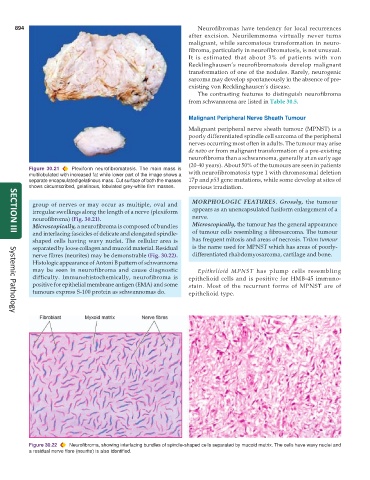
           Figure 30.21  Plexiform neurofibromatosis. The main mass is  with neurofibromatosis type 1 with chromosomal deletion
           multilobulated with increased fat while lower part of the image shows a
           separate encapsulated gelatinous mass. Cut surface of both the masses  17p and p53 gene mutations, while some develop at sites of
           shows circumscribed, gelatinous, lobulated grey-white firm masses.  previous irradiation.

                                                                 MORPHOLOGIC FEATURES. Grossly, the tumour
            group of nerves or may occur as multiple, oval and
            irregular swellings along the length of a nerve (plexiform  appears as an unencapsulated fusiform enlargement of a
            neurofibroma) (Fig. 30.21).                          nerve.
            Microscopically, a neurofibroma is composed of bundles  Microscopically, the tumour has the general appearance
            and interlacing fascicles of delicate and elongated spindle-  of tumour cells resembling a fibrosarcoma. The tumour
     SECTION III
            shaped cells having wavy nuclei. The cellular area is  has frequent mitosis and areas of necrosis. Triton tumour
            separated by loose collagen and mucoid material. Residual  is the name used for MPNST which has areas of poorly-
            nerve fibres (neurites) may be demonstrable (Fig. 30.22).  differentiated rhabdomyosarcoma, cartilage and bone.
            Histologic appearance of Antoni B pattern of schwannoma
            may be seen in neurofibroma and cause diagnostic      Epithelioid MPNST has plump cells resembling
            difficulty. Immunohistochemically, neurofibroma is  epithelioid cells and is positive for HMB-45 immuno-
            positive for epithelial membrane antigen (EMA) and some  stain. Most of the recurrent forms of MPNST are of
            tumours express S-100 protein as schwannomas do.   epithelioid type.


     Systemic Pathology


           Figure 30.22  Neurofibroma, showing interlacing bundles of spindle-shaped cells separated by mucoid matrix. The cells have wavy nuclei and
           a residual nerve fibre (neurite) is also identified.

