


Page 908 - Textbook of Pathology, 6th Edition
P. 908
892


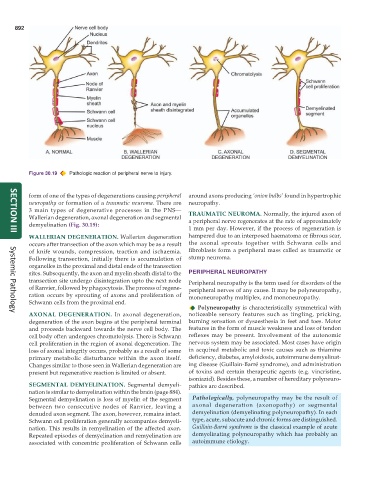
           Figure 30.19  Pathologic reaction of peripheral nerve to injury.


           form of one of the types of degenerations causing peripheral  around axons producing ‘onion bulbs’ found in hypertrophic
           neuropathy or formation of a traumatic neuroma. There are  neuropathy.
           3 main types of degenerative processes in the PNS—  TRAUMATIC NEUROMA. Normally, the injured axon of
           Wallerian degeneration, axonal degeneration and segmental  a peripheral nerve regenerates at the rate of approximately
           demyelination (Fig. 30.19):
                                                               1 mm per day. However, if the process of regeneration is
     SECTION III
           WALLERIAN DEGENERATION. Wallerian degeneration      hampered due to an interposed haematoma or fibrous scar,
           occurs after transection of the axon which may be as a result  the axonal sprouts together with Schwann cells and
           of knife wounds, compression, traction and ischaemia.  fibroblasts form a peripheral mass called as traumatic or
           Following transection, initially there is accumulation of  stump neuroma.
           organelles in the proximal and distal ends of the transection
           sites. Subsequently, the axon and myelin sheath distal to the  PERIPHERAL NEUROPATHY
           transection site undergo disintegration upto the next node  Peripheral neuropathy is the term used for disorders of the
           of Ranvier, followed by phagocytosis. The process of regene-  peripheral nerves of any cause. It may be polyneuropathy,
           ration occurs by sprouting of axons and proliferation of  mononeuropathy multiplex, and mononeuropathy.
           Schwann cells from the proximal end.
                                                                  Polyneuropathy is characteristically symmetrical with
           AXONAL DEGENERATION.  In axonal degeneration,       noticeable sensory features such as tingling, pricking,
     Systemic Pathology
           degeneration of the axon begins at the peripheral terminal  burning sensation or dysaesthesia in feet and toes. Motor
           and proceeds backward towards the nerve cell body. The  features in the form of muscle weakness and loss of tendon
           cell body often undergoes chromatolysis. There is Schwann  reflexes may be present. Involvement of the autonomic
           cell proliferation in the region of axonal degeneration. The  nervous system may be associated. Most cases have origin
           loss of axonal integrity occurs, probably as a result of some  in acquired metabolic and toxic causes such as thiamine
           primary metabolic disturbance within the axon itself.  deficiency, diabetes, amyloidosis, autoimmune demyelinat-
           Changes similar to those seen in Wallerian degeneration are  ing disease (Guillain-Barré syndrome), and administration
           present but regenerative reaction is limited or absent.  of toxins and certain therapeutic agents (e.g. vincristine,
                                                               isoniazid). Besides these, a number of hereditary polyneuro-
           SEGMENTAL DEMYELINATION.  Segmental demyeli-        pathies are described.
           nation is similar to demyelination within the brain (page 884).
           Segmental demyelination is loss of myelin of the segment  Pathologically, polyneuropathy may be the result of
           between two consecutive nodes of Ranvier, leaving a   axonal degeneration (axonopathy) or segmental
           denuded axon segment. The axon, however, remains intact.  demyelination (demyelinating polyneuropathy). In each
           Schwann cell proliferation generally accompanies demyeli-  type, acute, subacute and chronic forms are distinguished.
           nation. This results in remyelination of the affected axon.  Guillain-Barré syndrome is the classical example of acute
           Repeated episodes of demyelination and remyelination are  demyelinating polyneuropathy which has probably an
           associated with concentric proliferation of Schwann cells  autoimmune etiology.

