


Page 909 - Textbook of Pathology, 6th Edition
P. 909
893


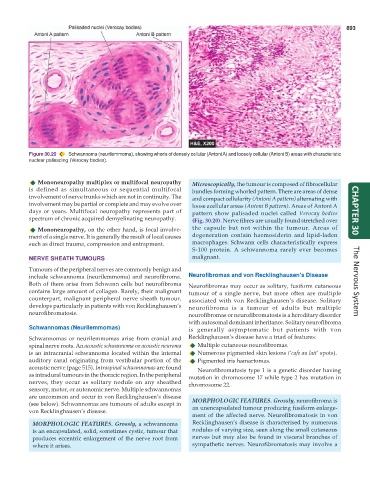
           Figure 30.20  Schwannoma (neurilemmoma), showing whorls of densely cellular (Antoni A) and loosely cellular (Antoni B) areas with characteristic
           nuclear palisading (Verocay bodies).


              Mononeuropathy multiplex or multifocal neuropathy  Microscopically, the tumour is composed of fibrocellular
           is defined as simultaneous or sequential multifocal   bundles forming whorled pattern. There are areas of dense
           involvement of nerve trunks which are not in continuity. The  and compact cellularity (Antoni A pattern) alternating with
           involvement may be partial or complete and may evolve over  loose acellular areas (Antoni B pattern). Areas of Antoni A
           days or years. Multifocal neuropathy represents part of  pattern show palisaded nuclei called  Verocay bodies  CHAPTER 30
           spectrum of chronic acquired demyelinating neuropathy.  (Fig. 30.20). Nerve fibres are usually found stretched over

              Mononeuropathy, on the other hand, is focal involve-  the capsule but not within the tumour. Areas of
           ment of a single nerve. It is generally the result of local causes  degeneration contain haemosiderin and lipid-laden
           such as direct trauma, compression and entrapment.    macrophages. Schwann cells characteristically express
                                                                 S-100 protein. A schwannoma rarely ever becomes
           NERVE SHEATH TUMOURS                                  malignant.
           Tumours of the peripheral nerves are commonly benign and
           include schwannoma (neurilemmoma) and neurofibroma.  Neurofibromas and von Recklinghausen’s Disease
           Both of them arise from Schwann cells but neurofibroma  Neurofibromas may occur as solitary, fusiform cutaneous  The Nervous System
           contains large amount of collagen. Rarely, their malignant  tumour of a single nerve, but more often are multiple
           counterpart, malignant peripheral nerve sheath tumour,  associated with von Recklinghausen’s disease. Solitary
           develops particularly in patients with von Recklinghausen’s  neurofibroma is a tumour of adults but multiple
           neurofibromatosis.                                  neurofibromas or neurofibromatosis is a hereditary disorder
                                                               with autosomal dominant inheritance. Solitary neurofibroma
           Schwannomas (Neurilemmomas)                         is generally asymptomatic but patients with von
           Schwannomas or neurilemmomas arise from cranial and  Recklinghausen’s disease have a triad of features:
           spinal nerve roots. An acoustic schwannoma or acoustic neuroma  Multiple cutaneous neurofibromas.
           is an intracranial schwannoma located within the internal  Numerous pigmented skin lesions (‘cafe au lait’ spots).
           auditory canal originating from vestibular portion of the  Pigmented iris hamartomas.
           acoustic nerve (page 515). Intraspinal schwannomas are found  Neurofibromatosis type 1 is a genetic disorder having
           as intradural tumours in the thoracic region. In the peripheral  mutation in chromosome 17 while type 2 has mutation in
           nerves, they occur as solitary nodule on any sheathed  chromosome 22.
           sensory, motor, or autonomic nerve. Multiple schwannomas
           are uncommon and occur in von Recklinghausen’s disease  MORPHOLOGIC FEATURES. Grossly, neurofibroma is
           (see below). Schwannomas are tumours of adults except in  an unencapsulated tumour producing fusiform enlarge-
           von Recklinghausen’s disease.
                                                                 ment of the affected nerve. Neurofibromatosis in von
            MORPHOLOGIC FEATURES. Grossly, a schwannoma          Recklinghausen’s disease is characterised by numerous
            is an encapsulated, solid, sometimes cystic, tumour that  nodules of varying size, seen along the small cutaneous
            produces eccentric enlargement of the nerve root from  nerves but may also be found in visceral branches of
            where it arises.                                     sympathetic nerves. Neurofibromatosis may involve a

