


Page 156 - 9780077418427.pdf
P. 156
/Users/user-f465/Desktop
          tiL12214_ch05_115-138.indd Page 133  9/1/10  9:39 PM user-f465
          tiL12214_ch05_115-138.indd Page 133  9/1/10  9:39 PM user-f465                                                /Users/user-f465/Desktop


                                                                                            A Closer Look


                                                                                                        Doppler Radar
                             he Doppler effect was named after   and weather radar that measures frequency   show a higher frequency, and waves from
                          Tthe Austrian scientist Johann Doppler   changes as a result of motion is called Dop-  objects moving away from the antenna
                          (1803–1853), who first demonstrated the   pler radar.                show a lower frequency. These shifts of
                          effect using sound waves in 1842. The same   Weather radar broadcasts short radio   frequency  are measured, then displayed as
                          principle applies to electromagnetic radia-  waves from an antenna. When directed at   the speed and direction of winds that move
                          tion as well as sound, but now the shifts are   a storm, the waves are reflected back to the   raindrops and other objects in the storm.
                          in the frequency of the radiation. A lower   antenna by rain, snow, and hail. Reflected   Weather forecasters can direct a Doppler
                          frequency is observed when a source of   radar waves are electronically converted   radar machine to measure different eleva-
                          light is moving away, and this is called a   and displayed on a monitor, showing the   tions of a storm system. This shows highly
                          redshift. Also, a  blueshift toward a higher   location and intensity of precipitation. A   accurate information that can be used to
                          frequency occurs when a source of light is   Doppler radar also measures frequency   identify, for example, where and when a tor-
                          moving toward an observer. Radio waves   shifts in the reflected radio waves. Waves   nado might form or the intensity of storm
                          will also experience such shifts of frequency,   from objects moving toward the antenna   winds in a given area.


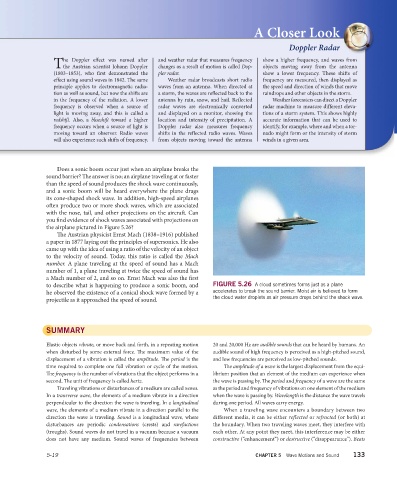
                           Does a sonic boom occur just when an airplane breaks the

                       sound barrier? The answer is no; an airplane traveling at or faster
                       than the speed of sound produces the shock wave continuously,
                       and a sonic boom will be heard everywhere the plane drags
                       its cone-shaped shock wave. In addition, high-speed airplanes

                       often produce two or more shock waves, which are associated
                       with the nose, tail, and other projections on the aircraft . Can
                       you find evidence of shock waves associated with projections on

                       the airplane pictured in Figure 5.26?

                           The Austrian physicist Ernst Mach (1838–1916) published
                         a paper in 1877 laying out the principles of supersonics. He also
                       came up with the idea of using a ratio of the velocity of an object
                       to the velocity of sound. Today, this ratio is called the  Mach
                       number. A plane traveling at the speed of sound has a Mach
                       number of 1, a plane traveling at twice the speed of sound has
                       a Mach number of 2, and so on. Ernst Mach was also the fi rst
                       to describe what is happening to produce a sonic boom, and   FIGURE 5.26  A cloud sometimes forms just as a plane
                       he observed the existence of a conical shock wave formed by a   accelerates to break the sound barrier. Moist air is believed to form
                       projectile as it approached the speed of sound.         the cloud water droplets as air pressure drops behind the shock wave.


                       SUMMARY

                       Elastic objects vibrate, or move back and forth, in a repeating motion   20 and 20,000 Hz are audible sounds that can be heard by humans. An

                       when disturbed by some external force. The maximum value of the   audible sound of high frequency is perceived as a high-pitched sound,
                       displacement of a vibration is called the amplitude. Th e period is the   and low frequencies are perceived as low-pitched sounds.
                       time required to complete one full vibration or cycle of the motion.   Th e amplitude of a wave is the largest displacement from the equi-
                       Th e frequency is the number of vibrations that the object performs in a   librium position that an element of the medium can experience when
                       second. The unit of frequency is called hertz.          the wave is passing by. Th e period and frequency of a wave are the same

                           Traveling vibrations or disturbances of a medium are called waves.   as the period and frequency of vibrations on one element of the medium
                       In a transverse wave, the elements of a medium vibrate in a direction   when the wave is passing by. Wavelength is the distance the wave travels
                       perpendicular to the direction the wave is traveling. In a longitudinal   during one period. All waves carry energy.
                       wave, the elements of a medium vibrate in a direction parallel to the   When a traveling wave encounters a boundary between two
                       direction the wave is traveling. Sound is a longitudinal wave, where   different media, it can be either reflected or refracted (or both) at
                       disturbances are periodic  condensations (crests) and  rarefactions   the boundary. When two traveling waves meet, they interfere with
                       (troughs). Sound waves do not travel in a vacuum because a vacuum   each other. At any point they meet, this interference may be either
                       does not have any medium. Sound waves of frequencies between   constructive (“enhancement”) or destructive  (“disappearance”). Beats

                       5-19                                                                  CHAPTER 5  Wave Motions and Sound   133

