


Page 155 - 9780077418427.pdf
P. 155
/Users/user-f465/Desktop
          tiL12214_ch05_115-138.indd Page 132  9/1/10  9:39 PM user-f465
          tiL12214_ch05_115-138.indd Page 132  9/1/10  9:39 PM user-f465                                                /Users/user-f465/Desktop


                           People Behind the Science


                           Johann Christian Doppler (1803–1853)

                       ohann Doppler was an Austrian physicist   Doppler explained the effect that bears
                     Jwho discovered the Doppler effect, which   his name by pointing out that sound waves
                     relates the observed frequency of a wave   from a source moving toward an observer
                     to the relative motion of the source and   will reach the observer at a greater frequency
                     the observer. The Doppler effect is readily   than if the source is stationary, thus increas-
                     observed in moving sound sources, produc-  ing the observed frequency and raising the
                     ing a fall in pitch as the source passes the   pitch of the sound. Similarly, sound waves
                     observer, but it is of most use in astronomy,   from a source moving away from the observer
                     where it is used to estimate the velocities   reach the observer more slowly, resulting in a
                     and distances of distant bodies.   decreased frequency and a lowering of pitch.
                        Doppler was born in Salzburg,  Austria,   In 1842, Doppler put forward this explana-
                     on November 29, 1803, the son of a stone-  tion and derived the observed frequency
                     mason. He showed early promise in math-  mathematically in Doppler’s principle.
                     ematics and attended the Polytechnic   The first experimental test of Doppler’s
                                                                                          Johann Christian Doppler
                     Institute in Vienna from 1822 to 1825.   principle was made in 1845 at Utrecht in
                     Despairing of ever obtaining an academic   Holland. A locomotive was used to carry a   1848 that shifts in the spectral lines of stars
                     post, he decided to emigrate to the United   group of trumpeters in an open carriage to   could be observed and ascribed to the Dop-
                     States. Then, on the point of departure, he   and fro past some musicians able to sense   pler effect and so enable their motion to
                     was offered a professorship of mathemat-  the pitch of the notes being played. The   be determined. This idea was first applied
                     ics at the State Secondary School in Prague   variation of pitch produced by the motion of   in 1868 by  William Huggins (1824–1910),
                     and changed his mind. He subsequently   the trumpeters verified Doppler’s equations.  who found that S irius is moving away from
                     obtained professorships in mathematics   Doppler correctly suggested his prin-  the solar system by detecting a small red-
                     at the State Technical Academy in Prague   ciple would apply to any wave motion   shift in its spectrum. With the linking of the
                     in 1841 and at the Mining Academy in   and cited light and sound as examples. He   velocity of a galaxy to its distance by Edwin
                     Schemnitz in 1847. Doppler returned to   believed all stars emit white light and that   Hubble (1889–1953) in 1929, it became
                     Vienna the following year and, in 1850,   differences in color are observed on Earth   possible to use the redshift to determine
                     became director of the new Physical Insti-  because the motion of stars affects the   the distances of galaxies. Thus, the prin-
                     tute and Professor of Experimental Phys-  observed frequency of light and hence its   ciple that Doppler discovered to explain
                     ics at the Royal Imperial University of   color. This idea was not universally true,   an everyday and inconsequential effect in
                     Vienna. He died from a lung disease in   as stars vary in their basic color. However,   sound turned out to be of truly cosmological
                     Venice on March 17, 1853.          Armand Fizeau (1819–1896) pointed out in   importance.


                   Source: From the Hutchinson Dictionary of Scientific Biography. © Research Machines plc 2003. All Rights Reserved. Helicon Publishing is a division of Research Machines.


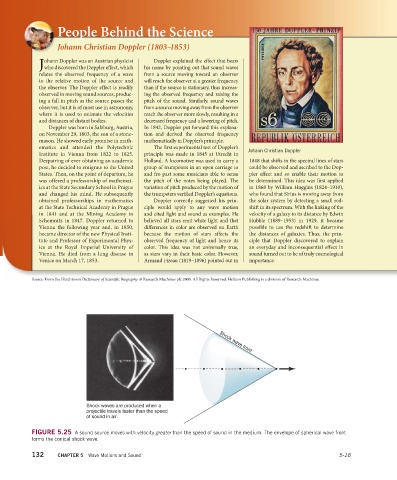
                                                                                 Shock wave front


                   FIGURE 5.25  A sound source moves with velocity greater than the speed of sound in the medium. The envelope of spherical wave front
                   forms the conical shock wave.

                   132     CHAPTER 5  Wave Motions and Sound                                                            5-18

