


Page 152 - 9780077418427.pdf
P. 152
/Users/user-f465/Desktop
          tiL12214_ch05_115-138.indd Page 129  9/1/10  9:39 PM user-f465
          tiL12214_ch05_115-138.indd Page 129  9/1/10  9:39 PM user-f465                                                /Users/user-f465/Desktop


                              CONCEPTS Applied                                 and pure tones, but you can readily identify the source of the

                                                                               very same musical note made by two different instruments. You
                              A Singing Glass                                  recognize it as a musical note, not noise and not a pure tone. You
                                                                               also recognize if the note was produced by a violin or a guitar.
                          Did you ever hear a glass “sing” when the rim was    Th e difference is in the wave form of the sounds made by the two

                          rubbed? The trick to make the glass sing is to remove as

                          much oil from your finger as possible. Then you lightly   instruments, and the difference is called the sound quality. How
                          rub your wet finger around and on the top of the glass   does a musical instrument produce a sound of a characteristic

                          rim at the correct speed. Without oil, your wet finger will   quality? The answer may be found by looking at the instruments
                          imperceptively catch on the glass as you rub the rim.   that make use of vibrating strings.
                          With the appropriate pressure and speed, your catching
                          finger might match the natural frequency of the glass.
                          The resonant vibration will cause the glass to “sing” with   VIBRATING STRINGS
                          a high-pitched note.                                 A stringed musical instrument, such as a guitar, has strings that
                                                                               are stretched between two fixed ends. When a string is plucked,

                                                                               waves of many different frequencies travel back and forth on

                                                                               the string, reflecting from the fixed ends. Many of these waves


                                                                               quickly fade away, but certain frequencies resonate, setting up
                         5.6  SOURCES OF SOUNDS                                patterns of waves. Before we consider these resonant patterns
                                                                               in detail, keep in mind that (1) two or more waves can be in the
                       All sounds have a vibrating object as their source. Th e vibra-  same place at the same time, traveling through one another from
                       tions of the object send pulses or waves of condensations and   opposite directions; (2) a confined wave will be reflected at a


                       rarefactions through the air. These sound waves have physical   boundary, and the reflected wave will be inverted (a crest

                       properties that can be measured, such as frequency and inten-  becomes a trough); and (3) reflected waves interfere with incom-

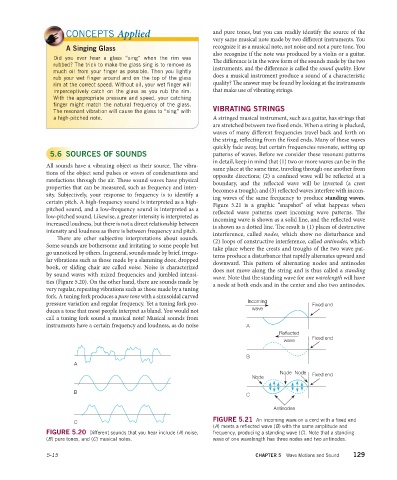
                       sity. Subjectively, your response to frequency is to identify a   ing waves of the same frequency to produce standing waves.
                       certain pitch. A high-frequency sound is interpreted as a high-  Figure 5.21 is a graphic “snapshot” of what happens when
                       pitched sound, and a low-frequency sound is interpreted as a   reflected wave patterns meet incoming wave patterns. Th e

                       low-pitched sound. Likewise, a greater intensity is interpreted as   incoming wave is shown as a solid line, and the refl ected wave
                       increased loudness, but there is not a direct relationship between   is shown as a dotted line. The result is (1) places of destructive

                       intensity and loudness as there is between frequency and pitch.  interference, called  nodes, which show no disturbance and
                           There are other subjective interpretations about sounds.

                       Some sounds are bothersome and irritating to some people but   (2) loops of constructive interference, called antinodes, which
                                                                               take place where the crests and troughs of the two wave pat-
                       go unnoticed by others. In general, sounds made by brief, irregu-  terns produce a disturbance that rapidly alternates upward and
                       lar vibrations such as those made by a slamming door, dropped   downward. This pattern of alternating nodes and antinodes

                       book, or sliding chair are called  noise. Noise is characterized   does not move along the string and is thus called a standing
                       by sound waves with mixed frequencies and jumbled intensi-  wave. Note that the standing wave for one wavelength will have
                       ties (Figure 5.20). On the other hand, there are sounds made by   a node at both ends and in the center and also two antinodes.
                       very regular, repeating vibrations such as those made by a tuning
                       fork. A tuning fork produces a pure tone with a sinusoidal curved
                       pressure variation and regular frequency. Yet a tuning fork pro-   Incoming              Fixed end
                       duces a tone that most people interpret as bland. You would not      wave
                       call a tuning fork sound a musical note! Musical sounds from
                       instruments have a certain frequency and loudness, as do noise     A
                                                                                                     Reflected
                                                                                                      wave      Fixed end


                                                                                          B
                                 A
                                                                                                     Node Node
                                                                                            Node                Fixed end

                                 B                                                        C

                                                                                                   Antinodes

                                 C                                             FIGURE 5.21  An incoming wave on a cord with a fixed end
                                                                               (A) meets a reflected wave (B) with the same amplitude and
                       FIGURE 5.20  Different sounds that you hear include (A) noise,   frequency, producing a standing wave (C). Note that a standing
                        (B) pure tones, and (C) musical notes.                 wave of one wavelength has three nodes and two antinodes.

                       5-15                                                                  CHAPTER 5  Wave Motions and Sound   129

