


Page 154 - 9780077418427.pdf
P. 154
/Users/user-f465/Desktop
          tiL12214_ch05_115-138.indd Page 131  9/1/10  9:39 PM user-f465
          tiL12214_ch05_115-138.indd Page 131  9/1/10  9:39 PM user-f465                                                /Users/user-f465/Desktop


                                                                                  Science and Society


                                                                                                             Laser Bug
                              old a fully inflated balloon lightly   The reflected beam, however, will have dif-    hanging picture, or the glass front of a
                          Hbetween your fingertips and talk.   ferent frequencies and amplitudes from   china cabinet.
                          You will be able to feel the slight vibra-  the windowpane vibrating in and out. The
                          tions from your voice. Likewise, the sound   changes can be detected by a receiver and   QUESTIONS TO DISCUSS
                          waves from your voice will cause a nearby   converted into sound in a headphone.
                                                                                                 1.  Is it legal for someone to listen in on
                          window to vibrate slightly. If a laser beam is   You cannot see an infrared laser beam
                                                                                                  your private conversations?
                          bounced off the window, the reflection will   because infrared is outside the frequen-
                          be changed by the vibrations. The incoming   cies that humans can see. Any sound-    2.  Should the sale of technology such as
                          laser beam is coherent; all the light has the   sensitive target can be used by the laser bug,   the laser bug be permitted? What are
                          same frequency and amplitude (see p. 191 ).   including a windowpane, inflated  balloon,   the issues?


                       maker are also harmonic instruments. These include all the wind
                       instruments such as the clarinet, fl ute, trombone, trumpet, pipe
                       organ, and many others. The various wind instruments have dif-

                                                                                             v                     v
                       ferent ways of making a column of air vibrate. In the fl ute, air
                       vibrates as it moves over a sharp edge, while in the clarinet, saxo-
                       phone, and other reed instruments, it vibrates through fl uttering
                       thin reeds. The air column in brass instruments, on the other          Sound

                                                                                    A         wave fronts
                       hand, is vibrated by the tightly fluttering lips of the player.


                           The length of the air column determines the frequency, and
                       woodwind instruments have holes in the side of a tube that are                          (For motion
                       opened or closed to change the length of the air column. Th e                         toward observer)
                       resulting tone depends on the length of the air column and the
                       resonant overtones.
                                                                                                                 v o
                       SOUNDS FROM MOVING SOURCES

                       When the source of a sound is stationary, equally spaced sound        (For motion away
                       waves expand from a source in all directions. But if the sound-  B     from observer)
                       ing source starts moving, then successive sound waves become
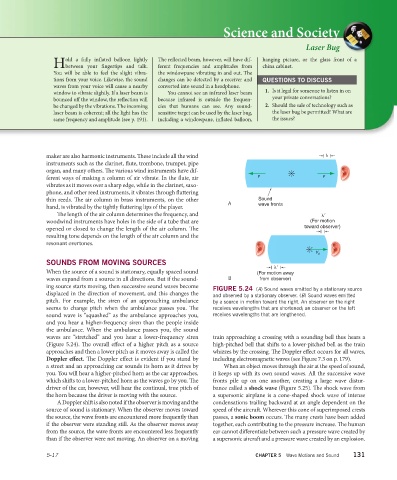
                                                                               FIGURE 5.24  (A) Sound waves emitted by a stationary source
                       displaced in the direction of movement, and this changes the   and observed by a stationary observer. (B) Sound waves emitted
                       pitch. For example, the siren of an approaching ambulance   by a source in motion toward the right. An observer on the right
                       seems to change pitch when the ambulance passes you. Th e   receives wavelengths that are shortened; an observer on the left
                       sound wave is “squashed” as the ambulance approaches you,   receives wavelengths that are lengthened.
                       and you hear a higher-frequency siren than the people inside
                       the ambulance. When the ambulance passes you, the sound
                       waves are “stretched” and you hear a lower-frequency siren   train approaching a crossing with a sounding bell thus hears a


                       (Figure 5.24). The overall effect of a higher pitch as a source   high-pitched bell that shifts to a lower-pitched bell as the train


                       approaches and then a lower pitch as it moves away is called the   whizzes by the crossing. The Doppler effect occurs for all waves,

                       Doppler eff ect. The Doppler effect is evident if you stand by   including electromagnetic waves (see Figure 7.3 on p. 179 ).

                       a street and an approaching car sounds its horn as it drives by   When an object moves through the air at the speed of sound,
                       you. You will hear a higher-pitched horn as the car approaches,   it keeps up with its own sound waves. All the successive wave
                       which shifts to a lower-pitched horn as the waves go by you. Th e   fronts pile up on one another, creating a large wave distur-


                       driver of the car, however, will hear the continual, true pitch of   bance called a shock wave (Figure 5.25). The shock wave from
                       the horn because the driver is moving with the source.  a supersonic airplane is a cone-shaped shock wave of intense

                           A Doppler shift is also noted if the observer is moving and the   condensations trailing backward at an angle dependent on the
                       source of sound is stationary. When the observer moves toward   speed of the aircraft. Wherever this cone of superimposed crests


                       the source, the wave fronts are encountered more frequently than   passes, a sonic boom occurs. The many crests have been added
                       if the observer were standing still. As the observer moves away   together, each contributing to the pressure increase. Th e human

                       from the source, the wave fronts are encountered less frequently   ear cannot differentiate between such a pressure wave created by

                       than if the observer were not moving. An observer on a moving   a supersonic aircraft and a pressure wave created by an explosion.
                       5-17                                                                  CHAPTER 5  Wave Motions and Sound   131

