


Page 170 - 9780077418427.pdf
P. 170
/Users/user-f465/Desktop
          tiL12214_ch06_139-176.indd Page 147  9/1/10  9:40 PM user-f465
          tiL12214_ch06_139-176.indd Page 147  9/1/10  9:40 PM user-f465                                                /Users/user-f465/Desktop


                                                                               joules/coulomb, or volts (equation 6.3). The source of the electri-

                                                                               cal potential difference is therefore referred to as a voltage source.

                                                                               The device where the charges do their work causes a voltage drop.


                                                                               Electrical potential difference is measured in volts, so the term
                                                       Upper                   voltage is often used for it. Household circuits usually have a dif-

                                                       reservoir               ference of potential of 120 or 240 volts. A voltage of 120 volts
                                                                               means that each coulomb of charge that moves through the cir-
                          Pump                                                 cuit can do 120 joules of work in some electrical device.

                                                                                  Voltage describes the potential difference, in joules per cou-
                                                               Waterwheel      lomb, between two places in an electric circuit. By way of anal-
                                                                               ogy to pressure on water in a circuit of water pipes, this potential

                                                                               difference is sometimes called an electrical force or electromotive
                                                                               force (emf). Note that in electrical matters, however, the potential
                                                                               difference is the source of a force rather than being a force such as

                                                                               water under pressure. Nonetheless, just as you can have a small
                                  Lower reservoir                              water pipe and a large water pipe under the same pressure, the

                                                                               two pipes would have a different rate of water flow in gallons per

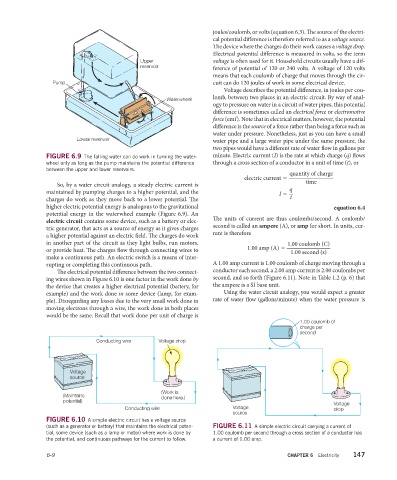
                       FIGURE 6.9  The falling water can do work in turning the water-  minute. Electric current (I) is the rate at which charge (q) fl ows
                       wheel only as long as the pump maintains the potential difference   through a cross section of a conductor in a unit of time (t), or
                       between the upper and lower reservoirs.
                                                                                                        quantity of charge
                                                                                                        __
                                                                                         electric current =
                           So, by a water circuit analogy, a steady electric current is                      time
                                                                                                        q
                                                                                                        _
                       maintained by pumping charges to a higher potential, and the                  I =

                       charges do work as they move back to a lower potential. Th e                     t
                       higher electric potential energy is analogous to the gravitational                              equation 6.4
                       potential energy in the waterwheel example (Figure 6.9). An
                                                                               The units of current are thus coulombs/second. A coulomb/

                       electric circuit contains some device, such as a battery or elec-
                                                                               second is called an ampere (A), or amp for short. In units, cur-
                       tric generator, that acts as a source of energy as it gives charges
                                                                               rent is therefore

                       a higher potential against an electric fi eld. The charges do work
                       in another part of the circuit as they light bulbs, run motors,                 __
                                                                                                       1.00 coulomb (C)


                       or provide heat. The charges flow through connecting wires to      1.00 amp (A) =      1.00 second (s)

                       make a continuous path. An electric switch is a means of inter-
                       rupting or completing this continuous path.             A 1.00 amp current is 1.00 coulomb of charge moving through a
                           The electrical potential difference between the two connect-  conductor each second, a 2.00 amp current is 2.00 coulombs per


                       ing wires shown in Figure 6.10 is one factor in the work done by   second, and so forth (Figure 6.11). Note in Table 1.2 (p.  6) that
                       the device that creates a higher electrical potential (battery, for   the ampere is a SI base unit.
                       example) and the work done in some device (lamp, for exam-  Using the water circuit analogy, you would expect a greater

                       ple). Disregarding any losses due to the very small work done in   rate of water flow (gallons/minute) when the water pressure  is
                       moving electrons through a wire, the work done in both places
                       would be the same. Recall that work done per unit of charge is
                                                                                                           1.00 coulomb of
                                                                                                           charge per
                                                                                                           second
                                        Conducting wire      Voltage drop
                               Voltage
                               source
                                                              (Work is
                             (Maintains                       done here.)
                             potential)                                                                                Voltage
                                                  Conducting wire                    Voltage                           drop
                                                                                     source
                       FIGURE 6.10  A simple electric circuit has a voltage source
                       (such as a generator or battery) that maintains the electrical poten-  FIGURE 6.11  A simple electric circuit carrying a current of
                       tial, some device (such as a lamp or motor) where work is done by   1.00 coulomb per second through a cross section of a conductor has
                       the potential, and continuous pathways for the current to follow.  a current of 1.00 amp.

                       6-9                                                                             CHAPTER 6  Electricity   147

