


Page 192 - 9780077418427.pdf
P. 192
/Users/user-f465/Desktop
          tiL12214_ch06_139-176.indd Page 169  9/1/10  9:41 PM user-f465
          tiL12214_ch06_139-176.indd Page 169  9/1/10  9:41 PM user-f465                                                /Users/user-f465/Desktop


                                                               Circuit breaker panel

                                                        One circuit        Circuit
                                                                           breaker
                                                                           switches


                                                                                Load wire
                                             Light

                                                                                                       Wall
                                                                                                       outlet
                                                 Switch


                                                                                                        Ground


                                                                                                Radio
                                                            Toaster
                                                                                Can
                                                                                opener
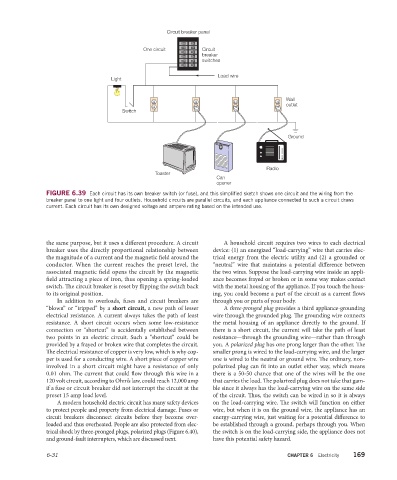
                       FIGURE 6.39  Each circuit has its own breaker switch (or fuse), and this simplified sketch shows one circuit and the wiring from the
                       breaker panel to one light and four outlets. Household circuits are parallel circuits, and each appliance connected to such a circuit draws
                       current. Each circuit has its own designed voltage and ampere rating based on the intended use.


                       the same purpose, but it uses a different procedure. A circuit   A household circuit requires two wires to each electrical

                       breaker uses the directly proportional relationship between   device: (1) an energized “load-carrying” wire that carries elec-
                       the magnitude of a current and the magnetic field around the   trical energy from the electric utility and (2) a grounded or

                       conductor. When the current reaches the preset level, the   “neutral” wire that maintains a potential diff erence  between
                       associated magnetic field opens the circuit by the magnetic   the two wires. Suppose the load-carrying wire inside an appli-


                       field attracting a piece of iron, thus opening a spring-loaded   ance becomes frayed or broken or in some way makes contact
                       switch. The circuit breaker is reset by flipping the switch back   with the metal housing of the appliance. If you touch the hous-


                       to its original position.                               ing, you could become a part of the circuit as a current fl ows
                           In addition to overloads, fuses and circuit breakers are   through you or parts of your body.
                       “blown” or “tripped” by a short circuit, a new path of lesser   A three-pronged plug provides a third appliance-grounding
                       electrical resistance. A current always takes the path of least   wire through the grounded plug. The grounding wire connects

                       resistance. A short circuit occurs when some low-resistance   the metal housing of an appliance directly to the ground. If
                       connection or “shortcut” is accidentally established between   there is a short circuit, the current will take the path of least
                       two points in an electric circuit. Such a “shortcut” could be   resistance—through the grounding wire—rather than through
                         provided by a frayed or broken wire that completes the circuit.   you. A polarized plug has one prong larger than the other. Th e
                       The electrical resistance of copper is very low, which is why cop-  smaller prong is wired to the load-carrying wire, and the larger

                       per is used for a conducting wire. A short piece of copper wire   one is wired to the neutral or ground wire. The ordinary, non-


                       involved in a short circuit might have a resistance of only   polarized plug can fit into an outlet either way, which means


                        0.01 ohm. The current that could flow through this wire in a   there is a 50-50 chance that one of the wires will be the one

                       120 volt circuit, according to Ohm’s law, could reach 12,000 amp   that carries the load. The polarized plug does not take that gam-
                       if a fuse or circuit breaker did not interrupt the circuit at the   ble since it always has the load-carrying wire on the same side
                       preset  15 amp load level.                              of the circuit. Thus, the switch can be wired in so it is always


                           A modern household electric circuit has many safety devices   on the load-carrying wire. The switch will function on either
                       to protect people and property from electrical damage. Fuses or   wire, but when it is on the ground wire, the appliance has an
                       circuit breakers disconnect circuits before they become over-  energy-carrying wire, just waiting for a potential diff erence to
                       loaded and thus overheated. People are also protected from elec-  be established through a ground, perhaps through you. When
                       trical shock by three-pronged plugs, polarized plugs ( Figure 6.40),   the switch is on the load-carrying side, the appliance does not
                       and ground-fault interrupters, which are discussed next.  have this potential safety hazard.
                       6-31                                                                            CHAPTER 6  Electricity   169

