


Page 190 - 9780077418427.pdf
P. 190
/Users/user-f465/Desktop
          tiL12214_ch06_139-176.indd Page 167  9/1/10  9:40 PM user-f465
          tiL12214_ch06_139-176.indd Page 167  9/1/10  9:40 PM user-f465                                                /Users/user-f465/Desktop


                                                                                            A Closer Look


                                                                                                             Solar Cells
                             ou may be familiar with many solid-
                          Ystate devices such as calculators, com-
                          puters, word processors, digital watches,
                          VCRs, digital stereos, and camcorders. All of
                          these are called solid-state devices because
                          they use a solid material, such as the semi-
                          conductor silicon, in an electric circuit in
                          place of vacuum tubes. Solid-state technol-
                          ogy developed from breakthroughs in the
                          use of semiconductors during the 1950s,
                          and the use of thin pieces of silicon crystal
                          is common in many electric circuits today.
                             A related technology also uses thin
                          pieces of a semiconductor such as silicon
                          but not as a replacement for a vacuum
                          tube. This technology is concerned with
                          photovoltaic devices, also called solar cells,
                          that generate electricity when exposed
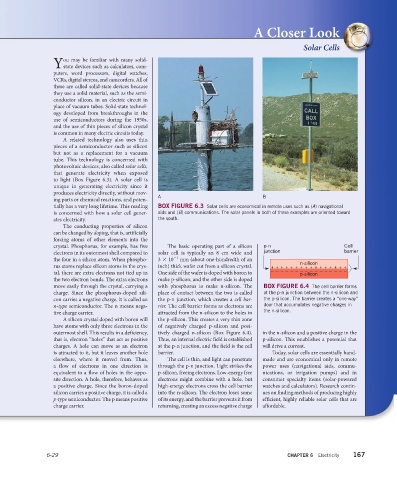
                          to light (Box Figure 6.3). A solar cell is
                          unique in generating electricity since it
                          produces electricity directly, without mov-
                                                             A                                 B
                          ing parts or chemical reactions, and poten-
                          tially has a very long lifetime. This reading   BOX FIGURE 6.3  Solar cells are economical in remote uses such as (A) navigational
                          is  concerned with how a solar cell gener-  aids and (B) communications. The solar panels in both of these examples are oriented toward
                          ates electricity.                  the south.
                             The conducting properties of silicon
                          can be changed by doping, that is, artificially
                          forcing atoms of other elements into the
                          crystal. Phosphorus, for example, has five   The basic operating part of a silicon
                          electrons in its outermost shell compared to   solar cell is typically an 8 cm wide and
                                                                  −1
                          the four in a silicon atom. When phospho-  3 × 10  mm (about one-hundredth of an
                          rus atoms replace silicon atoms in the crys-  inch) thick wafer cut from a silicon crystal.
                          tal, there are extra electrons not tied up in   One side of the wafer is doped with boron to
                          the two electron bonds. The extra electrons   make p-silicon, and the other side is doped
                          move easily through the crystal, carrying a   with phosphorus to make n-silicon. The   BOX FIGURE 6.4  The cell barrier forms
                          charge. Since the phosphorus-doped sili-  place of contact between the two is called   at the p-n junction between the n-silicon and
                          con carries a neg ative charge, it is called an   the p-n junction, which creates a cell bar-  the p-silicon. The barrier creates a “one-way”
                          n-type semiconductor. The n means nega-  rier. The cell barrier forms as electrons are   door that accumulates negative charges in
                          tive charge carrier.               attracted from the n-silicon to the holes in   the n-silicon.
                             A silicon crystal doped with boron will   the p-silicon. This creates a very thin zone
                          have atoms with only three electrons in the   of negatively charged p-silicon and posi-
                          outermost shell. This results in a deficiency,   tively charged n-silicon (Box Figure 6.4).   in the n-silicon and a positive charge in the
                          that is, electron “holes” that act as positive   Thus, an internal electric field is established   p-silicon. This establishes a potential that
                          charges. A hole can move as an electron   at the p-n junction, and the field is the cell   will drive a current.
                          is attracted to it, but it leaves another hole   barrier.               Today, solar cells are essentially hand-
                          elsewhere, where it moved from. Thus,   The cell is thin, and light can penetrate   made and are economical only in remote
                          a flow of electrons in one direction is   through the p-n junction. Light strikes the   power uses (navigational aids, commu-
                          equivalent to a flow of holes in the oppo-  p-silicon, freeing electrons. Low-energy free   nications, or irrigation pumps) and in
                          site direction. A hole, therefore, behaves as   electrons might combine with a hole, but   consumer specialty items (solar-powered
                          a  positive  charge. Since the boron-doped   high-energy electrons cross the cell barrier   watches and calculators). Research contin-
                            silicon carries a positive charge, it is called a   into the n-silicon. The electron loses some   ues on finding methods of producing highly
                          p-type semiconductor. The p means positive   of its energy, and the barrier prevents it from   efficient, highly reliable solar cells that are
                          charge carrier.                    returning, creating an excess negative charge   affordable.


                       6-29                                                                            CHAPTER 6  Electricity   167

