Page 191 - 9780077418427.pdf
P. 191

/Users/user-f465/Desktop
          tiL12214_ch06_139-176.indd Page 168  9/1/10  9:41 PM user-f465
          tiL12214_ch06_139-176.indd Page 168  9/1/10  9:41 PM user-f465                                                /Users/user-f465/Desktop


                                                                             A series circuit has resistances connected one aft er the
                                                                          other, so the current passing through each resistance is the
                                                                          same through each resistance. Adding more resistances to a
                                                                          series circuit will cause a decrease in the current available in
                                                                          the circuit and a reduction of the voltage available for each
                                                                          individual resistance. Since power is determined from the
                                                                          product of the current and the voltage (P = IV), adding more
                                                                          lamps to a series circuit will result in dimmer lights. Perhaps
                                                                          you have observed such a dimming when you connected two
                                 + –                                      or more strings of decorating lights, which are oft en  con-
                                                                          nected in a series circuit. Another disadvantage to a series
                                 Dry    Electron current
                                 cell                                     circuit is that if one bulb burns out, the circuit is broken and
                                                                          all the lights go out.
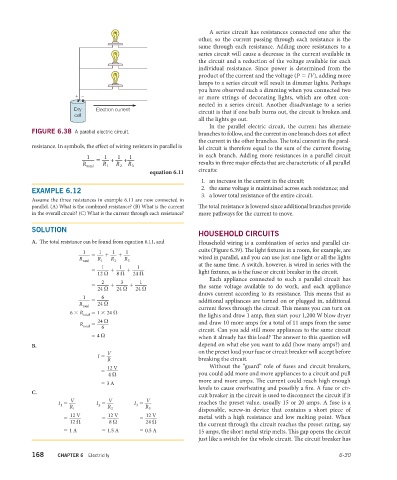
                                                                             In the parallel electric circuit, the current has alternate
                   FIGURE 6.38  A parallel electric circuit.
                                                                          branches to follow, and the current in one branch does not aff ect

                                                                          the current in the other branches. The total current in the paral-
                   resistance. In symbols, the effect of wiring resisters in parallel is

                                                                          lel circuit is therefore equal to the sum of the current fl owing
                                     1 _ _ _ _                            in each branch. Adding more resistances in a parallel circuit
                                           1
                                               1
                                                   1


                                          =       +     +

                                      R         R        R      R         results in three major effects that are characteristic of all parallel
                                           1
                                                2
                                                    3
                                     total
                                                          equation 6.11   circuits:
                                                                            1.  an increase in the current in the circuit;
                   EXAMPLE 6.12                                             2.  the same voltage is maintained across each resistance; and
                                                                            3.  a lower total resistance of the entire circuit.
                   Assume the three resistances in example 6.11 are now connected in

                   parallel. (A) What is the combined resistance? (B) What is the current   The total resistance is lowered since additional  branches provide
                   in the overall circuit? (C) What is the current through each resistance?  more pathways for the current to move.
                   SOLUTION
                                                                          HOUSEHOLD CIRCUITS
                   A.  The total resistance can be found from equation 6.11, and  Household wiring is a combination of series and parallel cir-

                                    1 _  1 _ _    1 _                     cuits (Figure 6.39). Th e light fixtures in a room, for example, are
                                             1
                                            =         +        +


                                    R         R        R        R         wired in parallel, and you can use just one light or all the lights
                                    total  1  2    3
                                        _       1 _  _                    at the same time. A switch, however, is wired in series with the
                                          1
                                                      1
                                      =            +           +

                                        12 Ω   8 Ω  24 Ω                  light fixtures, as is the fuse or circuit breaker in the circuit.
                                                                             Each appliance connected to such a parallel circuit has
                                        _      _     _
                                                3
                                                      1
                                          2
                                      =            +            +             the same voltage available to do work, and each appliance
                                        24 Ω   24 Ω  24 Ω
                                                                          draws current according to its resistance. This means that as

                                    1 _  _
                                          6
                                          =                               additional appliances are turned on or plugged in, additional

                                    R       24 Ω
                                    total                                 current fl ows through the circuit. This means you can turn on

                               6 ×  R      = 1 × 24 Ω
                                    total                                 the lights and draw 1 amp, then start your 1,200 W blow dryer
                                        24 Ω
                                        _

                                   R      =                               and draw 10 more amps for a total of 11 amps from the same
                                    total  6
                                                                          circuit. Can you add still more appliances to the same circuit
                                      = 4 Ω                               when it already has this load? The answer to this question will

                   B.                                                     depend on what else you want to add (how many amps?) and
                                            V _                           on the preset load your fuse or circuit breaker will accept before
                                        I =
                                            R                             breaking the circuit.
                                           _                                 Without the “guard” role of fuses and circuit breakers,
                                            12 V
                                          =
                                            4 Ω                           you could add more and more appliances to a circuit and pull

                                                                          more and more amps. The current could reach high enough
                                          = 3 A
                                                                          levels to cause overheating and possibly a fire. A fuse or cir-

                   C.
                                                                          cuit breaker in the circuit is used to disconnect the circuit if it
                                V _         V _          V _


                            I     =              I     =              I     =          reaches the preset value, usually 15 or 20 amps. A fuse is a
                                                     3
                            1
                                         2
                                R            R           R                disposable, screw-in device that contains a short piece of
                                                         3
                                             2
                                1
                               _            _           _
                                                        12 V
                               12 V
                                            12 V
                             =            =            =                  metal with a high resistance and low melting point. When
                               12 Ω         8 Ω         24 Ω
                                                                          the current through the circuit reaches the preset rating, say
                             = 1 A        = 1.5 A     = 0.5 A               15 amps, the short metal strip melts. This gap opens the circuit

                                                                          just like a switch for the whole circuit. The circuit breaker has

                   168     CHAPTER 6 Electricity                                                                        6-30
   186   187   188   189   190   191   192   193   194   195   196