


Page 188 - 9780077418427.pdf
P. 188
/Users/user-f465/Desktop
          tiL12214_ch06_139-176.indd Page 165  9/1/10  9:40 PM user-f465
          tiL12214_ch06_139-176.indd Page 165  9/1/10  9:40 PM user-f465                                                /Users/user-f465/Desktop


                              CONCEPTS Applied                                 diverting it into increased kinetic energy of the positive ions and
                                                                               thus increased temperature of the conductor. The energy lost to

                              Swinging Coils                                   resistance is therefore reduced by lowering the current, which is
                                                                               what a transformer does by increasing the voltage. Hence, electric
                          The interactions between moving magnets and moving
                          charges can be easily demonstrated with two large magnets   power companies step up the voltage of generated power for eco-
                          and two coils of wire.                               nomical transmission. A step-up transformer at a power plant, for
                                                                               example, might step up the voltage from 22,000 volts to  500,000 volts
                          1.  Make a coil of wire from insulated bell wire (#18 copper   for transmission across the country to a city. This step up in volt-

                             wire) by wrapping 50 windings around a narrow jar. Tape
                             the coil at several places so it does not come apart.  age correspondingly reduces the current, lowering the resistance
                          2.  Now make a second coil of wire from insulated bell   losses to a more acceptable 4 or 5 percent over long distances. A
                             wire and tape the coil as before.                 step-down transformer at a substation near the city reduces the
                          3.  Suspend both coils of wire on separate ring stands or   voltage to several thousand volts for transmission around the
                             some other support on a tabletop. The coils should   city. Additional step-down transformers reduce this voltage to
                             hang so they will swing with the broad circle of the   120 volts for transmission to three or four houses (Figure 6.35).
                             coil moving back and forth. Place a large magnet on
                             supports so it is near the center of each coil (Box
                             Figure 6.2).                                       6.6 CIRCUIT CONNECTIONS
                          4.  Connect the two coils of wire.
                          5.  Move one of the coils of wire and observe what   Practically all of the electricity generated by power plants is alter-
                             happens to the second coil. The second coil should   nating current, which is stepped up, transmitted over high lines,
                             move, mirroring the movements of the first coil (if it   and stepped down for use in homes and industry. Electric circuits
                             does not move, find some stronger magnets).       in automobiles, cell phones, MP3 players, and laptops, on the
                          6.  Explain what happens in terms of magnetic fields and   other hand, all have direct-current circuits. Thus, most all industry

                             currents at the first coil and at the second coil.  and household circuits are ac circuits, and most movable or por-
                                                                               table circuits are dc circuits. It works out that way because of the
                                                                               present need to use transformers for transmitting large currents,
                                  u
                                   pp
                                      r
                                 Support 1
                                                                               which can only be done economically with alternating currents,
                                                                               and because chemical batteries are the main source of current for
                                                                               dc devices.
                                                 Connecting
                                                    n
                                                   e
                                                 wires s
                                                                               VOLTAGE SOURCES IN CIRCUITS
                                                           Suppport 2
                                  C Coil of
                                  Co  o
                                                                               Most standard flashlights use two dry cells, each with a potential

                                  w wi wire 1 1
                                    r

                                                                               difference of 1.5 volts. All such dry cells are 1.5 volts, no matter
                                                                               how small or large they are, from penlight batteries up to much
                                                                               larger D cells. To increase the voltage above 1.5 volts, the cells
                                                                               must be arranged and connected in a series circuit. A series
                                  N N N  S
                                                                               connection has the negative terminal of one cell connected to
                                                            Co
                                                            Coil of
                                                                               the positive terminal of another cell (see Figure 6.36A ). Th e total
                                                            wi wire 2
                                                                               voltage produced this way is equal to the sum of the single cell
                                  M Magneet 1
                                  Ma
                                                            N   S                                           +  –
                                                                                                            Dry
                                                                                                            cell  + –
                                                           Magnet 2             + –         +  –                         + –
                                                             a
                                                              g

                          BOX FIGURE 6.2  Why does moving one coil result in    Dry         Dry                   Dry
                                                                                                                  cell
                          motion of the second coil?                                                                    Dry
                                                                                cell  +  –  cell
                                                                                                                        cell
                                                                                      Dry
                                                                                      cell
                           Energy losses in transmission are reduced by stepping up the   A                B
                       voltage. Recall that electrical resistance results in an energy loss and
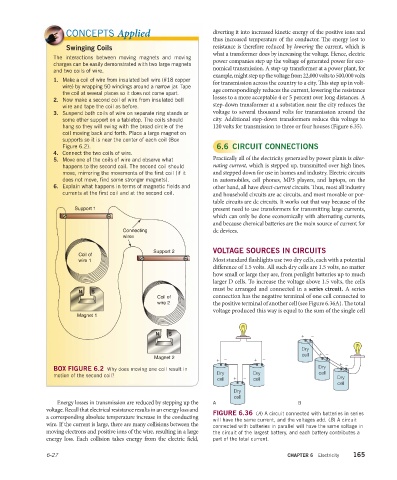
                                                                               FIGURE 6.36  (A) A circuit connected with batteries in series
                       a corresponding absolute temperature increase in the conducting
                                                                               will have the same current, and the voltages add. (B) A circuit
                       wire. If the current is large, there are many collisions between the   connected with batteries in parallel will have the same voltage in
                       moving electrons and positive ions of the wire, resulting in a large   the circuit of the largest battery, and each battery contributes a
                       energy loss. Each collision takes energy from the electric fi eld,   part of the total current.
                       6-27                                                                            CHAPTER 6  Electricity  165

