


Page 214 - 9780077418427.pdf
P. 214
/Users/user-f465/Desktop
          tiL12214_ch07_177-202.indd Page 191  9/1/10  9:44 PM user-f465
          tiL12214_ch07_177-202.indd Page 191  9/1/10  9:44 PM user-f465                                                /Users/user-f465/Desktop


                                                                                            A Closer Look


                                                                                                                  Lasers
                             he word laser is from light amplification   tube with mirrors at both ends. The mir-  Lasers are everywhere today and have
                          Tby stimulated emission of radiation. A   ror at one end is only partly silvered, which   connections with a wide variety of tech-
                          laser is a device that produces a coherent     allows light to escape as the laser beam. The   nologies. At the supermarket, a laser and
                          beam of single-frequency, in-phase light.   distance between the mirrors matches the   detector unit reads the bar code on each
                          The beam comes from atoms that have been   resonant frequency of the light produced,   grocery item. The laser sends the pattern
                          stimulated by electricity. Most ordinary light   so the trapped light will set up an optical   to a computer, which sends a price to the
                          sources produce incoherent light; light that   standing wave. An electric discharge pro-  register as well as tracks the store inven-
                          is emitted randomly and at different fre-  duces fast electrons that raise the energy   tory. A low-powered laser and detector also
                          quencies. The coherent light from a laser has   level of the electrons of the specific gas   read your CD music or MP3 disc and can
                          the same frequency, phase, and direction, so   atoms in the tube. The electrons of the   be used to make a three-dimensional image.
                          it does not tend to spread out and it can be   energized gas atoms emit a particular   Most laser printers use a laser, and a laser is
                          very intense. This has made possible a num-  frequency of light as they drop back to a   the operational part of a fiber optics com-
                          ber of specialized applications, and the list of   lower level, and this emitted light sets up   munication system. Stronger lasers are used
                          uses continues to grow.            the standing wave. The standing wave   for cutting, drilling, and welding. Lasers are
                             There are different kinds of lasers in   stimulates other atoms of the gas, resulting   used extensively in many different medical
                          use, and new ones are under development.   in the emission of more light at the same   procedures, from welding a detached retina
                          One common type of laser is a gas-filled   frequency and phase.       to bloodless  surgery.


                       Both theories failed to explain some behaviors of light, such as   of transverse waves vibrating in all conceivable random directions.
                       light moving through certain transparent crystals. For example,   Polarizing materials, such as the tourmaline crystal, transmit light
                       a slice of the mineral tourmaline transmits what appears to be a   that is vibrating in one direction only, such as the vertical direc-
                       low-intensity greenish light. But if a second slice of tourmaline   tion in Figure 7.20B. Such a wave is said to be polarized, or
                       is placed on the first and rotated, the transmitted light passing   plane-polarized since it vibrates only in one plane. Th e  single


                       through both slices begins to dim. The transmitted light is prac-  crystal polarized light by transmitting only waves that vibrate
                       tically zero when the second slice is rotated 90°. Newton sug-  parallel to a certain direction while selectively absorbing waves
                       gested that this behavior had something to do with “sides” or   that vibrate in all other directions. Your eyes cannot tell the dif-
                       “poles” and introduced the concept of what is now called the   ference between unpolarized and polarized light, so the  light
                       polarization of light.                                  transmitted through a single crystal looks just like any other

                           The waves of Huygens’ wave theory were longitudinal, mov-  light. When a second crystal is placed on the first, the amount

                       ing as sound waves do, with wave fronts moving in the direction   of light transmitted depends on the alignment of the two crystals
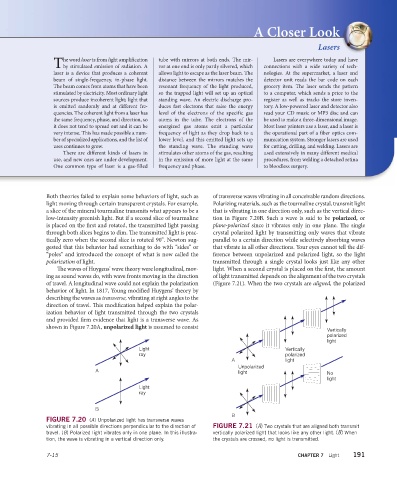
                       of travel. A longitudinal wave could not explain the polarization   (Figure 7.21). When the two crystals are aligned, the polarized

                       behavior of light. In 1817, Young modified Huygens’ theory by
                       describing the waves as transverse, vibrating at right angles to the
                       direction of travel. Th is modification helped explain the polar-

                        ization behavior of light transmitted through the two crystals
                        and provided firm evidence that light is a transverse wave. As

                        shown in Figure 7.20A, unpolarized light is assumed to consist


                                                                                     A
                                        A


                                        B
                                                                                     B
                       FIGURE 7.20  (A) Unpolarized light has transverse waves
                       vibrating in all possible directions perpendicular to the direction of   FIGURE 7.21  (A) Two crystals that are aligned both transmit
                       travel. (B) Polarized light vibrates only in one plane. In this illustra-  vertically polarized light that looks like any other light. (B) When
                       tion, the wave is vibrating in a vertical direction only.  the crystals are crossed, no light is transmitted.

                       7-15                                                                                CHAPTER 7  Light   191

