


Page 215 - 9780077418427.pdf
P. 215
/Users/user-f465/Desktop
          tiL12214_ch07_177-202.indd Page 192  9/1/10  9:44 PM user-f465
          tiL12214_ch07_177-202.indd Page 192  9/1/10  9:44 PM user-f465                                                /Users/user-f465/Desktop


                           A Closer Look


                           Why Is the Sky Blue?
                        unlight entering our atmosphere is scat-  Shorter-wavelength blue and violet light is   When viewing a sunrise or sunset, you see
                     Stered, or redirected, by interactions with   scattered more strongly than red and orange   only light that has not been scattered in
                     air molecules. Sunlight appears to be white   light. When you look at the sky, you see the   other directions. The red and orange part of
                     to the human eye but is actually a mixture   light that was redirected by the atmosphere   sunlight travels through a maximum length
                     of all the colors of the rainbow. The blue   into your line of sight. Since blue and vio-  of the atmosphere, and the blue and violet
                     and violet part of the spectrum has shorter   let light is scattered more efficiently than   has been scattered away, so a sunrise or sun-
                     wavelengths than the red and orange part.   red and orange light, the sky appears blue.   set appears to be more orange and reddish.


                   light from the first crystal passes through the second with little
                   absorption. When the crystals are crossed at 90°, the light trans-         Horizontally
                   mitted by the first is vibrating in a plane that is absorbed by the        polarized

                   second crystal, and practically all the light is absorbed. At some         light
                   other angle, only a fraction of the polarized light from the fi rst   Unpolarized
                   crystal is transmitted by the second.                        light
                      You can verify whether a pair of sunglasses is made of
                   polarizing material by rotating a lens of one pair over a lens of a
                   second pair. Light is transmitted when the lenses are aligned but
                   mostly absorbed at 90° when the lenses are crossed.
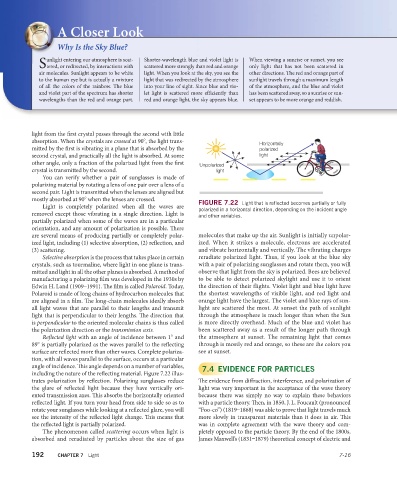
                                                                          FIGURE 7.22  Light that is reflected becomes partially or fully
                      Light is completely polarized when all the waves are
                                                                          polarized in a horizontal direction, depending on the incident angle
                   removed except those vibrating in a single direction. Light is   and other variables.
                   partially polarized when some of the waves are in a particular
                   orientation, and any amount of polarization is possible. Th ere
                   are several means of producing partially or completely polar-  molecules that make up the air. Sunlight is initially unpolar-
                   ized light, including (1) selective absorption, (2) refl ection, and   ized. When it strikes a molecule, electrons are accelerated
                   (3) scattering.                                        and vibrate horizontally and vertically. The vibrating charges
                      Selective absorption is the process that takes place in certain   reradiate polarized light. Thus, if you look at the blue sky
                   crystals, such as tourmaline, where light in one plane is trans-  with a pair of polarizing sunglasses and rotate them, you will
                   mitted and light in all the other planes is absorbed. A method of   observe that light from the sky is polarized. Bees are believed

                   manufacturing a polarizing film was developed in the 1930s by   to be able to detect polarized skylight and use it to orient
                   Edwin H. Land (1909–1991). Th e film is called Polaroid. Today,   the direction of their flights. Violet light and blue light have

                   Polaroid is made of long chains of hydrocarbon molecules that   the shortest wavelengths of visible light, and red light and
                   are aligned in a fi lm. The long-chain molecules ideally absorb   orange light have the largest. The violet and blue rays of sun-

                   all light waves that are parallel to their lengths and transmit   light are scattered the most. At sunset the path of sunlight
                   light that is perpendicular to their lengths. The direction that   through the atmosphere is much  longer than when the Sun

                   is perpendicular to the oriented molecular chains is thus called   is more directly overhead. Much of the blue and violet has
                   the polarization direction or the transmission axis.   been scattered away as a result of the longer path through
                      Refl ected light with an angle of incidence between 1° and   the atmosphere at sunset. The remaining light that comes
                   89° is partially polarized as the waves parallel to the refl ecting   through is mostly red and orange, so these are the colors you
                   surface are reflected more than other waves. Complete polariza-  see at sunset.

                   tion, with all waves parallel to the surface, occurs at a particular

                   angle of incidence. This angle depends on a number of variables,   7.4  EVIDENCE FOR PARTICLES

                   including the nature of the reflecting material. Figure 7.22 illus-
                   trates polarization by reflection. Polarizing sunglasses reduce   The evidence from diffraction, interference, and polarization of


                   the glare of reflected light because they have vertically ori-  light was very important in the acceptance of the wave theory


                   ented transmission axes. This absorbs the horizontally oriented   because there was simply no way to explain these behaviors
                   reflected light. If you turn your head from side to side so as to   with a particle theory. Then, in 1850, J. L. Foucault (pronounced


                   rotate your sunglasses while looking at a reflected glare, you will   “Foo-co”) (1819–1868) was able to prove that light travels much


                   see the intensity of the reflected light change. This means that   more slowly in transparent materials than it does in air. Th is
                   the reflected light is partially polarized.            was in complete agreement with the wave theory and com-

                      The phenomenon called scattering occurs when light is   pletely opposed to the particle theory. By the end of the 1800s,
                   absorbed and reradiated by particles about the size of gas   James Maxwell’s (1831–1879) theoretical concept of electric and
                   192     CHAPTER 7 Light                                                                              7-16

