


Page 228 - 9780077418427.pdf
P. 228
/Users/user-f465/Desktop
          tiL12214_ch08_203-228.indd Page 205  9/1/10  9:45 PM user-f465
          tiL12214_ch08_203-228.indd Page 205  9/1/10  9:45 PM user-f465                                                /Users/user-f465/Desktop


                                                                                                Magnet
                                                                                    –
                                                                                             +

                                                                                  Charged
                                                                                  plates
                                                                                                                       Detecting
                                                                                                                       screen


                                                                                                             Cathode
                                                                                                             rays


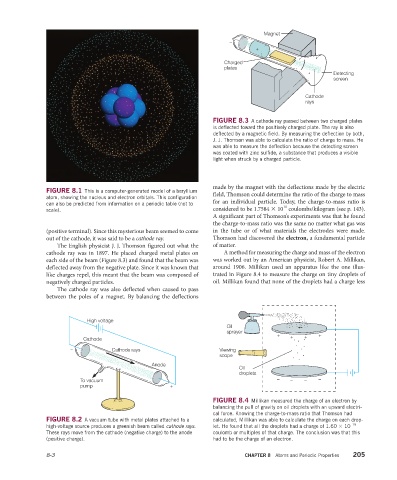
                                                                               FIGURE 8.3  A cathode ray passed between two charged plates
                                                                               is deflected toward the positively charged plate. The ray is also
                                                                               deflected by a magnetic field. By measuring the deflection by both,
                                                                               J. J. Thomson was able to calculate the ratio of charge to mass. He
                                                                               was able to measure the deflection because the detecting screen
                                                                               was coated with zinc sulfide, a substance that produces a visible
                                                                               light when struck by a charged particle.


                                                                               made by the magnet with the deflections made by the electric
                       FIGURE 8.1  This is a computer-generated model of a beryllium
                                                                               field, Thomson could determine the ratio of the charge to mass
                       atom, showing the nucleus and electron orbitals. This configuration
                       can also be predicted from information on a periodic table (not to   for an individual particle. Today, the charge-to-mass ratio is
                                                                                                      11
                       scale).                                                 considered to be 1.7584 × 10  coulombs/kilogram (see  p. 143 ).
                                                                               A significant part of Thomson’s experiments was that he found
                                                                               the charge-to-mass ratio was the same no matter what gas was
                       (positive terminal). Since this mysterious beam seemed to come   in the tube or of what materials the electrodes were made.
                       out of the cathode, it was said to be a cathode ray.    Thomson had discovered the electron, a fundamental particle
                           The English physicist J. J. Thomson figured out what the   of matter.
                       cathode ray was in 1897. He placed charged metal plates on   A method for measuring the charge and mass of the  electron
                       each side of the beam (Figure 8.3) and found that the beam was   was worked out by an American physicist, Robert A. Millikan,
                         deflected away from the negative plate. Since it was known that   around 1906. Millikan used an apparatus like the one illus-
                       like charges repel, this meant that the beam was composed of   trated in Figure 8.4 to measure the charge on tiny droplets of
                       negatively charged particles.                           oil.  Millikan found that none of the droplets had a charge less
                           The cathode ray was also deflected when caused to pass
                       between the poles of a magnet. By balancing the deflections


                                     High voltage
                                                                                   Oil
                                                                                   sprayer
                                    Cathode                                                         +   +    +    +
                                –            Cathode rays                        Viewing
                                                                                 scope
                                                          Anode
                                                                                       Oil
                                                                                       droplets
                                   To vacuum                                                        –   –    –    –
                                   pump                         +

                                                                               FIGURE 8.4  Millikan measured the charge of an electron by
                                                                               balancing the pull of gravity on oil droplets with an upward electri-
                                                                               cal force. Knowing the charge-to-mass ratio that Thomson had
                       FIGURE 8.2  A vacuum tube with metal plates attached to a     calculated, Millikan was able to calculate the charge on each drop-
                       high-voltage source produces a greenish beam called cathode rays.   let. He found that all the droplets had a charge of 1.60 × 10 –19
                       These rays move from the cathode (negative charge) to the anode   coulomb or multiples of that charge. The conclusion was that this
                       (positive charge).                                      had to be the charge of an electron.

                       8-3                                                               CHAPTER 8  Atoms and Periodic Properties   205

