


Page 229 - 9780077418427.pdf
P. 229
/Users/user-f465/Desktop
          tiL12214_ch08_203-228.indd Page 206  9/1/10  9:45 PM user-f465
          tiL12214_ch08_203-228.indd Page 206  9/1/10  9:45 PM user-f465                                                /Users/user-f465/Desktop


                                               –19
                   than one particular value (1.60 × 10  coulomb) and that larger          Nucleus
                   charges on various droplets were always multiples of this unit of
                   charge. Since all of the droplets carried the single unit of charge
                   or multiples of the single unit, the unit of charge was under-
                   stood to be the charge of a single electron.
                      Knowing the charge of a single electron and knowing the                                 Atoms
                   charge-to-mass ratio that Thomson had measured now made it
                   possible to calculate the mass of a single electron. The mass of
                                                              –31
                   an electron was thus determined to be about 9.11 × 10  kg, or    Particles
                                                                                    from
                   about 1/1,840 of the mass of the lightest atom, hydrogen.        source
                      Thomson had discovered the negatively charged electron,
                   and Millikan had measured the charge and mass of the electron.
                   But atoms themselves are electrically neutral. If an electron is                  Deflected
                   part of an atom, there must be something else that is positively                  particle
                   charged, canceling the negative charge of the electron. The next
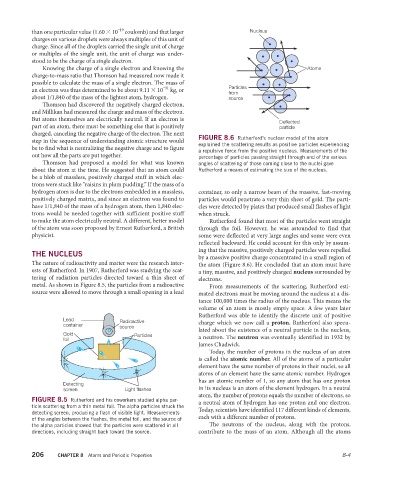
                   step in the sequence of understanding atomic structure would   FIGURE 8.6  Rutherford’s nuclear model of the atom
                                                                          explained the scattering results as positive particles experiencing
                   be to find what is neutralizing the negative charge and to figure   a repulsive force from the positive nucleus. Measurements of the
                   out how all the parts are put together.                percentage of particles passing straight through and of the various
                      Thomson had proposed a model for what was known     angles of scattering of those coming close to the nuclei gave
                   about the atom at the time. He suggested that an atom could   Rutherford a means of estimating the size of the nucleus.
                   be a blob of massless, positively charged stuff in which elec-
                   trons were stuck like “raisins in plum pudding.” If the mass of a
                   hydrogen atom is due to the electrons embedded in a massless,   container, so only a narrow beam of the massive, fast-moving
                   positively charged matrix, and since an electron was found to   particles would penetrate a very thin sheet of gold. The parti-
                   have 1/1,840 of the mass of a hydrogen atom, then 1,840 elec-  cles were detected by plates that produced small flashes of light
                   trons would be needed together with sufficient positive stuff   when struck.
                   to make the atom electrically neutral. A different, better model   Rutherford found that most of the particles went straight
                   of the atom was soon proposed by Ernest Rutherford, a British   through the foil. However, he was astounded to find that
                   physicist.                                             some were deflected at very large angles and some were even
                                                                          reflected backward. He could account for this only by assum-
                                                                          ing that the massive, positively charged particles were repelled
                   THE NUCLEUS
                                                                          by a massive positive charge concentrated in a small  region of
                   The nature of radioactivity and matter were the research inter-  the atom (Figure 8.6). He concluded that an atom must have
                   ests of Rutherford. In 1907, Rutherford was studying the scat-  a tiny, massive, and positively charged nucleus surrounded by
                   tering of radiation particles directed toward a thin sheet of   electrons.
                   metal. As shown in Figure 8.5, the particles from a radioactive   From measurements of the scattering, Rutherford esti-
                   source were allowed to move through a small opening in a lead   mated electrons must be moving around the nucleus at a dis-
                                                                          tance 100,000 times the radius of the nucleus. This means the
                                                                          volume of an atom is mostly empty space. A few years later
                                                                          Rutherford was able to identify the discrete unit of positive
                             Lead               Radioactive
                             container          source                    charge which we now call a proton. Rutherford also specu-
                             Gold                    Particles            lated about the existence of a neutral particle in the nucleus,
                             foil                                         a neutron. The neutron was eventually identified in 1932 by
                                                                          James Chadwick.
                                                                             Today, the number of protons in the nucleus of an atom
                                                                          is called the atomic number. All of the atoms of a particular
                                                                          element have the same number of protons in their nuclei, so all
                                                                          atoms of an element have the same atomic number. Hydrogen
                                                                          has an atomic number of 1, so any atom that has one proton
                             Detecting
                             screen              Light flashes            in its nucleus is an atom of the element hydrogen. In a neutral
                                                                          atom, the number of protons equals the number of electrons, so
                   FIGURE 8.5  Rutherford and his coworkers studied alpha par-  a neutral atom of hydrogen has one proton and one electron.
                   ticle scattering from a thin metal foil. The alpha particles struck the
                                                                          Today, scientists have identified 117 different kinds of elements,
                   detecting screen, producing a flash of visible light. Measurements
                   of the angles between the flashes, the metal foil, and the source of   each with a  different number of protons.
                   the alpha particles showed that the particles were scattered in all   The neutrons of the nucleus, along with the protons,
                   directions, including straight back toward the source.    contribute to the mass of an atom. Although all the atoms


                   206     CHAPTER 8  Atoms and Periodic Properties                                                       8-4

