


Page 233 - 9780077418427.pdf
P. 233
/Users/user-f465/Desktop
          tiL12214_ch08_203-228.indd Page 210  9/1/10  9:45 PM user-f465
          tiL12214_ch08_203-228.indd Page 210  9/1/10  9:45 PM user-f465                                                /Users/user-f465/Desktop


                   the nucleus. There were three sets of rules that described this   n  Energy  Energy
                   electron:                                                     (J)       (eV)
                                                                              – 6.05 ✕ 10 –20  – 0.377
                     1.  Allowed Orbits. An electron can revolve around an   6
                                                                                                                  Violet

                      atom only in specific allowed orbits. Bohr considered the   5  – 8.70 ✕ 10 –20  – 0.544     (7.3 ✕ 10  Hz)
                                                                                                                        14
                      electron to be a particle with a known mass in motion
                                                                                                                  Violet
                      around the nucleus and used Newtonian mechanics to      –1.36 ✕ 10 –19  – 0.850             (6.9 ✕ 10  Hz)
                                                                                                                        14
                      calculate the distances of the  allowed orbits. According to   4
                      the Bohr model, electrons can exist only in one of these                                    Blue-green
                                                                                                                        14
                      allowed orbits and nowhere else.                     3  –2.42 ✕ 10 –19  –1.51               (6.2 ✕ 10  Hz)
                     2.  Radiationless Orbits. An electron in an allowed orbit
                      does not emit radiant energy as long as it remains in the                                   Red
                                                                                                                        14
                      orbit. According to Maxwell’s theory of electromagnetic   –5.44 ✕ 10 –19  – 3.40            (4.6 ✕ 10  Hz)
                      radiation, an accelerating electron should emit an   2
                      electromagnetic wave, such as light, which would move

                      off into space from the electron. Bohr  recognized that
                      electrons moving in a circular orbit are  accelerating,
                                                                              –2.18 ✕ 10 –18  –13.6
                      since they are changing direction continuously. Yet   1
                      hydrogen atoms did not emit light in their normal state.
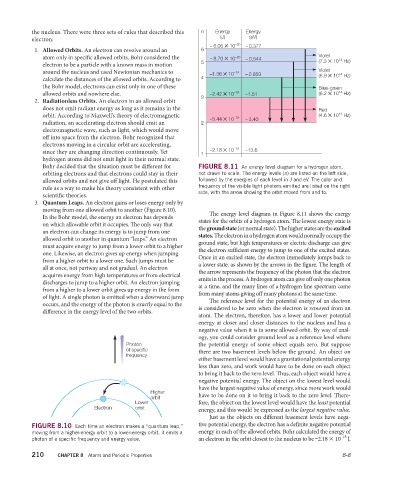
                      Bohr decided that the situation must be diff erent for   FIGURE 8.11  An energy level diagram for a hydrogen atom,
                      orbiting electrons and that electrons could stay in their   not drawn to scale. The energy levels (n) are listed on the left side,

                      allowed orbits and not give off light. He postulated this   followed by the energies of each level in J and eV. The color and
                      rule as a way to make his theory  consistent with other   frequency of the visible light photons emitted are listed on the right
                                                                          side, with the arrow showing the orbit moved from and to.
                      scientifi c theories.
                     3.  Quantum Leaps. An electron gains or loses energy only by
                        moving from one allowed orbit to another (Figure 8.10).
                                                                             The energy level diagram in Figure 8.11 shows the energy
                      In the Bohr model, the energy an electron has depends
                                                                          states for the orbits of a hydrogen atom. The lowest energy state is

                      on which  allowable orbit it occupies. The only way that
                                                                          the ground state (or normal state). The higher states are the excited
                      an electron can change its  energy is to jump from one
                                                                          states. The electron in a hydrogen atom would normally occupy the
                      allowed orbit to another in quantum “leaps.” An electron
                                                                          ground state, but high temperatures or electric  discharge can give
                      must acquire energy to jump from a lower orbit to a higher
                                                                          the electron sufficient energy to jump to one of the excited states.
                      one. Likewise, an electron gives up energy when  jumping
                                                                          Once in an excited state, the electron immediately jumps back to
                      from a higher orbit to a lower one. Such jumps must be
                                                                          a lower state, as shown by the arrows in the figure. The length of
                      all at once, not partway and not gradual. An  electron
                                                                          the arrow represents the frequency of the photon that the electron
                      acquires energy from high temperatures or from electrical
                                                                          emits in the process. A hydrogen atom can give off only one photon
                      discharges to jump to a higher orbit. An electron jumping
                                                                          at a time, and the many lines of a hydrogen line spectrum come
                      from a higher to a lower orbit gives up energy in the form
                                                                          from many atoms giving off many photons at the same time.
                      of light. A single photon is emitted when a downward jump
                                                                             The reference level for the potential energy of an electron
                      occurs, and the energy of the photon is  exactly equal to the
                                                                          is considered to be zero when the electron is removed from an
                      difference in the energy level of the two orbits.

                                                                          atom. The electron, therefore, has a lower and lower potential
                                                                          energy at closer and closer distances to the nucleus and has a
                                                                          negative value when it is in some allowed orbit. By way of anal-
                                                                          ogy, you could consider ground level as a reference level where
                                                  Photon                  the potential energy of some object equals zero. But suppose
                                                  of specific             there are two basement levels below the ground. An object on
                                                  frequency
                                                                          either basement level would have a gravitational potential energy
                                                                          less than zero, and work would have to be done on each object
                                                                          to bring it back to the zero level. Thus, each object would have a
                                                                          negative potential energy. The object on the lowest level would
                                                                          have the largest negative value of energy, since more work would
                                                          Higher
                                                          orbit           have to be done on it to bring it back to the zero level. There-
                                                     Lower                fore, the object on the lowest level would have the least potential
                                       Electron      orbit                energy, and this would be expressed as the largest negative value.
                                                                             Just as the objects on different basement levels have nega-
                                                                          tive potential energy, the electron has a definite negative potential
                   FIGURE 8.10  Each time an electron makes a “quantum leap,”
                   moving from a higher-energy orbit to a lower-energy orbit, it emits a   energy in each of the allowed orbits. Bohr calculated the energy of
                                                                                                                         –18
                   photon of a specific frequency and energy value.       an electron in the orbit closest to the nucleus to be –2.18 × 10  J,
                   210     CHAPTER 8  Atoms and Periodic Properties                                                       8-8

