


Page 230 - 9780077418427.pdf
P. 230
/Users/user-f465/Desktop
          tiL12214_ch08_203-228.indd Page 207  9/1/10  9:45 PM user-f465
          tiL12214_ch08_203-228.indd Page 207  9/1/10  9:45 PM user-f465                                                /Users/user-f465/Desktop


                                 Hydrogen-1  Hydrogen-2  Hydrogen-3
                                                                                TABLE 8.1

                                    1p          1p          1p                  Selected atomic weights calculated from mass and
                                    0n          1n          2n                    abundance of isotopes
                                                                                Stable    Mass of Isotope                Atomic
                                    1
                                    1 H         2 1 H      3 1 H                Isotopes   Compared to C-12   Abundance (%)   Weight
                                                                                   1

                                                                                          H   1.007           99.985
                                             (deuterium)  (tritium)              1  2

                                                                                          H   2.0141           0.015      1.0079

                                                                                 1
                                                                                  9
                                  Mass                                                   Be   9.01218        100.         9.01218

                                                                                 4
                                  number                                          14
                                                                                        N    14.00307         99.63


                                                                                    7
                                                                                   15


                                            1           Chemical                        N    15.00011          0.37      14.0067
                                                                                    7
                                                                                   16
                                            1 H         symbol                           O   15.99491         99.759

                                                                                    8
                                                                                   17
                                                                                         O

                                                                                    8        16.99914          0.037
                                                                                   18


                                                                                        O    17.00016          0.204     15.9994
                                  Atomic                                            8
                                                                                  19
                                  number                                                 F    18.9984        100.        18.9984
                                                                                     9
                                                                                  20


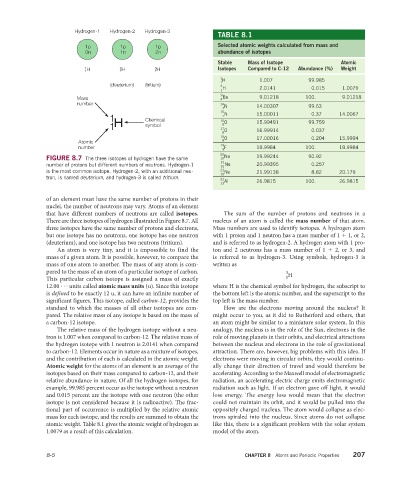
                       FIGURE 8.7  The three isotopes of hydrogen have the same           Ne  19.99244        90.92
                                                                                   10
                                                                                   21


                        number of protons but different numbers of neutrons. Hydrogen-1           Ne  20.99395  0.257
                                                                                   10
                        is the most common isotope. Hydrogen-2, with an additional neu-          Ne  21.99138  8.82      20.179
                                                                                   22


                                                                                   10
                        tron, is named deuterium, and hydrogen-3 is called tritium.    22


                                                                                        Al   26.9815         100.        26.9815
                                                                                   13
                       of an element must have the same number of protons in their
                       nuclei, the number of neutrons may vary. Atoms of an  element
                       that have different numbers of neutrons are called  isotopes.   The sum of the number of protons and neutrons in a
                       There are three isotopes of hydrogen illustrated in Figure 8.7. All     nucleus of an atom is called the mass number of that atom.
                       three isotopes have the same number of protons and  electrons,   Mass numbers are used to identify isotopes. A hydrogen atom
                       but one isotope has no neutrons, one  isotope has one neutron   with 1 proton and 1 neutron has a mass number of 1 + 1, or 2,
                       (deuterium), and one isotope has two neutrons (tritium).  and is referred to as hydrogen-2. A hydrogen atom with  1 pro-
                           An atom is very tiny, and it is impossible to find the   ton and 2 neutrons has a mass number of 1  + 2, or 3, and
                       mass of a given atom. It is possible, however, to compare the   is  referred to as hydrogen-3. Using symbols, hydrogen-3 is
                       mass of one atom to another. The mass of any atom is com-   written as
                       pared to the mass of an atom of a particular isotope of carbon.                 3
                                                                                                               H
                                                                                                       1
                       This   particular carbon isotope is assigned a mass of exactly
                            . . .
                       12.00         units called atomic mass units (u). Since this isotope   where H is the chemical symbol for hydrogen, the subscript to
                       is defined to be exactly 12 u, it can have an infinite number of   the bottom left is the atomic number, and the superscript to the
                       significant figures. This isotope, called carbon-12, provides the   top left is the mass number.
                       standard to which the masses of all other isotopes are com-  How are the electrons moving around the nucleus? It
                       pared. The relative mass of any isotope is based on the mass of   might occur to you, as it did to Rutherford and others, that
                       a carbon-12 isotope.                                    an atom might be similar to a miniature solar system. In this
                           The relative mass of the hydrogen isotope without a neu-  analogy, the nucleus is in the role of the Sun, electrons in the
                       tron is 1.007 when compared to carbon-12. The relative mass of   role of moving planets in their orbits, and electrical attractions
                       the hydrogen isotope with 1 neutron is 2.0141 when compared   between the nucleus and electrons in the role of gravitational
                       to carbon-12. Elements occur in nature as a mixture of isotopes,     attraction. There are, however, big problems with this idea. If
                       and the contribution of each is calculated in the atomic weight.   electrons were moving in circular orbits, they would continu-
                       Atomic weight for the atoms of an element is an average of the   ally change their direction of travel and would therefore be
                       isotopes based on their mass compared to carbon-12, and their   accelerating. According to the Maxwell model of electro magnetic
                       relative abundance in nature. Of all the hydrogen isotopes, for   radiation, an accelerating electric charge emits electromagnetic
                       example, 99.985 percent occur as the isotope without a neutron   radiation such as light. If an electron gave off light, it would
                       and 0.015 percent are the isotope with one  neutron (the other   lose energy. The energy loss would mean that the electron
                       isotope is not considered because it is  radioactive). The frac-  could not maintain its orbit, and it would be pulled into the
                       tional part of occurrence is multiplied by the relative atomic   oppositely charged nucleus. The atom would collapse as elec-
                       mass for each isotope, and the results are summed to obtain the   trons spiraled into the nucleus. Since atoms do not collapse
                       atomic weight. Table 8.1 gives the atomic weight of hydrogen as   like this, there is a significant problem with the solar system
                       1.0079 as a result of this  calculation.                model of the atom.
                       8-5                                                               CHAPTER 8  Atoms and Periodic Properties   207

