


Page 268 - 9780077418427.pdf
P. 268
/Users/user-f465/Desktop
          tiL12214_ch09_229-250.indd Page 245  9/7/10  9:12 PM user-f465
          tiL12214_ch09_229-250.indd Page 245  9/7/10  9:12 PM user-f465                                                /Users/user-f465/Desktop


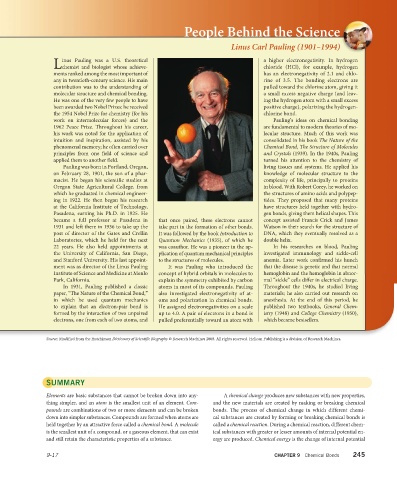
                                                                     People Behind the Science


                                                                                     Linus Carl Pauling (1901–1994)

                             inus Pauling was a U.S. theoretical                               a higher electronegativity. In hydrogen
                          Lchemist and biologist whose achieve-                                chloride (HCl), for example,  hydrogen
                          ments ranked among the most important of                             has an electronegativity of 2.1 and chlo-
                          any in twentieth-century science. His main                           rine of 3.5. The bonding electrons are
                          contribution was to the understanding of                             pulled toward the chlorine atom, giving it
                          molecular structure and chemical bonding.                            a small excess negative charge (and leav-
                          He was one of the very few people to have                            ing the hydrogen atom with a small excess
                          been awarded two Nobel Prizes: he received                           positive charge), polarizing the hydrogen-
                          the 1954 Nobel Prize for chemistry (for his                          chlorine bond.
                          work on intermolecular forces) and the                                   Pauling’s ideas on chemical bonding
                          1962 Peace Prize. Throughout his  career,                            are fundamental to modern theories of mo-
                          his work was noted for the appli cation of                           lecular structure. Much of this work was
                          intuition and inspiration, assisted by his                           consolidated in his book The Nature of the
                          phenomenal memory; he often carried over                             Chemical Bond, The Structure of Molecules
                          principles from one field of science and                             and Crystals (1939). In the 1940s, Pauling
                            applied them to another field.                                     turned his attention to the chemistry of
                             Pauling was born in Portland,  Oregon,                            living tissues and systems. He applied his
                          on February 28, 1901, the son of a phar-                             knowledge of molecular structure to the
                          macist. He began his scientific studies at                           complexity of life, principally to proteins
                          Oregon State Agricultural College, from                              in blood. With Robert Corey, he worked on
                          which he graduated in chemical engineer-                             the structures of amino acids and polypep-
                          ing in 1922. He then began his research                              tides. They proposed that many proteins
                          at the California Institute of Technology,                           have structures held together with hydro-
                          Pasadena,  earning his Ph.D. in 1925. He                             gen bonds, giving them helical shapes. This
                          became a full professor at Pasadena in   that once paired, these electrons cannot   concept assisted Francis Crick and James
                          1931 and left there in 1936 to take up the   take part in the formation of other bonds.   Watson in their search for the structure of
                          post of director of the Gates and Crellin   It was followed by the book Introduction to   DNA, which they eventually resolved as a
                          Laboratories, which he held for the next   Quantum Mechanics (1935), of which he   double helix.
                          22 years. He also held appointments at   was coauthor. He was a pioneer in the ap-  In his researches on blood, Pauling
                          the University of  California, San Diego,   plication of quantum mechanical principles   investigated immunology and sickle-cell
                          and Stanford University. His last appoint-  to the structures of molecules.  anemia. Later work confirmed his hunch
                          ment was as director of the Linus Pauling   It was Pauling who introduced the   that the disease is genetic and that normal
                          Institute of Science and Medicine at Menlo   concept of hybrid orbitals in molecules to   hemoglobin and the hemoglobin in abnor-
                          Park, California.                  explain the symmetry exhibited by carbon   mal “sickle” cells differ in electrical charge.
                             In 1931, Pauling published a  classic   atoms in most of its compounds. Pauling   Throughout the 1940s, he studied living
                          paper, “The Nature of the Chemical Bond,”   also investigated electronegativity of at-    materials; he also carried out research on
                          in which he used quantum mechanics   oms and polarization in chemical bonds.   anesthesia. At the end of this period, he
                          to  explain that an electron-pair bond is   He assigned electronegativities on a scale    published two textbooks,  General Chem-
                          formed by the interaction of two unpaired   up to 4.0. A pair of electrons in a bond is   istry (1948) and College Chemistry (1950),
                          electrons, one from each of two atoms, and   pulled preferentially toward an atom with   which became bestsellers.


                       Source: Modified from the Hutchinson Dictionary of Scientific Biography © Research Machines 2008. All rights reserved. Helicon Publishing is a division of Research Machines.


                       SUMMARY

                       Elements are basic substances that cannot be broken down into any-  A chemical change produces new substances with new properties,
                       thing simpler, and an atom is the smallest unit of an element. Com-  and the new materials are created by making or breaking chemical
                       pounds are combinations of two or more elements and can be broken   bonds. The process of chemical change in which different chemi-
                       down into simpler substances. Compounds are formed when atoms are   cal substances are created by forming or breaking chemical bonds is
                       held together by an attractive force called a chemical bond. A molecule   called a chemical reaction. During a chemical reaction, different chem-
                       is the smallest unit of a compound, or a gaseous element, that can exist   ical  substances with greater or lesser amounts of internal potential en-
                       and still retain the characteristic properties of a substance.  ergy are produced. Chemical energy is the change of internal  potential

                       9-17                                                                        CHAPTER 9  Chemical Bonds   245

