


Page 266 - 9780077418427.pdf
P. 266
/Users/user-f465/Desktop
          tiL12214_ch09_229-250.indd Page 243  9/3/10  10:07 PM user-f465
          tiL12214_ch09_229-250.indd Page 243  9/3/10  10:07 PM user-f465                                               /Users/user-f465/Desktop


                                                                                  Science and Society


                                                                            Microwave Ovens and Molecular Bonds
                             microwave oven rapidly cooks foods   BOX TABLE 9.1                                         Positive
                          Athat contain water, but paper, glass,                               Negative                 hydrogen
                          and plastic products remain cool in the   Approximate ranges of visible light,   oxygen       end
                          oven. If they are warmed at all, it is from the   infrared radiation, and microwave   end
                          heat conducted from the food. The explana-  radiation                A
                          tion of how the microwave oven heats water
                          but not most other substances begins with   Radiation   Frequency Range (Hz)
                          the nature of the chemical bond.    Visible     4 × 10  to 8 × 10 14
                                                                               14
                             A chemical bond acts much as a stiff      light                                            Maximum
                          spring, resisting both compression and   Infrared    3 × 10  to 4 × 10 14                     torque
                                                                               11
                          stretching as it maintains an equilibrium      radiation
                           distance between the atoms. As a result, a   Microwave  1 × 10  to 3 × 10 11
                                                                               9
                          molecule tends to vibrate when energized    radiation
                          or buffeted by other molecules. The rate of                          B
                            vibration depends on the “stiffness” of the
                          spring, which is determined by the bond   water molecule, the type of covalent bond
                          strength and the mass of the atoms mak-  holding the molecule together.
                          ing up the molecule. Each kind of molecule      The difference in electronegativity be-
                          therefore has its own set of characteristic   tween a hydrogen and oxygen atom is 1.4,
                            vibrations, a characteristic natural fre-  meaning the water molecule is held to gether   Moved  Aligned
                          quency.                            by a polar covalent bond. The electrons are   by            with
                                                                                               torque
                                                                                                                         field
                             Disturbances with a wide range of   strongly shifted toward the oxygen end of
                          frequencies can impact a vibrating sys-  the molecule, creating a negative pole at the
                          tem. When the frequency of a disturbance   oxygen end and a positive pole at the
                          matches the natural frequency, energy is     hydrogen end. The water molecule is thus a   C
                          transferred very efficiently, and the system   dipole, as shown in Box Figure 9.1A.  BOX FIGURE 9.1 (A) A water molecule
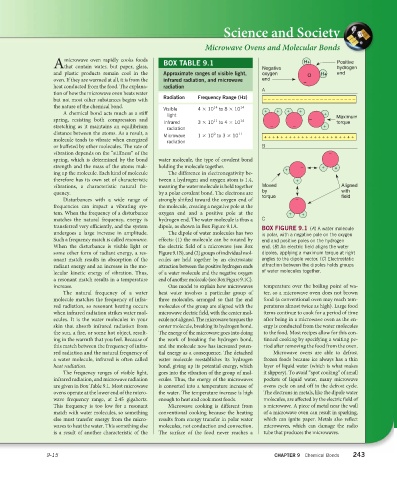
                          undergoes a large increase in amplitude.      The dipole of water molecules has two   is polar, with a negative pole on the oxygen
                          Such a frequency match is called resonance.   effects: (1) the molecule can be rotated by   end and positive poles on the hydrogen
                          When the disturbance is visible light or   the electric field of a microwave (see Box   end. (B) An electric field aligns the water
                          some other form of radiant energy, a res-    Figure 9.1B), and (2) groups of individual mol-  dipoles, applying a maximum torque at right
                          onant match results in absorption of the   ecules are held together by an electrostatic   angles to the dipole vector. (C) Electrostatic
                          radiant energy and an  increase in the mo-    attraction between the positive hydrogen ends   attraction between the dipoles holds groups
                          lecular kinetic energy of  vibration. Thus,   of a water molecule and the negative oxygen   of water molecules together.
                          a resonant match results in a temperature   end of another molecule (see Box Figure 9.1C).
                          increase.                             One model to explain how microwaves     temperature over the boiling point of wa-
                             The natural frequency of a water   heat water involves a particular group of   ter, so a microwave oven does not brown
                          molecule matches the frequency of infra-  three molecules, arranged so that the end   food (a conventional oven may reach tem-
                          red  radiation, so resonant heating occurs   molecules of the group are aligned with the   peratures almost twice as high). Large food
                          when infrared radiation strikes water mol-  microwave electric field, with the center mol-  items continue to cook for a period of time
                          ecules. It is the water molecules in your   ecule not aligned. The microwave torques the   after being in a microwave oven as the en-
                          skin that absorb infrared radiation from   center molecule, breaking its hydrogen bond.   ergy is conducted from the water molecules
                          the sun, a fire, or some hot object, result-  The energy of the microwave goes into  doing   to the food. Most recipes allow for this con-
                          ing in the warmth that you feel. Because of   the work of breaking the hydrogen bond,   tinued cooking by specifying a waiting pe-
                          this match between the frequency of infra-  and the molecule now has increased poten-  riod after removing the food from the oven.
                          red radiation and the natural frequency of   tial energy as a consequence. The detached      Microwave ovens are able to defrost
                          a water molecule, infrared is often called   water molecule reestablishes its hydrogen   frozen foods because ice always has a thin
                          heat radiation.                    bond, giving up its potential energy, which   layer of liquid water (which is what makes
                             The frequency ranges of visible light,   goes into the vibration of the group of mol-  it slippery). To avoid “spot cooking” of small
                          infrared radiation, and microwave radiation   ecules. Thus, the energy of the microwaves   pockets of liquid water, many microwave
                          are given in Box Table 9.1. Most microwave   is converted into a temperature increase of   ovens cycle on and off in the defrost cycle.
                          ovens operate at the lower end of the micro-  the  water. The temperature increase is high   The electrons in metals, like the dipole water
                          wave frequency range, at 2.45 gigahertz.   enough to heat and cook most foods.  molecules, are affected by the electric field of
                          This frequency is too low for a resonant      Microwave cooking is different from   a microwave. A piece of metal near the wall
                          match with water molecules, so something   conventional cooking because the heating   of a microwave oven can result in sparking,
                          else must transfer energy from the micro-  results from energy transfer in polar water   which can ignite paper. Metals also reflect
                          waves to heat the water. This something else   molecules, not conduction and convection.   microwaves, which can damage the radio
                          is a result of another characteristic of the   The surface of the food never reaches a   tube that produces the microwaves.


                       9-15                                                                        CHAPTER 9  Chemical Bonds   243

