


Page 265 - 9780077418427.pdf
P. 265
/Users/user-f465/Desktop
          tiL12214_ch09_229-250.indd Page 242  9/3/10  10:07 PM user-f465
          tiL12214_ch09_229-250.indd Page 242  9/3/10  10:07 PM user-f465                                               /Users/user-f465/Desktop


                      The crossover technique works because ionic bond-                               (OH) 1
                   ing results from a transfer of electrons, and the net charge is
                   conserved. A calcium ion has a 2+ charge because the atom               Mg 2
                   lost two electrons and two chlorine atoms gain one electron
                   each, for a total of two electrons gained. Two electrons lost                      (OH) 1
                   equals two electrons gained, and the net charge on calcium
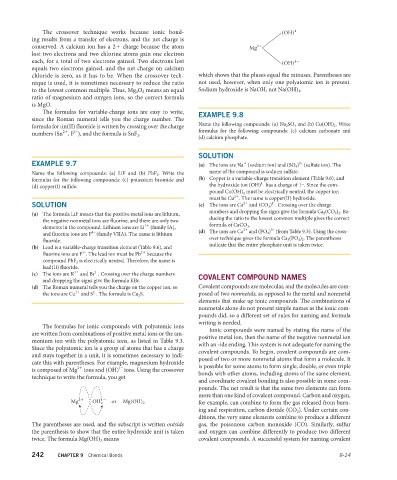
                   chloride is zero, as it has to be. When the crossover tech-  which shows that the pluses equal the minuses. Parentheses are
                   nique is used, it is sometimes necessary to reduce the ratio   not used, however, when only one polyatomic ion is present.
                   to the lowest common multiple. Thus, Mg 2 O 2  means an equal   Sodium hydroxide is NaOH, not Na(OH) 1 .
                     ratio of magnesium and oxygen ions, so the correct formula
                   is MgO.
                      The formulas for variable-charge ions are easy to write,   EXAMPLE 9.8
                   since the Roman numeral tells you the charge number. The
                                                                          Name the following compounds: (a) Na 2 SO 4  and (b) Cu(OH) 2 . Write
                     formula for tin(II) fluoride is written by crossing over the charge
                             2+  1–                                       formulas for the following compounds: (c) calcium carbonate and
                   numbers (Sn , F ), and the formula is SnF 2 .
                                                                          (d) calcium phosphate.
                                                                          SOLUTION
                                                                                                           2–
                                                                                         +
                   EXAMPLE 9.7                                            (a)  The ions are Na  (sodium ion) and (SO 4 )  (sulfate ion). The
                   Name the following compounds: (a) LiF and (b) PbF 2 . Write the   name of the compound is sodium sulfate.
                     formulas for the following compounds: (c) potassium bromide and   (b)  Copper is a variable-charge transition element (Table 9.6), and
                                                                                               1–
                   (d) copper(I) sulfide.                                     the hydroxide ion (OH)  has a charge of 1–. Since the com-
                                                                             pound Cu(OH) 2  must be electrically neutral, the  copper ion
                                                                                      2+
                                                                             must be Cu . The name is copper(II) hydroxide.
                                                                                         2+
                                                                                                  2–
                   SOLUTION                                               (c)  The ions are Ca  and (CO 3 ) . Crossing over the charge
                                                                               numbers and dropping the signs give the formula Ca 2 (CO 3 ) 2 . Re-
                   (a)  The formula LiF means that the positive metal ions are lithium,
                                                                             ducing the ratio to the lowest common multiple gives the  correct
                      the negative nonmetal ions are fluorine, and there are only two
                                                        1+                   formula of CaCO 3 .
                      elements in the compound. Lithium ions are Li  (family IA),                 3–
                                       1–                                 (d)  The ions are Ca 2+  and (PO 4 )  (from Table 9.3). Using the cross-
                      and fluorine ions are F  (family VIIA). The name is lithium
                                                                             over technique gives the formula Ca 3 (PO 4 ) 2 . The  parentheses
                       fluoride.
                                                                             indicate that the entire phosphate unit is taken twice.
                   (b)  Lead is a variable-charge transition element (Table 9.6), and
                                   1–                  2+
                      fluorine ions are F . The lead ion must be Pb  because the
                      compound PbF 2  is electrically neutral. Therefore, the name is
                      lead(II) fluoride.
                                 1+     1–
                   (c)  The ions are K  and Br . Crossing over the charge numbers   COVALENT COMPOUND NAMES
                      and dropping the signs give the formula KBr.
                   (d)  The Roman numeral tells you the charge on the copper ion, so   Covalent compounds are molecular, and the molecules are com-
                                 1+    2–
                      the ions are Cu  and S . The formula is Cu 2 S.     posed of two nonmetals, as opposed to the metal and nonmetal
                                                                          elements that make up ionic compounds. The combinations of
                                                                          nonmetals alone do not present simple names as the ionic com-
                                                                          pounds did, so a different set of rules for naming and formula
                                                                          writing is needed.
                      The formulas for ionic compounds with polyatomic ions
                                                                             Ionic compounds were named by stating the name of the
                   are written from combinations of positive metal ions or the am-
                                                                          positive metal ion, then the name of the negative nonmetal ion
                   monium ion with the polyatomic ions, as listed in Table 9.3.
                                                                          with an -ide ending. This system is not adequate for naming the
                   Since the polyatomic ion is a group of atoms that has a charge
                                                                          covalent compounds. To begin, covalent compounds are com-
                   and stays together in a unit, it is sometimes necessary to indi-
                                                                          posed of two or more nonmetal atoms that form a molecule. It
                   cate this with parentheses. For example, magnesium hydroxide
                                  2+            1–                        is possible for some atoms to form single, double, or even triple
                   is composed of Mg  ions and (OH)  ions. Using the crossover
                                                                          bonds with other atoms, including atoms of the same element,
                   technique to write the formula, you get
                                                                          and coordinate covalent bonding is also possible in some com-
                                                                          pounds. The net result is that the same two elements can form
                                                                          more than one kind of covalent compound. Carbon and oxygen,
                                Mg 2   OH 2 1   or  Mg(OH) 2              for example, can combine to form the gas released from burn-
                                                                          ing and respiration, carbon dioxide (CO 2 ). Under certain con-
                                                                          ditions, the very same elements combine to produce a different
                   The parentheses are used, and the subscript is written outside   gas, the poisonous  carbon monoxide (CO). Similarly, sulfur
                   the parenthesis to show that the entire hydroxide unit is taken   and oxygen can combine differently to produce two different
                   twice. The formula Mg(OH) 2  means                         covalent compounds. A successful system for naming covalent
                   242     CHAPTER 9 Chemical Bonds                                                                     9-14

