


Page 264 - 9780077418427.pdf
P. 264
/Users/user-f465/Desktop
          tiL12214_ch09_229-250.indd Page 241  9/3/10  10:07 PM user-f465
          tiL12214_ch09_229-250.indd Page 241  9/3/10  10:07 PM user-f465                                               /Users/user-f465/Desktop


                       IONIC COMPOUND NAMES                                       The metal hydroxides are named by identifying the
                       Ionic compounds formed by representative metal ions are   metal first and the term hydroxide second. Thus, NaOH is
                       named by stating first the name of the metal (positive ion),   named  sodium hydroxide and KOH is potassium hydroxide.
                       then the name of the nonmetal (negative ion). Ionic com-  The salts are similarly named, with the metal (or ammonium
                       pounds formed by variable-charge ions of the transition   ion) identified first, then the name of the polyatomic ion.
                       elements have an additional rule to identify which variable-  Thus, NaNO 3  is named sodium nitrate and NaNO 2  is sodium
                       charge ion is involved. There was an old way of identifying   nitrite. Note that the suffix -ate means the polyatomic ion
                       the charge on the ion by adding either -ic or -ous to the name   with one more oxygen atom than the -ite ion. For example,
                                                                                                                                –
                                                                                                     –
                       of the metal. The suffix -ic meant the higher of two possible   the chlorate ion is (ClO 3 )  and the chlorite ion is (ClO 2 ) .
                       charges, and the suffix -ous meant the lower of two possible   Sometimes more than two possibilities exist, and more oxy-
                       charges. For example, iron has two possible charges, 2+ or 3+.   gen atoms are  identified with the prefix per- and fewer with
                                                                                                                          –
                       The old system used the Latin name for the root. The Latin   the prefix hypo-. Thus, the perchlorate ion is (ClO 4 )  and the
                                                                                                    –
                       name for iron is ferrum, so a higher charged iron ion (3+) was   hypochlorite ion is (ClO) .
                       named a ferric ion. The lower charged iron ion (2+) was called
                       a  ferrous ion.
                           You still hear the old names sometimes, but chemists now   IONIC COMPOUND FORMULAS
                       have a better way to identify the variable-charge ion. The newer   The formulas for ionic compounds are easy to write. There are
                       system uses the English name of the metal with Roman numer-  two rules:
                       als in parentheses to indicate the charge number. Thus, an iron


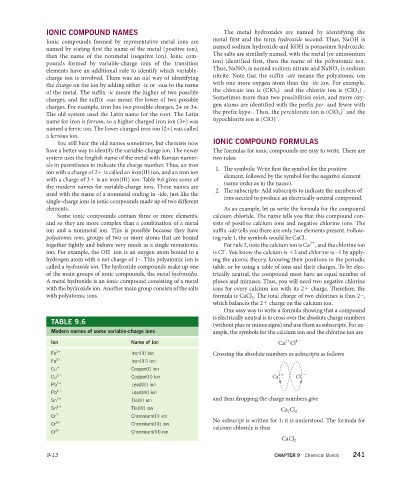
                       ion with a charge of 2+ is called an iron(II) ion, and an iron ion     1. The symbols: Write first the symbol for the positive
                       with a charge of 3+ is an iron(III) ion. Table 9.6 gives some of   element, followed by the symbol for the negative element
                       the modern names for variable-charge ions. These names are   (same order as in the name).

                       used with the name of a nonmetal ending in -ide, just like the     2.  The subscripts: Add subscripts to indicate the numbers of
                       single-charge ions in ionic compounds made up of two different   ions needed to produce an electrically neutral compound.
                       elements.                                                  As an example, let us write the formula for the compound
                           Some ionic compounds contain three or more elements,   calcium chloride. The name tells you that this compound con-
                       and so they are more complex than a combination of a metal   sists of positive calcium ions and negative chlorine ions. The
                       ion and a nonmetal ion. This is possible because they have   suffix -ide tells you there are only two elements present. Follow-
                       polyatomic ions, groups of two or more atoms that are bound   ing rule 1, the symbols would be CaCl.
                                                                                                               2+
                       together tightly and behave very much as a single monatomic      For rule 2, note the calcium ion is Ca , and the chlorine ion
                                             –
                                                                                  –
                       ion. For example, the OH  ion is an oxygen atom bound to a   is Cl . You know the calcium is +2 and chlorine is –1 by apply-
                       hydrogen atom with a net charge of 1–. This polyatomic ion is   ing the atomic theory, knowing their positions in the  periodic
                       called a  hydroxide ion. The hydroxide compounds make up one   table, or by using a table of ions and their charges. To be elec-
                       of the main groups of ionic compounds, the metal hydroxides.   trically neutral, the compound must have an equal number of
                       A metal hydroxide is an ionic compound consisting of a metal   pluses and minuses. Thus, you will need two negative chlorine
                       with the hydroxide ion. Another main group consists of the salts   ions for every calcium ion with its 2+ charge. Therefore, the
                       with polyatomic ions.                                   formula is CaCl 2 . The total charge of two chlorines is thus 2–,
                                                                               which balances the 2+ charge on the calcium ion.
                                                                                  One easy way to write a formula showing that a compound
                                                                               is electrically neutral is to cross over the absolute charge  numbers
                         TABLE 9.6
                                                                               (without plus or minus signs) and use them as subscripts. For ex-
                         Modern names of some variable-charge ions             ample, the symbols for the calcium ion and the chlorine ion are
                                                                                                       2+
                         Ion                        Name of Ion                                     Ca Cl 1–
                         Fe 2+                      Iron(II) ion               Crossing the absolute numbers as subscripts as follows
                         Fe 3+                      Iron(III) ion
                         Cu +                       Copper(I) ion
                         Cu 2+                      Copper(II) ion                                Ca 1 2   Cl 2 1
                         Pb 2+                      Lead(II) ion
                         Pb 4+                      Lead(IV) ion
                         Sn 2+                      Tin(II) ion                and then dropping the charge numbers give
                         Sn 4+                      Tin(IV) ion
                                                                                                     Ca 1 Cl 2
                         Cr 2+                      Chromium(II) ion
                                                                               No subscript is written for 1; it is understood. The formula for
                           3+
                         Cr                         Chromium(III) ion
                                                                               calcium chloride is thus
                         Cr 6+                      Chromium(VI) ion
                                                                                                      CaCl 2
                       9-13                                                                        CHAPTER 9  Chemical Bonds   241

