


Page 281 - 9780077418427.pdf
P. 281
/Users/user-f465/Desktop
          tiL12214_ch10_251-274.indd Page 258  9/3/10  6:11 PM user-f465
          tiL12214_ch10_251-274.indd Page 258  9/3/10  6:11 PM user-f465                                                /Users/user-f465/Desktop


                                                                          A second inventory shows
                                                                                 Reactants:  3 C
                                                                                           8 H
                                                                                           2 O
                                                                                 Products:   3 C
                                                                                           8 H (4 × 2 = 8)
                                                                                           10 O [(3 × 2) + (4 × 1) = 10]
                                                                          The O atoms are still unbalanced. Place a 5 in front of O 2 , and the equa-
                                                                          tion is balanced (5 × 2 = 10). Remember that you cannot change the
                                                                          subscripts and that oxygen occurs as a diatomic  molecule of O 2 .
                                                                                  C 3 H 8 ( g) + 5 O 2 ( g)  → 3 CO 2 ( g) + 4 H 2 O( g)
                                                                                                                    (balanced)
                                                                          Step 4:   Another inventory shows (a) the number of atoms on both
                                                                                 sides are now equal and (b) the coefficients are 1:5 → 3:4, the
                                                                                 lowest possible whole number ratio. The equation is balanced.


                                                                          EXAMPLE 10.6
                                                                          One type of water hardness is caused by the presence of calcium
                                                                            bicarbonate in solution, Ca(HCO 3 ) 2 . One way to remove the  troublesome
                                                                          calcium ions from wash water is to add washing soda, which is sodium
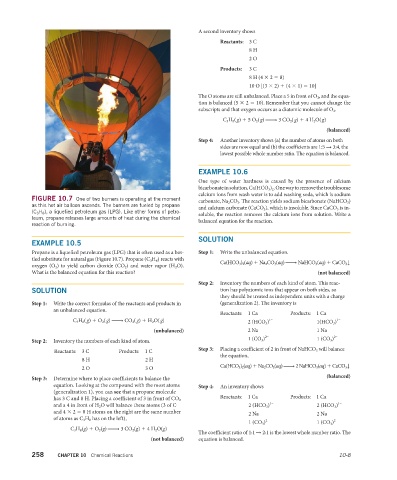
                     FIGURE 10.7  One of two burners is operating at the moment
                                                                          carbonate, Na 2 CO 3 . The reaction yields sodium  bicarbonate (NaHCO 3 )
                   as this hot air balloon ascends. The burners are fueled by propane   and calcium carbonate (CaCO 3 ), which is  insoluble. Since CaCO 3  is in-
                   (C 3 H 8 ), a liquefied petroleum gas (LPG). Like other forms of petro-
                                                                          soluble, the reaction removes the calcium ions from solution. Write a
                   leum, propane releases large amounts of heat during the chemical   balanced equation for the reaction.
                   reaction of burning.

                                                                          SOLUTION
                   EXAMPLE 10.5
                   Propane is a liquefied petroleum gas (LPG) that is often used as a bot-  Step 1:   Write the unbalanced equation.
                   tled substitute for natural gas (Figure 10.7). Propane (C 3 H 8 )  reacts with   Ca(HCO 3 ) 2 (aq) + Na 2 CO 3 (aq)  → NaHCO 3 (aq) + CaCO 3 ↓
                   oxygen (O 2 ) to yield carbon dioxide (CO 2 ) and water  vapor (H 2 O).
                   What is the balanced equation for this reaction?                                              (not balanced)

                                                                          Step 2:   Inventory the numbers of each kind of atom. This reac-
                   SOLUTION                                                      tion has polyatomic ions that appear on both sides, so
                                                                                 they should be treated as independent units with a charge
                   Step 1:   Write the correct formulas of the reactants and products in   (generalization 2). The  inventory is
                          an unbalanced equation.
                                                                                 Reactants:  1 Ca       Products:  1 Ca
                                 C 3 H 8 ( g) + O 2 ( g)  → CO 2 ( g) + H 2 O( g)         2 (HCO 3 ) 1–          1(HCO 3 ) 1–
                                                           (unbalanced)                   2 Na                   1 Na
                                                                                                2–                     2–
                                                                                          1 (CO 3 )              1 (CO 3 )
                   Step 2:   Inventory the numbers of each kind of atom.
                                                                          Step 3:   Placing a coefficient of 2 in front of NaHCO 3  will balance
                           Reactants:  3 C     Products:  1 C
                                                                                 the equation,
                                   8 H                  2 H
                                                                                 Ca(HCO 3 ) 2 (aq) + Na 2 CO 3 (aq)  → 2 NaHCO 3 (aq) + CaCO 3 ↓
                                   2 O                  3 O
                                                                                                                    (balanced)
                   Step 3:  Determine where to place coefficients to balance the
                          equation. Looking at the compound with the most atoms   Step 4:   An inventory shows
                           (generalization 1), you can see that a propane molecule
                          has 3 C and 8 H. Placing a coefficient of 3 in front of CO 2    Reactants:  1 Ca   Products:  1 Ca
                                                                                                 1–                     1–
                          and a 4 in front of H 2 O will balance these atoms (3 of C      2 (HCO 3 )             2 (HCO 3 )
                          and 4 × 2 = 8 H atoms on the right are the same number          2 Na                   2 Na
                          of atoms as C 3 H 8  has on the left),                                2–                     2–
                                                                                          1 (CO 3 )              1 (CO 3 )
                                C 3 H 8 (g) + O 2 (g)  → 3 CO 2 (g) + 4 H 2 O(g)
                                                                          The coefficient ratio of 1:1 → 2:1 is the lowest whole number ratio. The
                                                          (not balanced)   equation is balanced.

                   258     CHAPTER 10 Chemical Reactions                                                                10-8

