


Page 283 - 9780077418427.pdf
P. 283
/Users/user-f465/Desktop
          tiL12214_ch10_251-274.indd Page 260  9/3/10  6:11 PM user-f465
          tiL12214_ch10_251-274.indd Page 260  9/3/10  6:11 PM user-f465                                                /Users/user-f465/Desktop


                      Combustion is a rapid reaction with O 2  that releases   A reducing agent supplies electrons to the substance being
                   energy, usually with a flame. A very similar, although much slower   reduced. Hydrogen and carbon are commonly used reducing
                     reaction takes place in plant and animal respiration. In respira-  agents. Carbon is commonly used as a reducing agent to extract
                   tion, carbohydrates combine with O 2  and release energy used   metals from their ores. For example, carbon (from coke, which is
                   for biological activities. This reaction is slow compared to com-  coal that has been baked) reduces Fe 2 O 3 , an iron ore, in the reaction
                   bustion and requires enzymes to proceed at body temperature.
                                                                                  2 Fe 2 O 3 (s)   + 3 C(s)  → 4 Fe(s) + 3 CO 2 ↑
                   Nonetheless, CO 2  and H 2 O are the products.
                                                                          The Fe in the ore gained electrons from the carbon, the reduc-
                                                                          ing agent in this reaction.
                    10.3  TYPES OF CHEMICAL REACTIONS
                   The reactions involving hydrocarbons and carbohydrates with
                   oxygen are examples of an important group of chemical reac-   CONCEPTS Applied
                   tions called  oxidation-reduction reactions. Historically, when
                   the term oxidation was first used, it specifically meant reactions   Silver Polish
                     involving the combination of oxygen with other  atoms. But   Silverware and silver-plated objects often  become tarnished
                     fluorine, chlorine, and other nonmetals were soon understood   when the silver is oxidized by sulfur, forming Ag 2 S.
                   to have similar reactions to those of oxygen, so the definition was   Commercial  silver polishes often act by removing the
                   changed to one concerning the shifts of electrons in the  reaction.  oxidized layer with an abrasive. The silver can also be
                      An  oxidation-reduction reaction (or  redox reaction) is   polished by reducing the Ag 2 S back to metallic silver without
                   broadly defined as a reaction in which electrons are transferred   removing a layer. Place the tarnished silver in a clean
                   from one atom to another. As is implied by the name, such a re-  aluminum pan with about 80 g sodium bicarbonate
                                                                            (NaHCO 3 ) and 80 g NaCl dissolved in each liter of near-
                   action has two parts and each part tells you what happens to the
                                                                            boiling water. A sufficient amount should be  prepared to
                   electrons. Oxidation is the part of a redox reaction in which there
                                                                            cover the silver object or objects. The salts provide ions to
                   is a loss of electrons by an atom. Reduction is the part of a redox
                                                                            help transfer electrons and facilitate the reaction. The
                   reaction in which there is a gain of electrons by an atom. The name   reaction is
                   also implies that in any reaction in which oxidation occurs, reduc-
                                                                             3 Ag 2 S + 2 Al + 6 H 2 O  → 6 Ag + 2 Al(OH) 3  + 3 H 2 S
                   tion must take place, too. One cannot take place without the other.
                      Substances that take electrons from other substances are   (Note: H 2 S has a rotten egg odor.)
                   called oxidizing agents. Oxidizing agents take electrons from
                   the substances being oxidized. Oxygen is the most common
                     oxidizing agent, and several examples have already been given   Many chemical reactions can be classified as redox or non-
                   about how it oxidizes foods and fuels. Chlorine is another com-  redox reactions. Another way to classify chemical reactions is to
                   monly used oxidizing agent, often for the purposes of bleaching   consider what is happening to the reactants and products. This
                   or killing bacteria (Figure 10.9).                     type of classification scheme leads to four basic categories of
                                                                          chemical reactions, which are (1) combination, (2) decomposi-
                                                                          tion, (3) replacement, and (4) ion exchange reactions. The first
                                                                          three categories are subclasses of redox reactions. It is in the
                                                                          ion exchange reactions that you will find the first example of a
                                                                            reaction that is not a redox reaction.


                                                                          COMBINATION REACTIONS
                                                                          A combination reaction is a synthesis reaction in which two
                                                                          or more substances combine to form a single compound. The
                                                                          combining substances can be (1) elements, (2) compounds, or
                                                                          (3) combinations of elements and compounds. In generalized
                                                                          form, a combination reaction is
                                                                                             X + Y  → XY
                                                                             Many redox reactions are combination reactions. For ex-
                                                                          ample, metals are oxidized when they burn in air, forming
                                                                          a metal oxide. Consider magnesium, which gives off a bright
                                                                          white light as it burns:

                                                                                      2 Mg(s) + O 2 ( g)  → 2 MgO(s)
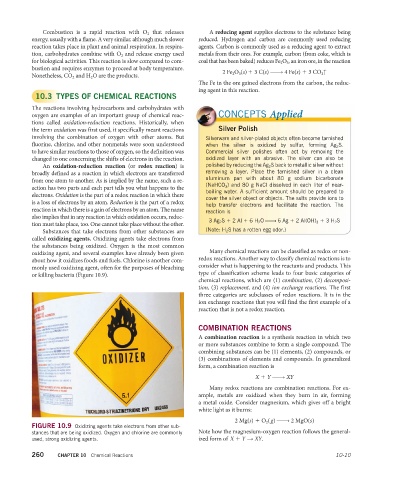
                   FIGURE 10.9  Oxidizing agents take electrons from other sub-
                   stances that are being oxidized. Oxygen and chlorine are commonly   Note how the magnesium-oxygen reaction follows the general-
                   used, strong oxidizing agents.                         ized form of X + Y → XY.

                   260     CHAPTER 10 Chemical Reactions                                                               10-10

