


Page 280 - 9780077418427.pdf
P. 280
/Users/user-f465/Desktop
          tiL12214_ch10_251-274.indd Page 257  9/3/10  6:11 PM user-f465
          tiL12214_ch10_251-274.indd Page 257  9/3/10  6:11 PM user-f465                                                /Users/user-f465/Desktop


                       Step 2:  Inventory the number of each kind of atom on both   Reaction:
                              sides of the unbalanced equation. In the example    Methane reacts with oxygen to yield
                              there are                                           carbon dioxide and water
                              Reactants:  1 C       Products:  1 C             Balanced equation:
                                                                                                CO 2  + 2    H 2 O
                                                                                  CH 4  + 2    O 2
                                        4 H                   2 H
                                        2 O                   3 O              Sketches representing molecules:

                       This shows that the H and O are unbalanced.
                                                                                            +                          +
                       Step 3:  Determine where to place coefficients in front of for-
                              mulas to balance the equation. It is often best to focus
                              on the simplest thing you can do with whole number
                              ratios. The H and the O are  unbalanced, for example,
                                                                               Meaning:
                              and there are 4 H atoms on the left and 2 H atoms on
                                                                                  1 molecule   2 molecules   1 molecule  2 molecules
                              the right. Placing a coefficient 2 in front of H 2 O will   of methane  +  of oxygen  of carbon  +  of water
                              balance the H atoms:                                                           dioxide
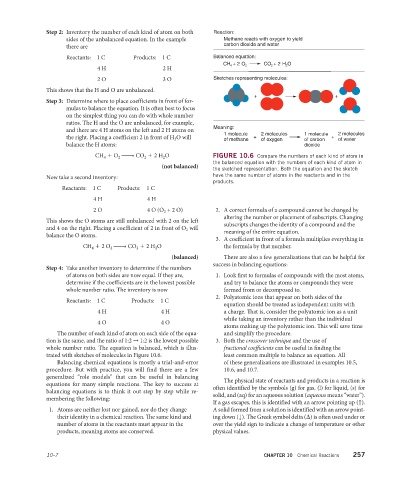
                                        CH 4  + O 2   → CO 2  + 2 H 2 O        FIGURE 10.6  Compare the numbers of each kind of atom in
                                                                               the balanced equation with the numbers of each kind of atom in
                                                              (not balanced)
                                                                               the sketched representation. Both the equation and the sketch
                       Now take a second inventory:                            have the same number of atoms in the reactants and in the
                                                                               products.
                             Reactants:  1 C   Products:  1 C
                                       4 H               4 H

                                       2 O               4 O (O 2  + 2 O)        2.  A correct formula of a compound cannot be changed by
                                                                                  altering the number or placement of subscripts. Changing
                       This shows the O atoms are still unbalanced with 2 on the left
                                                                                  subscripts changes the identity of a compound and the
                       and 4 on the right. Placing a coefficient of 2 in front of O 2  will
                                                                                  meaning of the  entire equation.
                       balance the O atoms.

                                                                                 3.  A coefficient in front of a formula multiplies everything in

                                    CH 4  + 2 O 2   → CO 2  + 2 H 2 O             the formula by that number.
                                                                 (balanced)       There are also a few generalizations that can be helpful for
                                                                               success in balancing equations:
                       Step 4:  Take another inventory to determine if the numbers

                              of atoms on both sides are now equal. If they are,     1.  Look first to formulas of compounds with the most atoms,
                              determine if the coefficients are in the lowest possible   and try to balance the atoms or compounds they were
                              whole number ratio. The inventory is now            formed from or decomposed to.
                                                                                 2.  Polyatomic ions that appear on both sides of the
                              Reactants:  1 C       Products:  1 C
                                                                                  equation should be treated as independent units with

                                         4 H                 4 H                  a charge. That is, consider the polyatomic ion as a unit
                                                                                  while taking an inventory rather than the individual
                                         4 O                 4 O

                                                                                  atoms making up the polyatomic ion. This will save time
                           The number of each kind of atom on each side of the equa-  and simplify the procedure.
                       tion is the same, and the ratio of 1:2 → 1:2 is the lowest possible     3.  Both the crossover technique and the use of
                       whole number ratio. The equation is balanced, which is illus-  fractional  coeffi  cients can be useful in fi nding the
                       trated with sketches of molecules in Figure 10.6.          least common multiple to balance an equation. All
                           Balancing chemical equations is mostly a trial-and-error   of these generalizations are illustrated in examples 10.5,
                       procedure. But with practice, you will find there are a few   10.6, and 10.7.
                       generalized “role models” that can be useful in balancing
                                                                                  The physical state of reactants and products in a reaction is
                       equations for many simple reactions. The key to success at
                                                                               often identified by the symbols (g) for gas, (l) for liquid, (s) for
                       balancing  equations is to think it out step by step while re-
                                                                               solid, and (aq) for an aqueous solution (aqueous means “water”).
                       membering the following:
                                                                               If a gas escapes, this is identified with an arrow pointing up (↑).
                         1.  Atoms are neither lost nor gained, nor do they change   A solid formed from a solution is identified with an arrow point-

                           their  identity in a chemical reaction. The same kind and   ing down (↓). The Greek symbol delta (Δ) is often used under or
                           number of atoms in the reactants must appear in the   over the yield sign to indicate a change of temperature or other
                           products, meaning atoms are conserved.              physical values.


                       10-7                                                                     CHAPTER 10  Chemical Reactions   257

