


Page 388 - 9780077418427.pdf
P. 388
/Users/user-f465/Desktop
          tiL12214_ch14_351-376.indd Page 365  9/3/10  6:16 PM user-f465
          tiL12214_ch14_351-376.indd Page 365  9/3/10  6:16 PM user-f465                                                /Users/user-f465/Desktop


                                                                                            A Closer Look


                                                                                           Redshift and Hubble’s Law

                             s described in chapter 5, the Doppler   ing toward the observer, a shift occurs in   the distance. Farther-away galaxies were
                          Aeffect tells us that the frequency of a   the spectral lines toward a higher frequency   moving away from the Milky Way, but
                          wave depends on the relative motion of the   (blueshift). If the star or galaxy is moving   galaxies that are more distant are mov-
                          source and the observer. When the source   away from the observer, a shift  occurs in   ing away faster than closer galaxies. This

                          and observer are moving toward each  other,   the spectral lines toward a lower frequency   proportional relationship  between galac-
                          the frequencies appear to be higher. If the   (redshift). Thus, a redshift or blueshift in   tic speed and distances was discovered
                          source and observer are moving apart,   the spectral lines will tell you if a star or   in 1929 by Hubble and today is know as
                          the frequency appears to be lower.  galaxy is moving toward or away from you.  Hubble’s law. The conclusion was that all
                             Light from a star or galaxy is changed   One of the first accurate measure-  the galaxies are moving away from one
                          by the Doppler effect, and the frequency of   ments of the distance to other galaxies   another, and an observer on any given
                          the observed spectral lines depends on the   was made by Edwin Hubble at Mount   galaxy would have the impression that
                          relative motion. The Doppler effect changes   Wilson Observatory in California. When   all galaxies were moving away in all di-
                          the frequency from what it would be if the   Hubble compared the distance figures   rections. In other words, the universe is
                          star or galaxy were motionless  relative to   with the observed  redshifts, he found that     expanding with component galaxies mov-
                          the observer. If the star or galaxy is mov-  the recession speeds were proportional to   ing farther and farther apart.


                                                                                  Among its many uses, the Hubble Space Telescope is used
                                                                               to study young galaxies and galaxies that are on collision courses.
                                                                               Based on these studies, astronomers today recognize that the dif-
                                                                               ferent shapes of galaxies do not represent an evolutionary sequence.
                                                                               The different shapes of galaxies are understood to be a result of
                                                                               the different conditions under which the galaxies were formed.
                                                                                  The current model of how galaxies form is based on the
                                                                               big bang theory of the creation of the universe. The big bang
                                                                               theory considers the universe to have had an explosive begin-
                                                                               ning.  According to this theory, all matter in the universe was
                                                                               located  together in an arbitrarily dense state from which it be-
                                                                               gan to  expand, an expansion that continues today. Evidence
                                                                               that  supports the big bang theory comes from (1) present-day
                                                                                 microwave radiation from outer space, (2) current data on the
                                                                               expansion of the universe, (3) the relative abundance of  elements
                                                                               that were altered in the core of older stars—this agrees with pre-
                                                                               dictions based on analysis of the big bang, and (4) the Cosmic
                                                                               Background  Explorer (COBE) spacecraft, which studied diffuse
                                                                               cosmic background radiation to help answer such  questions as
                                                                               how matter is distributed in the universe, whether the universe is
                                                                               uniformly expanding, and how and when galaxies first formed.
                                                                                  The 2003 results from NASA’s orbiting Wilkinson  Microwave
                                                                               Anisotropy Probe  (WMAP)  produced a precision map of the
                                                                                 remaining cosmic microwave background from the big bang.
                                                                               WMAP surveyed the entire sky for a whole year with a reso-
                                                                               lution some 40 times greater than that of COBE. Analysis of
                                                                               WMAP data  revealed that the universe is 13.7 billion years old,
                                                                               with 1 percent margin of error. The WMAP data found strong
                                                                               support for the big bang and expanding universe theories. It
                                                                               also  revealed that the contents of the  universe include 4 percent
                                                                                 ordinary matter, 23 percent of an unknown type of dark matter,
                                                                               and 73 percent of a mysterious dark energy.
                                                                                  The initial evidence for the big bang theory came from
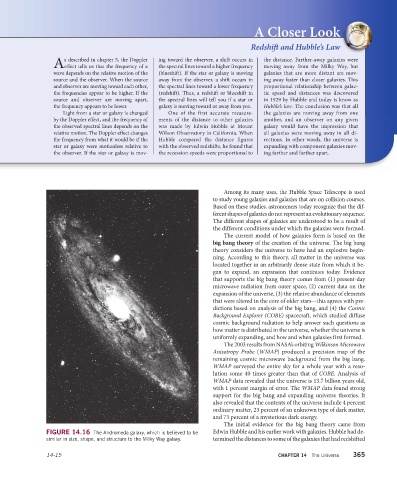
                       FIGURE 14.16  The Andromeda galaxy, which is believed to be     Edwin Hubble and his earlier work with galaxies. Hubble had de-
                       similar in size, shape, and structure to the Milky Way galaxy.  termined the distances to some of the galaxies that had  redshifted

                       14-15                                                                        CHAPTER 14  The Universe   365

