


Page 383 - 9780077418427.pdf
P. 383
/Users/user-f465/Desktop
          tiL12214_ch14_351-376.indd Page 360  9/3/10  6:16 PM user-f465
          tiL12214_ch14_351-376.indd Page 360  9/3/10  6:16 PM user-f465                                                /Users/user-f465/Desktop


                       –8
                       –6                                5        3
                       –4
                       –2 0                        4     2
                    Absolute magnitude  +2               1

                       +4
                       +6
                       +8
                      +10
                      +12
                      +14
                      +16

                          O      B      A      F     G      K      M
                                     Hotter stars  Cooler stars

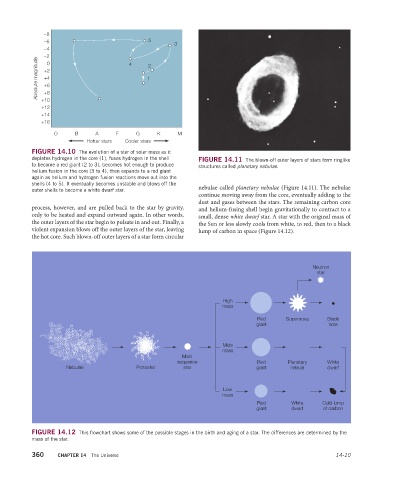
                   FIGURE 14.10  The evolution of a star of solar mass as it
                   depletes hydrogen in the core (1), fuses hydrogen in the shell   FIGURE 14.11  The blown-off outer layers of stars form ringlike
                   to become a red giant (2 to 3), becomes hot enough to produce   structures called planetary nebulae.
                   helium fusion in the core (3 to 4), then expands to a red giant
                   again as helium and hydrogen fusion reactions move out into the
                   shells (4 to 5). It eventually becomes unstable and blows off the
                                                                          nebulae called planetary nebulae (Figure 14.11). The nebulae
                   outer shells to become a white dwarf star.
                                                                          continue moving away from the core, eventually adding to the
                                                                          dust and gases between the stars. The remaining carbon core
                     process,  however, and are pulled back to the star by gravity,   and helium-fusing shell begin gravitationally to contract to a
                   only to be heated and expand outward again. In other words,   small, dense white dwarf star. A star with the original mass of
                   the outer layers of the star begin to pulsate in and out. Finally, a   the Sun or less slowly cools from white, to red, then to a black
                   violent expansion blows off the outer layers of the star, leaving   lump of carbon in space (Figure 14.12).
                   the hot core. Such blown-off outer layers of a star form circular


                                                                                                                Neutron
                                                                                                                 star


                                                                                  High
                                                                                  mass

                                                                                             Red       Supernova     Black
                                                                                             giant                   hole


                                                                                  Mids
                                                                                  mass
                                                                     Main
                                                                   sequence                  Red       Planetary     White
                              Nebulae                Protostar       star                    giant      nebula       dwarf


                                                                                  Low
                                                                                  mass
                                                                                             Red         White     Cold lump
                                                                                             giant       dwarf     of carbon


                   FIGURE 14.12  This flowchart shows some of the possible stages in the birth and aging of a star. The differences are determined by the
                   mass of the star.

                   360     CHAPTER 14 The Universe                                                                     14-10

