


Page 389 - 9780077418427.pdf
P. 389
/Users/user-f465/Desktop
          tiL12214_ch14_351-376.indd Page 366  9/3/10  6:16 PM user-f465
          tiL12214_ch14_351-376.indd Page 366  9/3/10  6:16 PM user-f465                                                /Users/user-f465/Desktop


                   spectra. From this expansive redshift, it was known that these   How old is the universe? As mentioned earlier, astronomical
                   galaxies were moving away from the Milky Way.  Hubble found a   and physical “clocks” indicate that the universe formed in a “big
                   relationship between the distance to a galaxy and the velocity   bang” some 13.7 billion years ago, expanding as an  intense and
                   with which it was moving away. He found the velocity to be   brilliant explosion from a primeval fireball with a temperature of
                                                                                 12
                     directly proportional to the distance; that is, the greater the   some 10   kelvins. This estimate of the age is based on precise
                     distance to a galaxy, the greater the velocity. This means that   measurements of the rate at which galaxies are moving apart, an
                   a galaxy twice as far from the Milky Way as a second galaxy   expansion that started with the big bang.  Astronomers used data
                   is moving away from the Milky Way at twice the speed as the   on the expansion to back-calculate the age, much like running a
                     second galaxy. Since this relationship was seen in all directions, it   movie backward, to arrive at the age  estimate. At first, this tech-
                   meant that the universe is expanding uniformly. The same effect   nique found that the universe was about 18 to 20 billion years old.
                   would be viewed from any particular galaxy; that is, all the other   But then astronomers found that the universe is not expanding at
                   galaxies are moving away with a velocity proportional to the dis-  a constant rate. Instead, the separation of galaxies is  actually ac-
                   tance to the other galaxies. This points to a common beginning,   celerating, pushed by a  mysterious force known as “dark energy.”
                   a time when all matter in the universe was together.   By adding in calculations for this poorly  understood force, the
                                                                          estimate of 13 to  14 billion years was developed.
                                                                             Other age-estimating techniques agree with this ballpark
                         Myths, Mistakes, & Misunderstandings             age. Studies of white dwarfs, for example, established their
                                                                          rate of cooling. By looking at the very faintest and oldest white
                     Hello, Enterprise?                                   dwarfs with the Hubble Space Telescope, astronomers were
                                                                          able to use the cooling rate to estimate the age of the uni-
                     It is a myth that spaceships could have instant two-way commu-  verse. The result found the dimmest of the white dwarfs to be
                     nication. Radio waves travel at the speed of light, but distances in
                     space are huge. The table below gives the approximate time re-  about 13 billion years old, plus or minus about one-half bil-
                     quired for a radio signal to travel from Earth to the planet or place.   lion years. More recently, data from the orbiting WMAP space-
                     Two-way communication would require twice the time listed.  craft has produced a precision map of the cosmic microwave
                                                                            background that shows the universe to be 13.7 billion years old.
                       Mars                     4.3 min                   An age of 13.7 billion years may not be the final answer for the
                                                                          age of the universe, but when three independent  measurement
                       Jupiter                  35 min
                                                                          techniques agree closely, the answer becomes more believable.
                       Saturn                   1.2 h
                                                                             An often used analogy for the movement of galaxies after
                       Uranus                   2.6 h
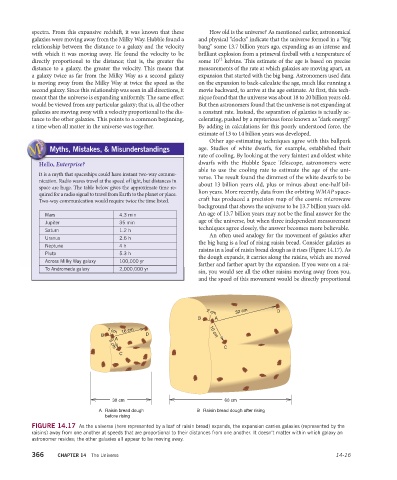
                                                                          the big bang is a loaf of rising raisin bread. Consider galaxies as
                       Neptune                  4 h
                                                                          raisins in a loaf of raisin bread dough as it rises (Figure 14.17). As
                       Pluto                    5.3 h
                                                                          the dough expands, it carries along the raisins, which are moved
                       Across Milky Way galaxy  100,000 yr
                                                                          farther and farther apart by the expansion. If you were on a rai-
                       To Andromeda galaxy      2,000,000 yr
                                                                          sin, you would see all the other raisins moving away from you,
                                                                          and the speed of this movement would be directly proportional

                                                                                      32 cm         D
                                                                             2 cm
                                                                          B    A

                                            1 cm  16 cm                       10 cm
                                          B             D
                                              A
                                                                                  C
                                            5 cm
                                                C                               1 cm  16 cm

                                                                                 5 cm


                                             30 cm                                 60 cm
                                         A Raisin bread dough            B Raisin bread dough after rising
                                           before rising
                   FIGURE 14.17  As the universe (here represented by a loaf of raisin bread) expands, the expansion carries galaxies (represented by the
                   raisins) away from one another at speeds that are proportional to their distances from one another. It doesn’t matter within which galaxy an
                   astronomer resides; the other galaxies all appear to be moving away.

                   366     CHAPTER 14 The Universe                                                                     14-16

