


Page 392 - 9780077418427.pdf
P. 392
/Users/user-f465/Desktop
          tiL12214_ch14_351-376.indd Page 369  9/3/10  6:16 PM user-f465
          tiL12214_ch14_351-376.indd Page 369  9/3/10  6:16 PM user-f465                                                /Users/user-f465/Desktop


                                                                     People Behind the Science


                                                                               Jocelyn (Susan) Bell Burnell (1943– )

                            ocelyn Bell is a British astronomer   Milton Keynes, United Kingdom. A winner   of the signal showed that it was in fact com-
                          Jwho discovered pulsating radio stars—   of the Royal Astronomical Society's presti-  posed of a rapid set of pulses that occurred
                          pulsars—an important astronomical dis-  gious Herschel medal (1989), she has made   precisely every 1.337 seconds. The pulsed
                          covery of the 1960s.               significant contributions in the fields of     signal was as regular as the most regular
                             Bell was born in Belfast, Ireland, on   X-ray and gamma-ray astronomy.  clock on the earth.
                          July 15, 1943. The Armagh Observatory,   She spent her first two years in Cam-  One attempted explanation of this cu-
                          of which her father was architect, was sited   bridge building a radio telescope that was   rious phenomenon was that it represented
                          near her home, and the staff there were par-  specially designed to track quasars—her   an interstellar beacon sent out by extra -
                          ticularly helpful and offered encouragement   Ph.D. research topic. The telescope that she   terrestrial life on another star, so initially it
                          when they learned of her early interest in   and her team built had the ability to record   was nicknamed LGM, for “little green men.”
                            astronomy. From 1956 to 1961, she attended   rapid variations in signals. It was also nearly   Within a few months of noticing this signal,
                          the Mount School in York, England. She then   2 hectares (about 5 acres) in area, equivalent   however, Bell located three other similar
                          went to the University of Glasgow, receiving   to a dish of 150 m (about 500 ft) in diameter,   sources. They too pulsed at an extremely
                          her B.Sc. degree in 1965. In the summer of   making it an extremely sensitive instrument.   regular rate, but their periods varied over
                          1965, she began to work for her Ph.D. un-  The sky survey began when the telescope   a few fractions of a second, and they all
                          der the supervision of Anthony Hewish at   was finally completed in 1967, and Bell was   originated from widely spaced locations
                          the University of Cambridge. It was during   given the task of analyzing the signals re-  in our galaxy. Thus, it seemed that a more
                          the course of this work that the discovery   ceived. One day, while scanning the charts   likely  explanation of the signals was that
                          of  pulsars was made. Having completed her   of recorded signals, she noticed a rather un-  they were being emitted by a special kind of
                          doctorate at Cambridge, she went on to work   usual radio source that had occurred during   star—a pulsar.
                          in gamma-ray astronomy at the University   the night and had been picked up in a part of   Since the astonishing discovery was an-
                          of Southampton, and from 1974 to 1982, she   the sky that was opposite in direction to the   nounced, other observatories have searched
                          worked at the Mullard Space Science Labora-  sun. This was curious because strong varia-  the heavens for new pulsars. Some 300 are
                          tory in X-ray astronomy. In 1982, she was ap-  tions in the signals from quasars are caused   now known to exist, their periods ranging
                          pointed a senior research fellow at the Royal   by solar wind and are usually weak during   from hundredths of a second to 4 seconds. It
                          Observatory, Edinburgh, where she worked   the night. At first, she thought that the signal   is thought that neutron stars are  responsible
                          on infrared and optical astronomy. She was   might be due to a local interference. After   for the signal. These are tiny stars, only
                          head of the James Clark Maxwell Telescope   a month of further observations, it became   about 7 km (about 4.3 mi) in  diameter, but
                          section, responsible for the British end of the   clear that the position of the peculiar signals   they are incredibly massive. The whole star
                          telescope project based in Hawaii. In 1991,   remained fixed with respect to the stars,   and its associated magnetic field are spin-
                          she was appointed professor of physics and     indicating that it was neither terrestrial nor   ning at a rapid rate, and the  rotation pro-
                          departmental chair at the Open University,   solar in origin. A more detailed examination   duces the pulsed signal.


                       Source: From the Hutchinson Dictionary of Scientific Biography. © Research Machines plc 2003. All Rights Reserved. Helicon Publishing is a division of Research  Machines.


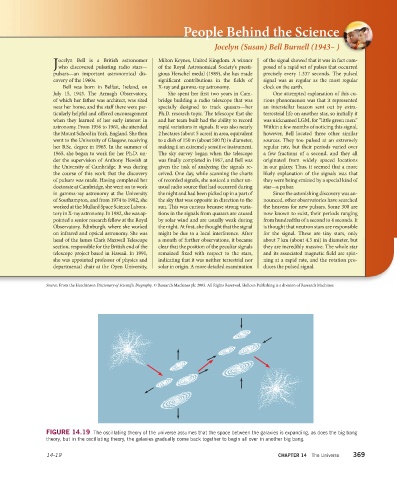
                       FIGURE 14.19  The oscillating theory of the universe assumes that the space between the galaxies is expanding, as does the big bang
                       theory, but in the oscillating theory, the galaxies gradually come back together to begin all over in another big bang.

                       14-19                                                                        CHAPTER 14  The Universe   369

