


Page 385 - 9780077418427.pdf
P. 385
/Users/user-f465/Desktop
          tiL12214_ch14_351-376.indd Page 362  9/3/10  6:16 PM user-f465
          tiL12214_ch14_351-376.indd Page 362  9/3/10  6:16 PM user-f465                                                /Users/user-f465/Desktop


                                                                          see more galaxies than individual stars in any direction, each
                                       Rotation axis     Beamed
                                                         radiation        galaxy with its own structure of billions of stars. Yet there are
                                                                          similarities that point to a common origin. Some of the similari-
                                             +  –
                      Magnetic                                            ties and associations of stars will be introduced in this section
                      field lines                                         along with the Milky Way galaxy, the vast, flat, spiraling arms
                                                                          of stars, gas, and dust where the Sun is  located (Figure 14.14).
                                                         Magnetic axis
                                                            +
                                                    +
                                                      +                   THE MILKY WAY GALAXY
                                                                          Away from city lights, you can clearly see the faint, luminous
                                                                          band of the Milky Way galaxy on a moonless night. Through a
                                          ticles
                                                                          telescope or a good pair of binoculars, you can see that the lu-
                                                                          minous band is made up of countless numbers of stars. You may
                              –                                           also be able to see the faint glow of nebulae: concentrations of gas
                             –                                            and dust. There are dark regions in the Milky Way that also give
                               +
                                                                          an impression of something blocking starlight, such as dust. You
                                       +                                  can also see small groups of stars called galactic clusters. Galactic
                                            –
                                         –                                  clusters are gravitationally bound subgroups of as many as
                                                                          1,000 stars that move together within the Milky Way. Other
                                                                          clusters are more symmetrical and tightly packed, containing as
                                          Energetic
                                          charged particles               many as a million stars, and are known as globular clusters.
                                                                             Viewed from a distance in space, the Milky Way would
                                                                            appear to be a huge, flattened cloud of spiral arms radiating out
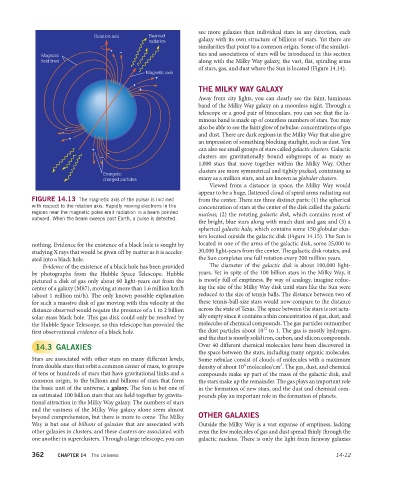
                   FIGURE 14.13  The magnetic axis of the pulsar is inclined   from the center. There are three distinct parts: (1) the spherical
                   with respect to the rotation axis. Rapidly moving electrons in the   concentration of stars at the center of the disk called the galactic
                   regions near the magnetic poles emit radiation in a beam pointed
                                                                          nucleus; (2) the rotating galactic disk, which contains most of
                   outward. When the beam sweeps past Earth, a pulse is detected.
                                                                          the bright, blue stars along with much dust and gas; and (3) a
                                                                          spherical galactic halo, which contains some 150 globular clus-
                                                                          ters located outside the galactic disk (Figure 14.15). The Sun is
                   nothing.  Evidence for the existence of a black hole is sought by   located in one of the arms of the galactic disk, some 25,000 to
                   studying X rays that would be given off by matter as it is acceler-  30,000 light-years from the center. The galactic disk rotates, and
                   ated into a black hole.                                the Sun completes one full rotation every 200 million years.
                      Evidence of the existence of a black hole has been provided   The diameter of the  galactic disk is about 100,000 light-
                   by photographs from the Hubble Space Telescope. Hubble   years. Yet in spite of the 100 billion stars in the Milky Way, it
                     pictured a disk of gas only about 60 light-years out from the   is mostly full of emptiness. By way of analogy, imagine reduc-
                   center of a galaxy (M87), moving at more than 1.6 million km/h   ing the size of the Milky Way disk until stars like the Sun were
                   (about 1 million mi/h). The only known possible explanation   reduced to the size of tennis balls. The distance between two of
                   for such a massive disk of gas moving with this velocity at the   these tennis-ball-size stars would now compare to the distance
                   distance observed would require the presence of a 1 to 2 billion   across the state of Texas. The space between the stars is not actu-
                   solar-mass black hole. This gas disk could only be resolved by   ally empty since it contains a thin concentration of gas, dust, and
                   the Hubble Space Telescope, so this telescope has provided the   molecules of chemical compounds. The gas particles outnumber
                                                                                               12
                   first observational evidence of a black hole.          the dust  particles about 10  to 1. The gas is mostly hydrogen,
                                                                          and the dust is mostly solid iron, carbon, and silicon compounds.
                    14.3 GALAXIES                                         Over 40 different chemical molecules have been discovered in
                                                                          the space between the stars, including many organic molecules.
                   Stars are associated with other stars on many different levels,   Some  nebulae consist of clouds of molecules with a maximum
                                                                                         6
                                                                                                     3
                   from double stars that orbit a common center of mass, to groups   density of about 10  molecules/cm . The gas, dust, and chemical
                   of tens or hundreds of stars that have gravitational links and a   compounds make up part of the mass of the galactic disk, and
                   common origin, to the billions and billions of stars that form   the stars make up the remainder. The gas plays an important role
                   the basic unit of the universe, a galaxy. The Sun is but one of   in the formation of new stars, and the dust and chemical com-
                   an estimated 100 billion stars that are held together by gravita-  pounds play an important role in the formation of  planets.
                   tional attraction in the Milky Way galaxy. The  numbers of stars
                   and the vastness of the Milky Way galaxy alone seem  almost
                   beyond comprehension, but there is more to come. The Milky   OTHER GALAXIES
                   Way is but one of billions of galaxies that are associated with   Outside the Milky Way is a vast expanse of emptiness, lacking
                   other galaxies in clusters, and these clusters are associated with   even the few molecules of gas and dust spread thinly through the
                   one  another in superclusters. Through a large telescope, you can   galactic nucleus. There is only the light from faraway galaxies

                   362     CHAPTER 14 The Universe                                                                     14-12

