


Page 397 - 9780077418427.pdf
P. 397
/Users/user-f465/Desktop
          tiL12214_ch14_351-376.indd Page 374  9/3/10  6:16 PM user-f465
          tiL12214_ch14_351-376.indd Page 374  9/3/10  6:16 PM user-f465                                                /Users/user-f465/Desktop


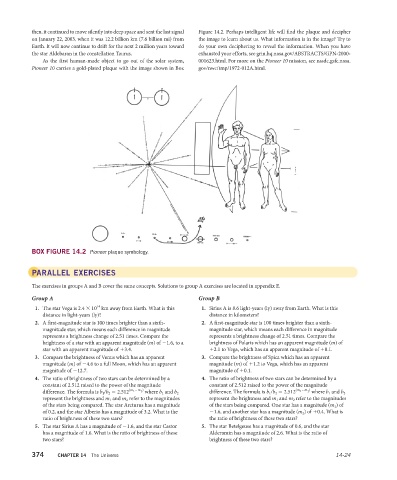
                   then, it continued to move silently into deep space and sent the last signal   Figure 14.2. Perhaps intelligent life will find the plaque and decipher
                   on January 22, 2003, when it was 12.2 billion km (7.6  billion mi) from   the image to learn about us. What information is in the image? Try to
                   Earth. It will now continue to drift for the next 2 million years toward   do your own deciphering to reveal the information. When you have
                   the star Aldebaran in the constellation Taurus.          exhausted your efforts, see grin.hq.nasa.gov/ABSTRACTS/GPN-2000-
                      As the first human-made object to go out of the solar system,   001623.html. For more on the Pioneer 10 mission, see nssdc.gsfc.nasa.
                     Pioneer 10 carries a gold-plated plaque with the image shown in Box   gov/nwc/tmp/1972-012A.html.


                   BOX FIGURE 14.2  Pioneer plaque symbology.


                       PARALLEL EXERCISES

                   The exercises in groups A and B cover the same concepts. Solutions to group A exercises are located in appendix E.

                   Group A                                                Group B
                                        14
                     1.  The star Vega is 2.4 × 10  km away from Earth. What is this     1.  Sirius A is 8.6 light-years (ly) away from Earth. What is this
                      distance in light-years (ly)?                          distance in kilometers?
                     2.  A first-magnitude star is 100 times brighter than a sixth-    2.  A first-magnitude star is 100 times brighter than a sixth-
                      magnitude star, which means each difference in magnitude   magnitude star, which means each difference in magnitude
                      represents a brightness change of 2.51 times. Compare the   represents a brightness change of 2.51 times. Compare the
                      brightness of a star with an apparent magnitude (m) of −1.6, to a   brightness of Polaris which has an apparent magnitude (m) of
                      star with an apparent magnitude of +3.4.               +2.1 to Vega, which has an apparent magnitude of +0.1.
                     3.  Compare the brightness of Venus which has an apparent     3.  Compare the brightness of Spica which has an apparent
                      magnitude (m) of −4.6 to a full Moon, which has an apparent   magnitude (m) of +1.2 to Vega, which has an apparent
                      magnitude of −12.7.                                    magnitude of +0.1.
                     4.  The ratio of brightness of two stars can be determined by a     4.  The ratio of brightness of two stars can be determined by a
                      constant of 2.512 raised to the power of the magnitude   constant of 2.512 raised to the power of the magnitude
                                                                                                              1  where b 1  and b 2
                                                       1  where b 1  and b 2
                      difference. The formula is  b 1 /b 2  = 2.512 (m 2  – m )  difference. The formula is  b 1 /b 2  = 2.512 (m 2  – m )
                      represent the brightness and m 1  and m 2  refer to the magnitudes   represent the brightness and m 1  and m 2  refer to the magnitudes
                      of the stars being compared. The star Arcturus has a magnitude   of the stars being compared. One star has a magnitude (m 1 ) of
                      of 0.2, and the star Alberio has a magnitude of 3.2. What is the   −1.6, and another star has a magnitude (m 2 ) of +0.4. What is
                      ratio of brightness of these two stars?                 the ratio of brightness of these two stars?
                     5.  The star Sirius A has a magnitude of −1.6, and the star Castor     5.  The star Betelgeuse has a magnitude of 0.6, and the star
                      has a magnitude of 1.6. What is the ratio of brightness of these   Alderamin has a magnitude of 2.6. What is the ratio of
                      two stars?                                              brightness of these two stars?

                   374     CHAPTER 14 The Universe                                                                     14-24

