


Page 402 - 9780077418427.pdf
P. 402
/Users/user-f465/Desktop
          tiL12214_ch15_377-404.indd Page 379  9/3/10  6:17 PM user-f465
          tiL12214_ch15_377-404.indd Page 379  9/3/10  6:17 PM user-f465                                                /Users/user-f465/Desktop


                                                                               of hydrogen, helium, and methane. The density of the giant plan-
                                                                               ets suggests the presence of rocky materials and iron as a core
                                                                               surrounded by a deep layer of compressed gases beneath a deep
                                                                               atmosphere of vapors and gases. Note that the terrestrial planets
                                                                               are separated from the giant planets by the asteroid belt.
                                                                                  We will start with the planet closest to the Sun and work
                                                                               our way outward, moving farther and farther from the Sun as
                                                                               we learn about our solar system.


                                                                               MERCURY
                                                                               Mercury is the innermost planet, moving rapidly in a highly el-
                                                                               liptical orbit that averages about 0.4 astronomical unit, or about
                                                                               0.4 of the average distance of Earth from the Sun. Mercury is
                                                                               the smallest planet and is slightly larger than Earth’s Moon.
                                                                               Mercury is very bright because it is so close to the Sun, but it
                                                                               is difficult to observe because it only appears briefly for a few
                                                                               hours immediately after sunset or before sunrise. This appear-
                                                                               ance, low on the horizon, means that Mercury must be viewed
                                                                               through more of Earth’s atmosphere, making the study of such a
                                                                               small object difficult at best (Figure 15.3).
                                                                                  Mercury moves around the Sun in about three Earth
                                                                               months, giving Mercury the shortest “year” of all the planets.
                                                                               With the highest orbital velocity of all the planets, Mercury
                                                                               was appropriately named after the mythical Roman messenger
                                                                               of speed. Oddly, however, this speedy planet has a rather long
                                                                               day in spite of its very short year. With respect to the stars,
                                                                               Mercury rotates once every 59 days. This means that Mercury
                                                                               rotates on its axis three times every two orbits.
                                                                                  The long Mercury day with a nearby large, hot Sun
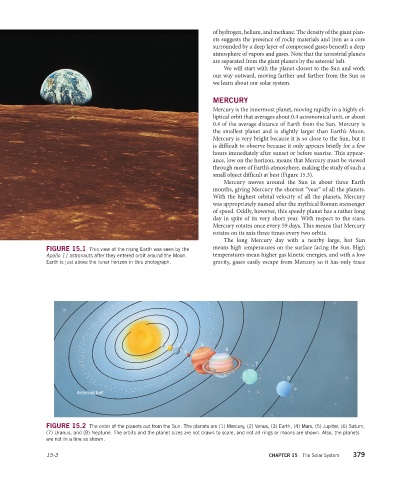
                       FIGURE 15.1  This view of the rising Earth was seen by the   means high temperatures on the surface facing the Sun. High
                       Apollo 11 astronauts after they entered orbit around the Moon.   temperatures mean higher gas kinetic energies, and with a low
                       Earth is just above the lunar horizon in this photograph.  gravity, gases easily escape from Mercury so it has only trace


                                                              1  2
                                                                   3       5
                                                                                   6
                                                                     4
                                                                                             7

                                                                                                       8

                                  Asteroid belt


                       FIGURE 15.2  The order of the planets out from the Sun. The planets are (1) Mercury, (2) Venus, (3) Earth, (4) Mars, (5) Jupiter, (6) Saturn,
                        (7) Uranus, and (8) Neptune. The orbits and the planet sizes are not drawn to scale, and not all rings or moons are shown. Also, the planets
                        are not in a line as shown.

                       15-3                                                                      CHAPTER 15  The Solar System   379

