


Page 42 - 9780077418427.pdf
P. 42
/Users/user-f465/Desktop
          tiL12214_ch01_001-024.indd Page 19  9/1/10  9:51 PM user-f465
          tiL12214_ch01_001-024.indd Page 19  9/1/10  9:51 PM user-f465                                                 /Users/user-f465/Desktop


                         150   120   90   60    30   0     30   60    90          The most recently developed scientific theory was refined
                                                                               and expanded during the 1970s. This theory concerns the sur-
                                                                               face of Earth, and it has changed our model of what Earth is
                         60
                                                                               like. At first, the basic idea of today’s accepted theory was pure
                                                                               and simple conjecture. The term conjecture usually means an
                                                                               explanation or idea based on speculation, or one based on triv-
                                                                               ial grounds without any real evidence. Scientists would look at
                         30
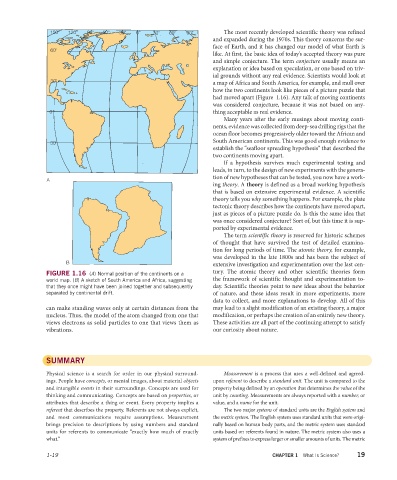
                                                                               a map of Africa and South America, for example, and mull over
                                                                               how the two continents look like pieces of a picture puzzle that
                                                                               had moved apart (Fig ure  1.16). Any talk of moving continents
                                                                               was considered conjecture, because it was not based on any-
                         0                                                     thing acceptable as real  evidence.
                                                                                  Many years after the early musings about moving conti-
                                                                               nents, evidence was collected from deep-sea drilling rigs that the
                                                                               ocean floor becomes progressively older toward the  African and
                                                                               South American continents. This was good enough  evidence to
                         30
                                                                               establish the “seafloor spreading hypothesis” that described the
                                                                               two continents moving apart.
                                                                                  If a hypothesis survives much experimental testing and
                                                                               leads, in turn, to the design of new experiments with the genera-
                                                                               tion of new hypotheses that can be tested, you now have a work-
                        A
                                                                               ing theory. A theory is defined as a broad working hypothesis
                                                                               that is based on extensive experimental evidence. A scientific
                                                                               theory tells you why something happens. For example, the plate
                                                                               tectonic theory describes how the continents have moved apart,
                                                                               just as pieces of a picture puzzle do. Is this the same idea that
                                                                               was once considered conjecture? Sort of, but this time it is sup-
                                                                               ported by experimental evidence.
                                                                                  The term scientific theory is reserved for historic schemes
                                                                               of thought that have survived the test of detailed examina-
                                                                               tion  for long periods of time. The atomic theory, for example,
                                                                               was  developed in the late 1800s and has been the subject of
                              B
                                                                               extensive  investigation and experimentation over the last cen-
                                                                               tury. The atomic theory and other scientific theories  form
                       FIGURE 1.16  (A) Normal position of the continents on a
                       world map. (B) A sketch of South America and Africa, suggesting   the framework of scientific thought and experimentation to-
                       that they once might have been joined together and subsequently   day. Scientific theories point to new ideas about the behavior
                         separated by continental drift.                       of  nature, and these ideas result in more experiments, more
                                                                               data to collect, and more explanations to develop. All of this
                       can make standing waves only at certain distances from the   may lead to a slight modification of an existing theory, a major
                       nucleus. Thus, the model of the atom changed from one that   modification, or perhaps the creation of an entirely new theory.
                       views electrons as solid particles to one that views them as   These activities are all part of the continuing attempt to satisfy
                        vibrations.                                            our curiosity about nature.


                       SUMMARY

                       Physical science is a search for order in our physical surround-  Measurement is a process that uses a well-defined and agreed-
                       ings. People have concepts, or mental images, about material objects   upon referent to describe a standard unit. The unit is compared to the
                       and intangible events in their surroundings. Concepts are used for   property being defined by an operation that determines the value of the
                       thinking and communicating. Concepts are based on properties, or   unit by counting. Measurements are always reported with a number, or
                       attributes that describe a thing or event. Every property implies a   value, and a name for the unit.
                       referent that describes the property. Referents are not always  explicit,   The two major systems of standard units are the English system and
                       and most communications require assumptions. Measurement   the metric system. The English system uses standard units that were origi-
                       brings precision to descriptions by using numbers and standard   nally based on human body parts, and the metric system uses standard
                       units for referents to communicate “exactly how much of exactly   units based on referents found in nature. The metric system also uses a
                       what.”                                                  system of prefixes to express larger or smaller amounts of units. The  metric

                       1-19                                                                       CHAPTER 1  What Is Science?   19

