


Page 43 - 9780077418427.pdf
P. 43
/Users/user-f465/Desktop
          tiL12214_ch01_001-024.indd Page 20  9/1/10  9:51 PM user-f465
          tiL12214_ch01_001-024.indd Page 20  9/1/10  9:51 PM user-f465                                                 /Users/user-f465/Desktop


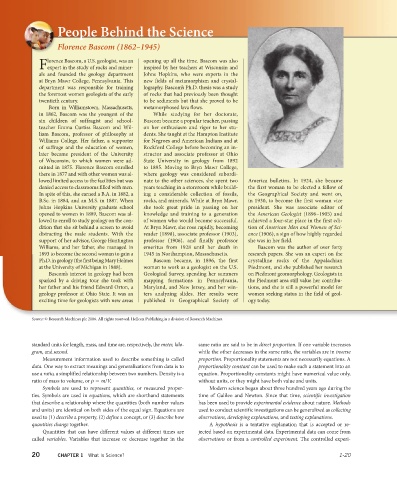
                           People Behind the Science


                           Florence Bascom (1862–1945)

                        lorence Bascom, a U.S. geologist, was an   opening up all the time. Bascom was also
                     Fexpert in the study of rocks and miner-  inspired by her teachers at  Wisconsin and
                     als and founded the geology department   Johns Hopkins, who were experts in the
                     at Bryn Mawr College, Pennsylvania. This   new fields of metamorphism and crystal-
                     department was responsible for training   lography. Bascom’s Ph.D. thesis was a study
                     the foremost women geologists of the early   of rocks that had previously been thought
                     twentieth century.                 to be sediments but that she proved to be
                        Born in Williamstown, Massachusetts,   metamorphosed lava flows.
                     in 1862, Bascom was the youngest of the   While studying for her doctorate,
                     six children of suffragist and school-    Bascom became a popular teacher, passing
                     teacher Emma Curtiss Bascom and Wil-  on her enthusiasm and rigor to her stu-
                     liam  Bascom, professor of philosophy at   dents. She taught at the Hampton  Institute
                     Williams College. Her father, a supporter   for Negroes and American Indians and at
                     of suffrage and the education of women,   Rockford College before becoming an in-
                     later became president of the University   structor and associate professor at Ohio
                     of Wisconsin, to which women were ad-  State University in geology from 1892
                     mitted in 1875.  Florence Bascom enrolled   to 1895. Moving to Bryn Mawr College,
                     there in 1877 and with other women was al-  where geology was considered subordi-
                     lowed limited  access to the facilities but was   nate to the other sciences, she spent two   America bulletins. In 1924, she became
                       denied access to classrooms filled with men.   years teaching in a storeroom while build-  the first woman to be elected a fellow of
                     In spite of this, she earned a B.A. in 1882, a   ing a considerable collection of fossils,   the Geographical Society and went on,
                     B.Sc. in 1884, and an M.S. in 1887. When   rocks, and minerals. While at Bryn Mawr,   in 1930, to become the first woman vice
                     Johns Hopkins University  graduate  school   she took great pride in passing on her   president. She was associate editor of
                     opened to women in 1889, Bascom was al-  knowledge and training to a generation   the  American Geologist (1896–1905) and
                     lowed to enroll to study geology on the con-  of women who would become successful.   achieved a four-star place in the first edi-
                     dition that she sit behind a screen to avoid   At Bryn Mawr, she rose rapidly, becoming   tion of American Men and Women of Sci-
                     distracting  the male students. With the   reader (1898), associate professor (1903),   ence (1906), a sign of how highly regarded
                     support of her  advisor, George Huntington   professor (1906), and  finally professor   she was in her field.
                     Williams, and her father, she managed in   emeritus from 1928 until her death in   Bascom was the author of over forty
                     1893 to  become the second woman to gain a   1945 in Northampton, Massachusetts.  research papers. She was an expert on the
                     Ph.D. in geology (the first being Mary  Holmes   Bascom became, in 1896, the first   crystalline rocks of the Appalachian
                     at the University of Michigan in 1888).  woman to work as a geologist on the U.S.   Piedmont, and she published her research
                        Bascom’s interest in geology had been   Geological Survey, spending her summers   on Piedmont geomorphology. Geologists in
                     sparked by a driving tour she took with   mapping formations in Pennsylvania,   the Piedmont area still value her contribu-
                     her father and his friend Edward Orton, a   Maryland, and New Jersey, and her win-  tions, and she is still a powerful model for
                     geology professor at Ohio State. It was an   ters analyzing slides. Her results were   women seeking status in the field of geol-
                     exciting time for geologists with new areas   published in Geographical Society of   ogy today.


                   Source: ©  Research Machines plc 2006. All rights reserved. Helicon Publishing is a division of Research Machines.


                   standard units for length, mass, and time are, respectively, the  meter, kilo-  same ratio are said to be in direct proportion. If one variable increases
                   gram, and second.                                      while the other decreases in the same ratio, the variables are in inverse
                      Measurement information used to describe something is called   proportion. Proportionality statements are not necessarily equations. A
                   data. One way to extract meanings and generalizations from data is to   proportionality constant can be used to make such a statement into an
                   use a ratio, a simplified relationship between two numbers. Density is a   equation. Proportionality constants might have numerical value only,
                   ratio of mass to volume, or ρ = m/V.                   without units, or they might have both value and units.
                      Symbols are used to represent  quantities, or measured proper-  Modern science began about three hundred years ago during the
                   ties. Symbols are used in equations, which are shorthand statements   time of Galileo and Newton. Since that time,  scientific  investigation
                   that describe a relationship where the quantities (both number values   has been used to provide experimental evidence about  nature. Methods
                   and units) are identical on both sides of the equal sign. Equations are   used to conduct scientific investigations can be  generalized as collecting
                   used to (1) describe a property, (2) define a concept, or (3) describe how     observations, developing explanations, and testing explanations.
                   quantities change together.                               A  hypothesis is a tentative explanation that is accepted or re-
                      Quantities that can have different values at different times are   jected based on experimental data. Experimental data can come from
                   called  variables. Variables that increase or decrease together in the     observations or from a controlled experiment. The controlled experi-

                   20      CHAPTER 1  What Is Science?                                                                  1-20

