


Page 40 - 9780077418427.pdf
P. 40
/Users/user-f465/Desktop
          tiL12214_ch01_001-024.indd Page 17  9/1/10  9:51 PM user-f465
          tiL12214_ch01_001-024.indd Page 17  9/1/10  9:51 PM user-f465                                                 /Users/user-f465/Desktop


                       LAWS AND PRINCIPLES
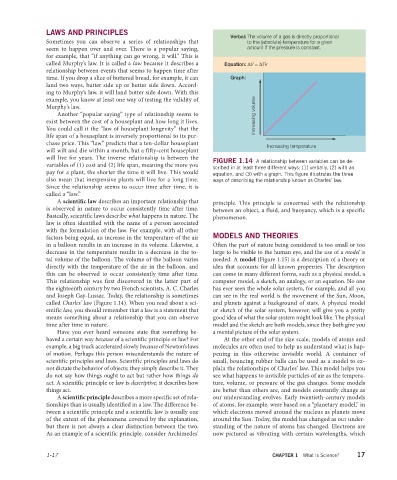
                                                                                    Verbal: The volume of a gas is directly proportional
                       Sometimes you can observe a series of relationships that           to the (absolute) temperature for a given
                       seem to happen over and over. There is a popular saying,           amount if the pressure is constant.
                       for example, that “if anything can go wrong, it will.” This is
                       called Murphy’s law. It is called a law because it describes a   Equation: ΔV = ΔTk
                       relationship between events that seems to happen time after
                       time. If you drop a slice of buttered bread, for example, it can   Graph:
                       land two ways, butter side up or butter side down. Accord-
                       ing to Murphy’s law, it will land butter side down. With this
                         example, you know at least one way of testing the validity of
                       Murphy’s law.
                           Another “popular saying” type of relationship seems to            Increasing volume
                       exist between the cost of a houseplant and how long it lives.
                       You could call it the “law of houseplant longevity” that the
                       life span of a houseplant is inversely proportional to its pur-
                       chase price. This “law” predicts that a ten-dollar houseplant             Increasing temperature
                       will wilt and die within a month, but a fifty-cent houseplant
                       will live for years. The inverse relationship is between the   FIGURE 1.14  A relationship between variables can be de-
                       variables of (1) cost and (2) life span, meaning the more you   scribed in at least three different ways: (1) verbally, (2) with an
                       pay for a plant, the shorter the time it will live. This would   equation, and (3) with a graph. This figure illustrates the three
                       also mean that inexpensive plants will live for a long time.   ways of describing the relationship known as Charles’ law.
                       Since the relationship seems to occur time after time, it is
                       called a “law.”
                           A scientifi c law describes an important relationship that   principle. This principle is concerned with the relationship
                       is observed in nature to occur consistently time after time.   between an object, a fluid, and buoyancy, which is a specific
                         Basically, scientific laws describe what happens in nature. The   phenomenon.
                       law is often identified with the name of a person associated
                       with the formulation of the law. For example, with all other
                       factors being equal, an increase in the temperature of the air   MODELS AND THEORIES
                       in a balloon results in an increase in its volume. Likewise, a   Often the part of nature being considered is too small or too
                       decrease in the temperature results in a decrease in the to-  large to be visible to the human eye, and the use of a model is
                       tal volume of the balloon. The volume of the balloon varies   needed. A model (Figure 1.15) is a description of a theory or
                       directly with the temperature of the air in the balloon, and   idea that accounts for all known properties. The description
                       this can be observed to occur consistently time after time.   can come in many different forms, such as a physical model, a
                       This relationship was first discovered in the latter part of   computer model, a sketch, an analogy, or an equation. No one
                       the eighteenth century by two French scientists, A. C. Charles   has ever seen the whole solar system, for example, and all you
                       and  Joseph Gay-Lussac. Today, the relationship is sometimes   can see in the real world is the movement of the Sun, Moon,
                       called Charles’ law (Figure 1.14). When you read about a sci-  and planets against a background of stars. A physical model
                       entific law, you should remember that a law is a statement that   or sketch of the solar system, however, will give you a pretty
                       means something about a relationship that you can observe   good idea of what the solar system might look like. The physical
                       time after time in nature.                              model and the sketch are both models, since they both give you
                           Have you ever heard someone state that something be-  a mental picture of the solar system.
                       haved a certain way because of a scientific principle or law? For   At the other end of the size scale, models of atoms and
                       example, a big truck accelerated slowly because of Newton’s laws   molecules are often used to help us understand what is hap-
                       of motion. Perhaps this person misunderstands the nature of   pening in this otherwise invisible world. A container of
                       scientific principles and laws. Scientific principles and laws do   small, bouncing rubber balls can be used as a model to ex-
                       not dictate the behavior of objects; they simply describe it. They   plain the relationships of Charles’ law. This model helps you
                       do not say how things ought to act but rather how things do   see what happens to invisible particles of air as the tempera-
                       act. A scientific principle or law is descriptive; it describes how   ture, volume, or pressure of the gas changes. Some models
                       things act.                                             are better than others are, and models constantly change as
                           A scientifi c principle describes a more specific set of rela-  our understanding evolves. Early twentieth-century models
                       tionships than is usually identified in a law. The difference be-  of atoms, for example, were based on a “planetary model,” in
                       tween a scientific principle and a scientific law is usually one   which electrons moved around the nucleus as planets move
                       of the extent of the phenomena covered by the explanation,   around the Sun. Today, the model has changed as our under-
                       but there is not always a clear distinction between the two.   standing of the nature of atoms has changed. Electrons are
                       As an example of a scientific principle, consider Archimedes’   now pictured as vibrating with certain wavelengths, which


                       1-17                                                                       CHAPTER 1  What Is Science?   17

