


Page 420 - 9780077418427.pdf
P. 420
/Users/user-f465/Desktop
          tiL12214_ch15_377-404.indd Page 397  9/3/10  6:17 PM user-f465
          tiL12214_ch15_377-404.indd Page 397  9/3/10  6:17 PM user-f465                                                /Users/user-f465/Desktop


                       planets revolving around the Sun as well as by the Ptolemaic   (20  mi) from Copenhagen, Brahe spent about twenty years
                       system. In Copernicus’ model, each planet moved around the   ( 1576–1597)  making systematic, uninterrupted measurements
                       Sun in perfect circles at different distances, moving at faster   of the Sun, Moon, planets, and stars. His skilled observations re-
                       speeds in orbits closer to the Sun. When viewed from a mov-  sulted in the first precise, continuous record of planetary position.
                       ing Earth, the other planets would appear to undergo retro-  In 1600, Brahe hired a young German, Johannes Kepler, as an
                       grade motion because of the combined motions of Earth and   assistant. When Brahe died in 1601, Kepler was promoted to
                       the planets. Earth, for example, moves along its inner orbit with   Brahe’s position and was given access to the vast collection of
                       about twice the angular speed as Mars in its outer orbit, which is   observation records. Kepler spent the next 25 years analyzing
                       about one and one-half times farther from the Sun. Since Earth   the data to find out if planets followed circular paths or if they
                       is moving faster in the inside orbit, it will move even with, then   followed the paths of epicycles. Using the careful observations
                       pass, Mars in the outer orbit (Figure 15.23). As this happens,   of Tycho Brahe, Kepler found that the planets did not move in
                       Mars will appear to slow to a stop, move backward, stop again,   epicycles nor did they move in perfect circles. Planets move in
                       then move on. This combined motion is similar to what you   the path of an ellipse of certain dimensions. He published his
                       observe when you pass a slower-moving car, which appears to   findings in 1609 and 1619, establishing the actual paths of plan-
                       move backward against the background of the landscape as you   etary movement. Kepler had found the first evidence that the
                       pass it. In an outer circular path, the car would appear to slow,   Ptolemaic system of complicated epicycles was unnecessary and
                       move backward, then move forward again as you pass it. (For   unacceptable as a model of the solar system. His findings also
                       information on Percival Lowell and Mars see the chapter 15 re-  required adjustments of the heliocentric  Copernican system,
                       sources on www.mhhe.com/tillery.)                       which are described by his three laws of planetary motion. To-
                           The Copernican system of a heliocentric, or Sun-centered,   day, his findings are called Kepler’s laws of planetary motion.
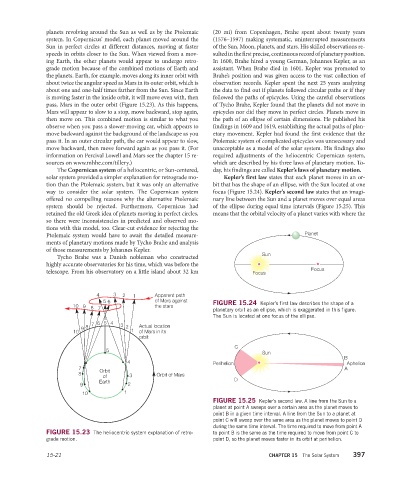
                       solar system provided a simpler explanation for retrograde mo-  Kepler’s first law states that each planet moves in an or-
                       tion than the Ptolemaic system, but it was only an alternative   bit that has the shape of an ellipse, with the Sun located at one
                       way to consider the solar system. The Copernican system   focus (Figure 15.24). Kepler’s second law states that an imagi-
                         offered no compelling reasons why the alternative Ptolemaic   nary line between the Sun and a planet moves over equal areas
                       system should be rejected. Furthermore, Copernicus had   of the ellipse during equal time intervals (Figure 15.25). This
                         retained the old Greek idea of planets moving in perfect circles,   means that the orbital velocity of a planet varies with where the
                       so there were inconsistencies in predicted and observed mo-
                       tions with this model, too. Clear-cut evidence for rejecting the
                       Ptolemaic system would have to await the detailed measure-                            Planet
                       ments of  planetary motions made by Tycho Brahe and analysis
                       of those measurements by Johannes Kepler.                               Sun
                           Tycho Brahe was a Danish nobleman who constructed
                       highly accurate observatories for his time, which was before the                        Focus
                       telescope. From his observatory on a little island about 32 km       Focus


                                        4     3  2  1      Apparent path
                                          5 6              of Mars against
                                                                               FIGURE 15.24  Kepler’s first law describes the shape of a
                                10  9  8  7                the stars           planetary orbit as an ellipse, which is exaggerated in this figure.
                                                                               The Sun is located at one focus of the ellipse.
                                   9  8  7  6  5  4  3  2  Actual location
                                10                  1  of Mars in its
                                                      orbit
                                                                                      C
                                           5                                                   Sun
                                                                                                                          B
                                                  4                            Perihelion                                  Aphelion
                                  7                                                                                       A
                                  8      Orbit              Orbit of Mars
                                          of       3
                                         Earth                                        D
                                   9               2
                                   10            1
                                                                               FIGURE 15.25  Kepler’s second law. A line from the Sun to a
                                                                               planet at point A sweeps over a certain area as the planet moves to
                                                                               point B in a given time interval. A line from the Sun to a planet at
                                                                               point C will sweep over the same area as the planet moves to point D
                                                                               during the same time interval. The time required to move from  point A
                       FIGURE 15.23  The heliocentric system explanation of retro-  to point B is the same as the time required to move from point C to
                       grade motion.                                           point D, so the planet moves faster in its orbit at perihelion.

                        15-21                                                                    CHAPTER 15  The Solar System   397

