


Page 416 - 9780077418427.pdf
P. 416
/Users/user-f465/Desktop
          tiL12214_ch15_377-404.indd Page 393  9/3/10  6:17 PM user-f465
          tiL12214_ch15_377-404.indd Page 393  9/3/10  6:17 PM user-f465                                                /Users/user-f465/Desktop


                       A                                                       B
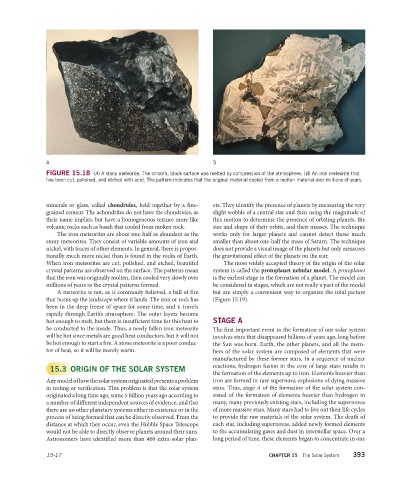
                       FIGURE 15.18  (A) A stony meteorite. The smooth, black surface was melted by compression of the atmosphere. (B) An iron meteorite that
                        has been cut, polished, and etched with acid. The pattern indicates that the original material cooled from a molten material over millions of years.


                       minerals or glass, called  chondrules, held together by a fine-  ets. They identify the presence of planets by measuring the very
                       grained cement. The achondrites do not have the chondrules, as   slight wobble of a central star and then using the magnitude of
                       their name implies, but have a homogeneous texture more like   this motion to determine the presence of orbiting planets, the
                       volcanic rocks such as basalt that cooled from molten rock.  size and shape of their orbits, and their masses. The technique
                           The iron meteorites are about one-half as abundant as the   works only for larger  planets and  cannot detect those much
                       stony meteorites. They consist of variable amounts of iron and   smaller than about one-half the mass of Saturn. The technique
                       nickel, with traces of other elements. In general, there is propor-  does not provide a visual image of the planets but only measures
                       tionally much more nickel than is found in the rocks of Earth.   the gravitational  effect of the planets on the star.
                       When iron meteorites are cut, polished, and etched, beautiful   The most widely accepted theory of the origin of the solar
                       crystal patterns are observed on the surface. The patterns mean   system is called the protoplanet nebular model. A protoplanet
                       that the iron was originally molten, then cooled very slowly over   is the earliest stage in the formation of a planet. The model can
                       millions of years as the crystal patterns formed.       be considered in stages, which are not really a part of the model
                           A meteorite is not, as is commonly believed, a ball of fire   but are simply a convenient way to organize the total picture
                       that burns up the landscape where it lands. The iron or rock has   (Figure 15.19).
                       been in the deep freeze of space for some time, and it travels
                       rapidly through Earth’s atmosphere. The outer layers become
                       hot enough to melt, but there is insufficient time for this heat to   STAGE A
                       be conducted to the inside. Thus, a newly fallen iron meteorite   The first important event in the formation of our solar system
                       will be hot since metals are good heat conductors, but it will not   involves stars that disappeared billions of years ago, long before
                       be hot enough to start a fire. A stone meteorite is a poor conduc-  the Sun was born. Earth, the other planets, and all the mem-
                       tor of heat, so it will be merely warm.                 bers of the solar system are composed of elements that were
                                                                               manufactured by these former stars. In a sequence of nuclear
                                                                               reactions, hydrogen fusion in the core of large stars results in
                         15.3  ORIGIN OF THE SOLAR SYSTEM
                                                                               the formation of the elements up to iron. Elements heavier than
                       Any model of how the solar system originated presents a problem   iron are formed in rare supernova explosions of dying massive
                       in testing or verification. This problem is that the solar  system   stars. Thus, stage A of the formation of the  solar system con-
                       originated a long time ago, some 5 billion years ago  according to   sisted of the formation of  elements heavier than hydrogen in
                       a number of different independent sources of  evidence, and that   many, many previously existing stars, including the supernovas
                       there are no other planetary systems either in existence or in the   of more massive stars. Many stars had to live out their life cycles
                       process of being formed that can be directly observed. From the   to provide the raw materials of the solar system. The death of
                       distance at which they occur, even the  Hubble Space Telescope   each star, including supernovas, added newly formed elements
                       would not be able to directly observe planets around their suns.   to the accumulating gases and dust in interstellar space. Over a
                       Astronomers have identified more than 460 extra-solar plan-  long period of time, these elements began to concentrate in one

                       15-17                                                                     CHAPTER 15  The Solar System   393

